Ships
- USS Lewis Hancock (DD-675) Captain, 29 September 1943 – 14 March 1944
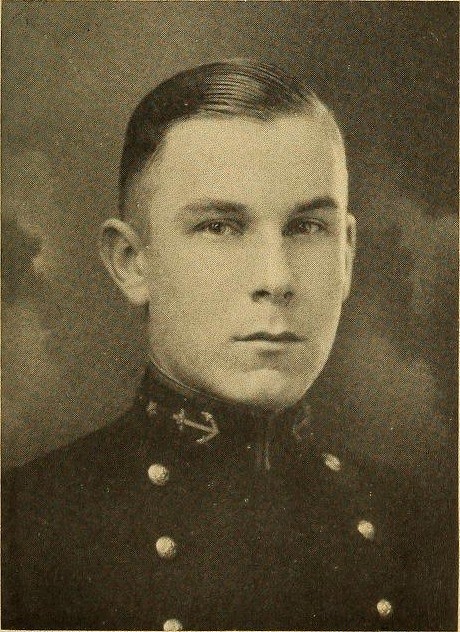
Charles Huntington Lyman was born in Philadelphia on 24 November 1903, the son of Charles Huntington Lyman II, a Marine who rose to major general and commanded the Fleet Marine Force. He entered the United States Naval Academy and graduated with the class of 1926, beginning a career that would keep him in the surface Navy through the Second World War.
His wartime promotions came in quick succession. He became a lieutenant commander on 26 June 1940, a temporary commander on 15 August 1942, and a temporary captain on 1 August 1943. That summer the Navy gave him a new Fletcher-class destroyer still on the ways at Kearny, New Jersey.
Lewis Hancock (DD-675) was built by the Federal Shipbuilding and Drydock Company. She had been launched on 1 August 1943, with Lieutenant Joy Hancock of the Naval Reserve as sponsor. The ship took her name from Joy Hancock's husband, Lieutenant Commander Lewis Hancock, Jr., a submariner killed in the loss of the airship Shenandoah in 1925, and she was the first American combatant christened by a woman officer. Lyman took her into commission at Kearny on 29 September 1943 as her first commanding officer.
He worked the new ship up out of Bermuda, then brought her north to New York. On 6 December 1943 Lewis Hancock sailed for the Pacific in company with the light carrier Langley. She entered Pearl Harbor on Christmas Day and joined Vice Admiral Marc Mitscher's fast carrier force, Task Force 58, then gathering for the drive across the Central Pacific.
On 16 January 1944 Lyman took Lewis Hancock out of Pearl Harbor with Task Group 58.2 for the invasion of the Marshall Islands. The carriers of his group were sent against Japanese air power on Kwajalein Atoll. On 29 January their aircraft struck the field at Roi and destroyed the planes based there. A second strike the next day hit defensive positions ashore, and troops went ashore on the atoll on 31 January, with Lewis Hancock screening the carriers through the opening of the campaign.
His command ended on 14 March 1944, when William Marvin Searles relieved him. Lyman moved to amphibious staff duty. From July 1944 to January 1945 he served as assistant chief of staff and operations officer for the commander of an amphibious task group, work for which he received the Legion of Merit. His father died in San Diego in July 1945 and was survived by Captain Charles H. Lyman of the Navy and by a second son, Major Andrew I. Lyman of the Marine Corps.
Lyman remained in the Navy after the war and retired as a rear admiral. His home was in the San Diego area, where the family had long been settled. He died in Bethesda, Maryland, on 28 December 1972.