Ships
- USS Monssen (DD-798) Captain, 21 July 1944 – 8 December 1944
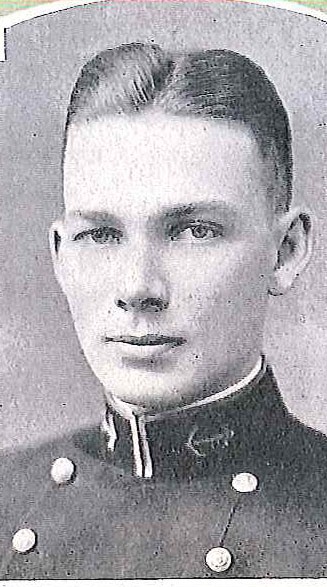
The Register of 1 July 1945 gives the name in full, Charles Kniese Bergin. The Lucky Bag of 1927 breaks the first name across the photograph but prints Kniese, Bergin, and Baltimore, Maryland. Hall of Valor, the Naval Postgraduate School's later sketch, and the compiled commanding-officer list for Des Moines use the same middle name or the initial K. Nothing read for this essay treats Kniese as a misspelling to be repaired. He is not Daniel Edward Bergin, Jr., Edward Redmond Bergin, Jr., John Joseph Bergin, or Charles L. Bergin, a Marine gunnery sergeant of a later war.
By the 1 July 1944 register he is a commander, file number 61070, the same number Hall of Valor prints as NSN 0-61070. The Navy Cross citation, as Hall of Valor gives it, calls him commander and commanding officer of Monssen (DD-798) on the night of 24–25 October 1944. The dates 21 July 1944 to 8 December 1944 are the same dates NavSource and uboat.net print. No deck log or war diary was in hand, so those two days are a compiled bracket, not a log entry read here. What the records do fix is that he had the ship on the night that mattered to the citation.
Origins
He was born in Baltimore. The Lucky Bag says so on the page, and the school's 1963 welcome says he was a native of Baltimore. The day is 25 January 1904 if the 1 January 1954 register has been read right. On that page the digit groups beside Captain Charles Kniese Bergin fall out as 3, 20, 45, then 1, 25, 04, then 6, 02, 27. The officer next to him, Robert Ellington Dixon, falls out as 4, 22, 06 in the same birth place in the row, and Dixon was born 22 April 1906. Hall of Valor prints 25 January 1904. The 1 July 1945 register's text layer reads 29 Jan. 04. That 29 is treated here as a misread of 25. The city is not in the register. The register does not name a father or a mother. The middle name Kniese is as far as the documents go toward a family. No census line, no church record, and no obituary naming parents was found, and none is invented.
The class book is the first portrait, and it is a classmate's portrait, fond and a little teasing, not a fitness report. He came to the Academy from Johns Hopkins. The Lucky Bag says Hopkins lost a valuable man when Charlie selected the Naval Academy on 9 July 1923. The 1 July 1945 register prints that same day as his date of entry. The school's later sketch says only that he attended Johns Hopkins before the Academy. It does not say whether he finished a year, a term, or a few weeks. The class gave him "Charlie" and "Large Boy." They found him reserved in manner and not as serious as he first looked. He never dodged a good time, they wrote, but he believed there was a time and a place for everything. The academics gave him very little trouble, so there was time for the rest. He was in his element at a hop and very seldom alone. The Second Battalion, they said, would vouch for him as a snake, which is the Academy's word, not this essay's, for a midshipman who did well with women. They called him the Beau Brummel of the Academy, and then they pulled the joke back: he did not spend all his time at tea fights, because he was at home on the lacrosse field, quick with a stick and of value to the team.
The activity lines that sit on his page, page 239 in the index, are lacrosse on the A squad in third-, second-, and first-class years, plebe varsity in youngster year, Navy numerals, class boxing in third- and second-class years, and the Gymkhana cast in first-class year. A block of football, track, and wrestling falls in the text layer between his essay and the page number, but that block matches the man ahead of him, whose own sketch is about those three sports. It is not used as Bergin's. The class closed on character, in the way a Lucky Bag always does. He was a man of his own convictions. He put his all into anything he undertook. He was always courteous, and he was remembered for that. They wished him a successful career and said the class would be proud to have had him. None of that is a prediction that came true on paper. It is what twenty-two-year-olds were willing to sign in 1927.
Formation
He was graduated with the Class of 1927. The 1 January 1954 register prints 6, 02, 27 in the date group after the birth digits, which is 2 June 1927, the day uboat.net gives him as ensign and the ordinary commissioning day of that class. The column heading is not on the OCR line, so the ensigncy is that digit group plus the class, not a sentence in the register that says "commissioned ensign." The early sea duty is thinner than the night in Surigao Strait. The Naval Postgraduate School's sketch, drawn from Bobbi O'Connor's "A Hearty Welcome" in The Classmate of September 1963, says that after graduation he served in Maryland and in destroyers, and that he then graduated from the Naval Postgraduate School. It does not name the destroyers. It does not give a year for the school. The magazine itself compresses the same years into one misleading sentence: upon completion of postgraduate education he was ordered to destroyer duty in the Pacific, and during Surigao Strait he won the Navy Cross. That sentence jumps a decade. It is not used as a chronology.
What the registers do show is the profession he was sent to learn. In the register printed at Washington in 1939, signal numbers effective through calendar 1940, he is indexed as a lieutenant, Charles K. Bergin, and the body line carries the qualification codes 26 and 32. The same two codes are on his line in the 1 July 1945 register. In that book's key, 26 is a completed postgraduate course in ordnance engineering, general, and 32 is a completed course in chemical warfare. So the ordnance school was behind him before the 1939 book, which is to say before the war, and it was still the qualification the Navy bothered to print beside a temporary captain in 1945. The later sketch's "Assistant Chief of the Bureau of Ordnance" sits on that same specialty. The year he held the bureau job is not in any register read here.
The register printed at Washington in 1941, its signal numbers effective through calendar 1942, still indexes him as a lieutenant and marks him (V). In that book's key, (V) means on the promotion list. It is not a decoration. The 1 July 1945 register then gives the permanent rank the list was pointing at: lieutenant commander, from 1 November 1941. By the 1 July 1944 register the index calls him commander. uboat.net dates a temporary commander's rank from 10 September 1942. That day was not recovered from a register line, and it is not asserted here. What is asserted is the shape of it. He was a lieutenant into the year of Pearl Harbor, selected upward, a lieutenant commander from the first of November 1941, a commander by the summer of 1944, and a temporary captain from 20 March 1945, with the permanent rank still lieutenant commander. The Navy promoted him for the war and did not, on the 1945 book, make the higher rank permanent.
No Navy Directory line was read for the ships of the 1930s. Maryland, the unnamed destroyers, and the ordnance course are the whole of the formation the school's sketch is willing to give, and the registers confirm only the rank and the two courses. The marriage belongs in those years, and only because his wife said where it happened. The Classmate says they were married at the Postgraduate School when the school was still at Annapolis, and that the place held nostalgic memories for him. It does not give the year, and it does not give her first name. She is Mrs. Charles K. Bergin, daughter of Captain and Mrs. Manning H. Philbrick, the father a retired naval officer, the family homestead at Rye, New Hampshire, a place the Bergins still visited in 1963. She was a graduate of the University of Pennsylvania. She told the magazine she belonged to that set of Navy wives who never joined their husbands for duty abroad. That one sentence is the cost of his sea time, said by the person who paid it, and it is almost the only personal sentence of hers that survives.
The war, as he lived it
If the compiled dates are right, he relieved Feutsch on 21 July 1944. DANFS has Monssen back at Saipan on 12 July, screening until the 23rd, then in the bombardment of Tinian, then screening a demonstration landing off Tinian Town on the 24th and firing in support of the beach through the 31st. She stayed in the Tinian area until 6 August, patrolled for submarines north of Saipan, and went to Eniwetok. None of that paragraph names a captain. If he had the ship from the 21st, the Tinian firing was his first work in her, a shore bombardment, not a surface action. The log that would put him on the bridge for those mornings was not read. The ship's movements are the ship's. The man is attached to them by a date from NavSource, uboat.net, and the compiled list.
From Eniwetok, DANFS sends her with Task Group 32.41 to Guadalcanal to rehearse the Palau attack. On 8 September she headed west to screen and support Task Group 32.4. She stood off Peleliu on the 15th and 16th, shifted to Angaur on the 17th, and stayed in that transport screen until the 23rd. On the 24th she sailed for Manus. On 11 October she left Manus for Leyte Gulf, her fifth amphibious landing of the commission and, if the July date holds, his first. In the screen of Task Group 79.11 she brought landing craft to the Dulag beaches on 20 October and then took a screening station with Destroyer Squadron 54 across Surigao Strait. Through the 24th the squadron met only sporadic air attacks. DANFS does not say whether any of them came close enough to matter.
The night of 24–25 October is the night the citation is about, and it is the only night on which a document names him in command. Rear Admiral Jesse B. Oldendorf had the Seventh Fleet's bombardment force and its old battleships waiting at the north end of the strait for the Japanese Southern Force. Captain Jesse B. Coward, commander of Destroyer Squadron 54, split his destroyers into an eastern and a western attack group. DANFS puts Monssen in the western group with McDermut, close to the Leyte shore. Soon after midnight the Japanese were reported in the strait. Between 0300 and 0301 the eastern group launched twenty-seven torpedoes in less than two minutes. At 0310 McDermut and Monssen launched. At 0320 explosions flashed. DANFS says one of Monssen's torpedoes scored on the battleship Yamashiro and did not stop her. After the fish were gone, Monssen and McDermut retired north along the Leyte coast, not only to get clear of the enemy but to stay out of the gunfire of Destroyer Squadrons 24 and 56 and of the American battle line. At dawn she was back on her patrol station. The next day she left for Hollandia.
The Navy Cross citation, printed by Hall of Valor from Commander, Third Amphibious Force, serial 00394 of 26 December 1944, is the Navy's sentence on that hour. The original letter was not in hand. As Hall of Valor gives it, the President took pleasure in presenting the Navy Cross to Commander Charles Kniese Bergin for extraordinary heroism as commanding officer of Monssen against Japanese forces at Surigao Strait on the night of 24–25 October 1944. "Although illuminated and subjected to enemy fire, Commander Bergin brought his ship to within short range of heavy enemy vessels, launched a daring torpedo attack which inflicted severe damage on the enemy, and retired without loss or injury." The attack, the citation says, contributed in large measure to eliminating a threat to the transports in Leyte Gulf. It closes on "high professional skill, forceful leadership, and gallant devotion to duty."
The citation and the ship's history do not use the same measure of damage. The citation says severe damage to the enemy. DANFS says one hit on Yamashiro, and that the battleship kept coming. Both can be true of a night battle in which other ships' torpedoes were also in the water, and neither was written as a gunnery report. What they agree on is the geometry. He took a destroyer in close to heavy ships, under illumination and under fire, launched, and brought her out. The citation adds that he brought her out without loss or injury. DANFS adds the second danger, which the citation does not mention: on the way out he had to hug the beach so that his own battleships would not kill him. That is the pressure the records actually describe. No speech to the crew, no private letter, and no deck-log remark of his was found. A battle narrative on the web puts words in the mouth of Monssen's captain that night. The source of the words is not identified there, and they are not repeated here.
The 1 July 1945 register records the decoration. Distinctions in that book are those issued and on the rolls through 1 May 1945. Beside his name is (B). In the key, (B) is the Navy Cross. There is no (G-1), which is the Bronze Star, and there would not yet be one if the Bronze Star was for Okinawa, a campaign that was still being fought when the book's cutoff fell. The register confirms the cross. It does not narrate the strait.
From Hollandia, DANFS has her screening reinforcement convoys back to Leyte through November. On 9 December she headed for Bougainville and arrived on the 12th. The compiled lists relieve Bergin on 8 December and give the ship to Everett George Sanderson. If both dates are right, he left her the day before she sailed for the rehearsals that led to Lingayen. Lingayen, the kamikaze morning of 12 January 1945, Iwo Jima, the retirement with the damaged Franklin, the Okinawa picket line, and the summer strikes on Japan are in DANFS, and they are not his. They are not narrated here.
What the school's sketch gives him next is a division, not another single ship. The Classmate says that shortly after Surigao, as commander of Destroyer Division 122, he received the Bronze Star for the skillful direction of his division in action against enemy forces in the Western Pacific. The library biography that cites that article adds "off Okinawa." The sentence in the magazine, as read here, does not say Okinawa. It says the Western Pacific. Destroyer Division 122, in the squadron histories of the Sumner class, was Blue, Brush, Taussig, and Samuel N. Moore, ships of Destroyer Squadron 61, which did fight at Okinawa. Those histories do not name Bergin. No citation text for the Bronze Star was found. The temporary captaincy of 20 March 1945 sits in the weeks before the Okinawa landings, which is a plausible moment for a division commander to put on a fourth stripe, and it is only a plausibility. The division, the medal, and the theater are the magazine. The island is the library's gloss. The ships of the division are a squadron page that never mentions him.
The cost
The war, as the family told it in 1963, was his and not hers. She had never gone overseas with him. She said so, and she said it sadly. The magazine does not say whether that was orders, money, children, or the simple fact that destroyer captains' wives stayed home. It says she stayed. When they finally traveled together, it was after the war, from their last duty station at Norfolk, a trip through Europe and the West Indies that she said appeased her somewhat for the years of remaining stateside while he "saw the world." The quotation marks are the magazine's, around his phrase or around the old Navy joke. Either way she is the one who put the years on one side and the trip on the other.
By September 1963 there were three daughters, and the magazine names all three, which is as close as these papers come to a household. Two of them came from Norfolk with their parents. Kathy was going back that month to Old Dominion College in Norfolk. Patricia was to enroll as a sophomore at Monterey Peninsula College and then go on to Mary Washington College in Fredericksburg. The oldest, Cecilia, was already married, to a lieutenant of the Naval Academy class of 1958. The scan of the magazine reads the husband's name as Bertom A. Robbins III. The given name is not clean, and it was not confirmed in a second source, so it is left as the scan has it. No sons are mentioned. A later internet summary that gives the wife a first name and adds sons is not traced to a document and is not used. The dog is. Mrs. Bergin told the magazine that George, "the all-American variety," was as much a Bergin as the rest of them. It is a small sentence. It is also one of the few that sound like a house rather than a billet.
Her own work, as the club magazine told it, was the work Navy wives were expected to do and then some. She became honorary president of the Officers' Wives Club at the Postgraduate School. She had given many hours to Navy Relief, to the Navy-Marine Residence Foundation, and to JANGO, the Junior Army-Navy Guild Organization. She raised African violets and refinished furniture. She and her husband boated and fished, particularly off the Florida Keys. None of that is heroism, and none of it is trivial. It is what was left in print of a marriage conducted, on her own account, with the sea mostly on his side of the door.
His side of the door, after the division, is a list of jobs and almost no interior. The sketch says he graduated from the Naval War College, commanded Des Moines, was assistant chief of the Bureau of Ordnance, commanded Destroyer Flotilla Three and Destroyer Flotilla One, served in the Office of the Assistant Secretary of Defense, and then commanded Mine Force, U.S. Pacific Fleet. He came to Monterey from command of the Operational Test and Evaluation Force, with headquarters in Norfolk. NavSource's compiled list of Des Moines captains, credited to Wolfgang Hechler and Ron Reeves, puts Captain Charles Kniese Bergin, class of 1927, final rank rear admiral, in that cruiser from 16 July 1952 to July 1953, between Robert Beaman Ellis and Howard Austin Yeager. The ship's own cruise in those months is not retold here. The point of the command, for him, is that the ordnance lieutenant of the 1930s had been given a heavy cruiser, and that a compiled list and the school's sketch agree he had her. They do not agree on anything he did with her, because neither source says.
On 1 January 1954 the register still has him a captain. The date uboat.net gives for rear admiral, 1 July 1955, was not checked against a later register. By August 1963, when he relieved Rear Admiral Marshall E. Dornin as superintendent, every local paper calls him rear admiral. The school's own page dates the appointment August 1963 and the tour 1963–1964. The change-of-command program in the Naval Postgraduate School archive is titled for August 1963 and says Rear Admiral Charles K. Bergin relieved Rear Admiral Dornin. The given name on that card is the initial only.
After
The last billet was a school, and it was the school where he had been married, moved in the meantime from Annapolis to Monterey. The magazine that welcomed him hoped the peninsula would be, in his wife's phrase, the best of the best. "Each duty station is our favorite and the best one yet," she had said. He had a little more than a year of it.
In the summer of 1964 the town used him as a superintendent is used. The June number of Noticias del Puerto de Monterey, the bulletin of the Monterey History and Art Association, announced that on Sunday, 5 July, the 118th anniversary of Commodore Sloat's raising of the flag would be marked at the Custom House. Rear Admiral Charles K. Bergin, superintendent of the Naval Postgraduate School, was to read the proclamation, and the flag with twenty-eight stars was to be hoisted, with the Twelfth Naval District Band and men from the school, and a reception afterward at Casa Serrano. The spelling "Superintendant" is the bulletin's. He was, by then, a member of the association as well as the officer who lent it a voice.
He did not finish the tour. Hall of Valor says he died on 6 December 1964, on active duty, a rear admiral, and tags the death DNB, died non-battle. That is a category on a medals website, not a cause. No death certificate, no hospital, and no obituary with a disease or an accident was found. uboat.net says Monterey County, which is where the job was, and which is not independently proved as the place of death. What the town's own bulletin proves is that he was dead before the December 1964 Noticias went out. That number prints a memorial list of members who had died since the last issue, and the first name on it is Rear Admiral Charles K. Bergin. The successor the school records, Rear Admiral Edward J. O'Donnell, was appointed superintendent in January 1965. He died in the office, about sixty, with the Navy Cross already twenty years behind him and the school not yet a full academic year in his hands.
Nothing in the papers says what he left the three daughters beyond the name and the fact of the marriage their mother described. No will, no letters, and no later interview with Cecilia, Kathy, or Patricia was found. The wife drops out of the record after the welcome article. A search that seemed to produce a widow named Eleanor and a son named Charles turned out, when opened, to be other people or an unsupported summary. They are not his.
The sea, in the documents, shaped him as an ordnance man who was given a destroyer at the moment a destroyer could decide a strait, and who was then given, in succession, a division, a cruiser, the bureau that had trained him, flotillas, a mine force, a test force, and at the end a school. The night of 24–25 October 1944 is the only hour in which the records show the convictions the classmates had claimed for him being spent on something that could kill his crew. He spent them close in, and he got the crew out. The rest of the life is ranks, schools, and a wife who stayed on the beach until Norfolk, and who then had one trip, and one short year in Monterey, before the December list.