Ships
- USS Louisville (CA-28) Captain from 9 September 1942 · Relieved on 24 June 1943
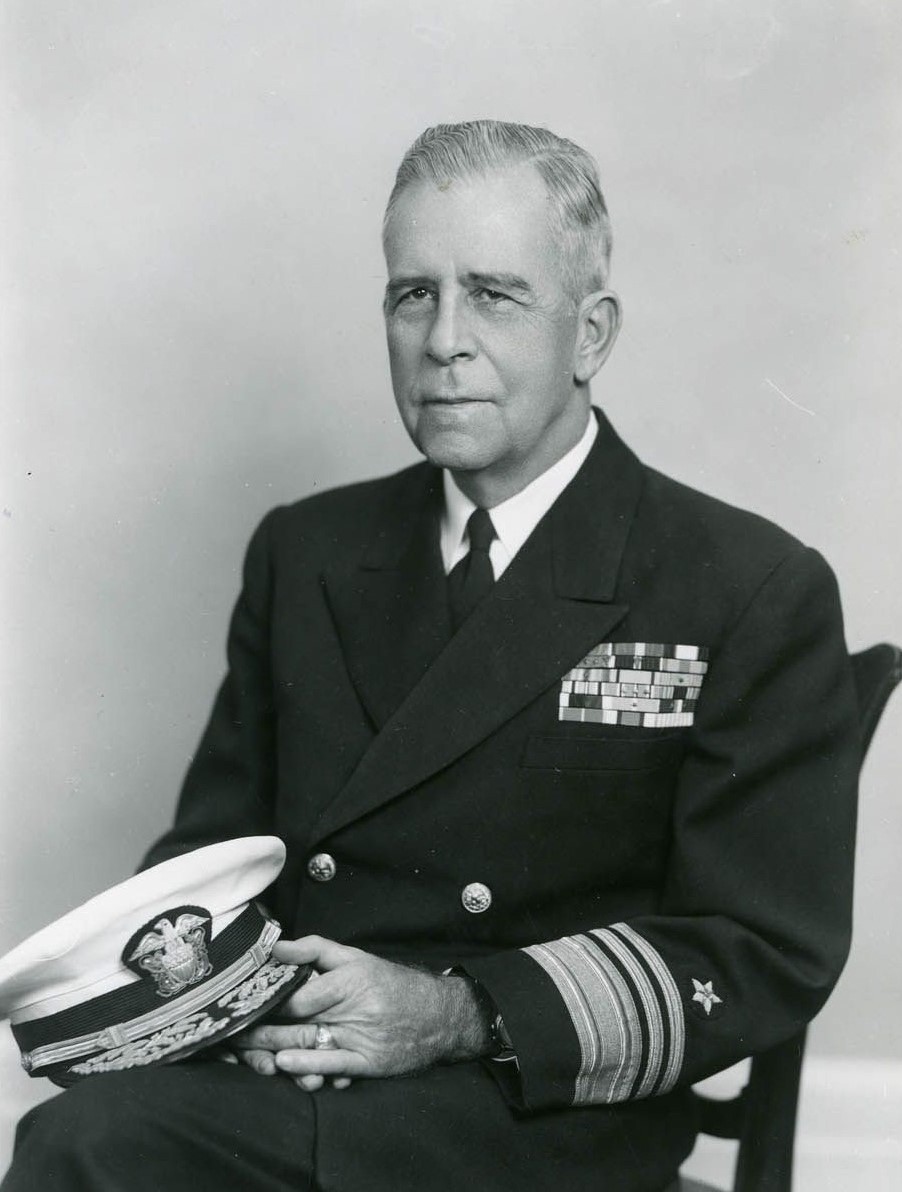
Charles Turner Joy was born in St. Louis, Missouri, on 17 February 1895. After private schooling in Missouri, New York, and Pennsylvania, he entered the United States Naval Academy in 1912 and was commissioned an ensign in 1916. His first ship was the battleship Pennsylvania, flagship of the Atlantic Fleet. He remained in her for more than four years, including the Navy’s service in the First World War.
After the war he was sent for postgraduate work in ordnance engineering and in 1923 earned a master of science degree from the University of Michigan. That year he went to China as aide and flag lieutenant to the commander of the Yangtze Patrol. He then served as executive officer of the Asiatic Fleet destroyer Pope, in the Bureau of Ordnance in Washington, in the battleship California, and at the Naval Mine Depot at Yorktown, Virginia. In May 1933 he took command of the destroyer Litchfield. He later joined the staff of Commander Destroyers, Battle Force. From 1937 to 1940, as a commander, he was an instructor at the Naval Academy, and he left that duty to become executive officer of the heavy cruiser Indianapolis.
In 1941 Joy was operations officer for the commander of the Scouting Force, Pacific Fleet. After the United States entered the Second World War in December, he spent the next months helping to plan and carry out early operations against Japanese forces.
He assumed command of the heavy cruiser Louisville (CA-28) on 9 September 1942. Under him the ship served in the South Pacific and afterward in the Aleutians. At the end of January 1943, in the battle off Rennell Island, the closing naval action of the Guadalcanal campaign, he tried to tow the damaged cruiser Chicago clear of Japanese aircraft. Chicago was lost. In April Louisville went north by way of Pearl Harbor for the Aleutian campaign. Joy was relieved on 24 June 1943. The Navy later awarded him the Legion of Merit for his command of the cruiser in the Pacific from January of that year through the day he left her.
In August 1943 he became chief of the Pacific plans division at Navy headquarters in Washington, and he held that post until May 1944. Promoted to rear admiral, he returned to sea in command of Cruiser Division 6. His ships gave gunfire support for the landing on Saipan, and the cruiser and amphibious commands he led took part in the Marianas, Philippine, Iwo Jima, and Okinawa campaigns. In June 1945 he took command of Amphibious Group 2, then preparing for an invasion of Japan. Japan surrendered while he still held that command, and he was soon assigned to duty in China. From 1946 to 1949 he commanded the Naval Proving Ground at Dahlgren, Virginia.
In August 1949 he was promoted to vice admiral and made Commander, Naval Forces, Far East, with headquarters in Tokyo. He directed American and allied naval forces through the first two years of the Korean War, beginning with the fighting that halted the North Korean advance in the summer of 1950. For his conduct of those naval forces in the opening months of the war he received the Distinguished Service Cross. From July 1951 to May 1952 he was also the senior United Nations delegate to the armistice conference, first at Kaesong and later at Panmunjom. He gave up the Far East naval command in June 1952.
His last assignment was superintendent of the Naval Academy, which he took up in 1952 while ill with leukemia. He retired in 1954. Joy died in 1956 and was buried in the Naval Academy Cemetery. The destroyer Turner Joy (DD-951), in service from 1959 to 1991, was named for him.