Ships
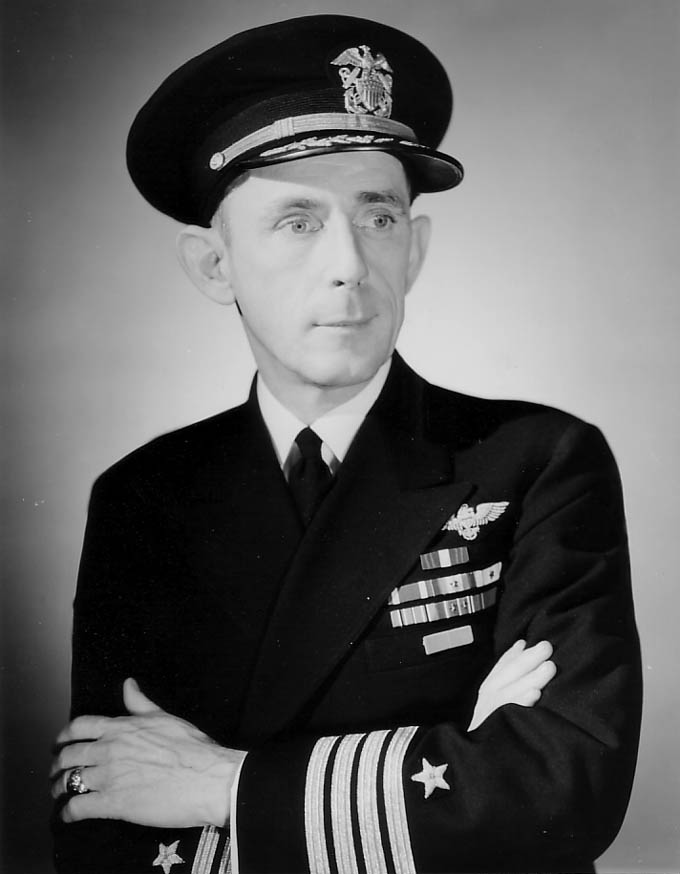
- USS Hancock (CV-19) Captain from 7 September 1944 · Relieved on 10 December 1945
Daniel Vincent Gallery was born on 10 July 1901, the son of Daniel Vincent Gallery, a Chicago lawyer, and the writer Mary Onahan Gallery. His grandfather had emigrated from Ennistymon, County Clare, Ireland. He entered the Naval Academy at 16 in 1917, graduated a year early in 1920, and wrestled for the United States at the Antwerp Olympics that summer. All three of his younger brothers served in the Navy. William O. and Philip D. Gallery both became rear admirals, and John Ireland Gallery was a Catholic priest and Navy chaplain.
An early naval aviator, Gallery flew seaplanes, torpedo bombers and amphibians, and in the late 1930s he won at the National Air Races in a race-tuned TBD Devastator. As naval attaché in London in 1941 he earned his flight pay ferrying unarmed Spitfires to RAF fields. In 1942 he commanded the Fleet Air Base at Reykjavík, Iceland.
In 1943 he commissioned the escort carrier Guadalcanal and led antisubmarine hunter-killer groups out of Norfolk. On 4 June 1944 his Task Group 22.3 captured the German submarine U-505 intact, codebooks and all. She was the first foreign man-of-war captured in battle on the high seas by the U.S. Navy since the War of 1812. The task group received the Presidential Unit Citation, and Gallery received the Distinguished Service Medal, along with a blistering dressing-down from Admiral King for risking the secret of Allied codebreaking. He then commanded Hancock until 10 December 1945.
As a rear admiral he was Assistant to the Chief of Naval Operations. His outspoken articles against postwar cuts to the Navy put him at odds with the administration in the "Revolt of the Admirals." He commanded Carrier Division Six during the Korean War. His last command was the Tenth Naval District in San Juan, Puerto Rico (1956–60), where he helped found the island's first Little Leagues and created the Navy Steel Band, "Admiral Dan's Pandemoniacs," which toured the world until 1999. He retired, medically unfit, in 1960 and became a prolific author of fiction and nonfiction. He died at Bethesda Naval Medical Center on 16 January 1977 and is buried at Arlington beside two of his brothers.