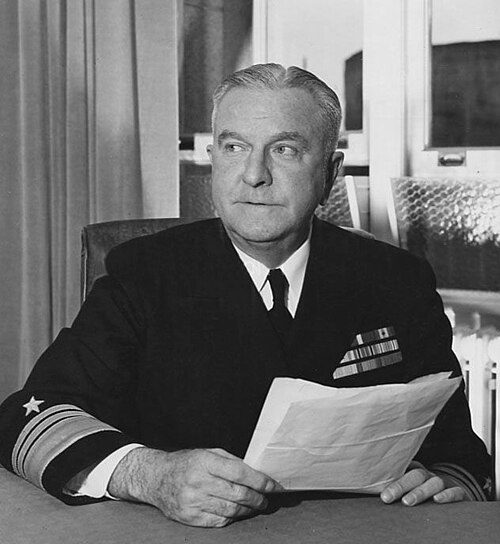
Ships
- USS Pensacola (CA-24) Captain, 28 December 1931 – 10 June 1933
Compiled lists give him Pensacola (CA-24) as captain from 28 December 1931 to 10 June 1933. That tour is not a war cruise.
That man is the admiral born in 1883, not a son and not another officer who shared the surname. The Register of 1 January 1933 lists David Worth Bagley, signal number 194, captain from 2 June 1927, marked with the symbol the Register then used for the Navy Distinguished Service Medal, and gives his duty in one line: “Commanding Pensacola.” The Register of 1 July 1942, in the rear-admiral birth table, prints 8 January 1883 beside the row that lines up with him, and a date of entry dittoed to 7 September 1900. His son in that same 1942 volume is David Harrington Bagley, a midshipman appointed from North Carolina on 7 August 1940. The son was at the Academy while the father was already a flag officer. He did not command Pensacola in 1931.
Those dates are a compiled commanding-officer list, repeated by NavSource, which has Alfred Graham Howe relieved on 28 December 1931 and Bagley himself relieved on 10 June 1933. The public-domain Dictionary of American Naval Fighting Ships biography, the text Wikipedia incorporates and that the Naval History and Heritage Command page for Bagley has carried, says the Pensacola assignment lasted until May 1933, when he was called to the Bureau of Navigation. Both cannot be the exact day he left the ship. What the Register settles is the middle: on 1 January 1933 he was still her captain. “May” in the ship-biography cannot mean he had already gone ashore in 1932. The 10 June date is not in any Register page read here. NavSource also points to a photograph in the Washington Evening Star of 10 January 1932, a change-of-command ceremony at the Brooklyn Navy Yard. That newspaper page was not opened for this essay. The ceremony, if the caption is faithful, is the one concrete scene of his taking the cruiser. It is not a battle.
The other correction is the war. Pensacola’s famous Pacific career — the Manila convoy turned toward Australia, the Lexington screen, Midway, Santa Cruz, the torpedo at Tassafaronga — belongs to other captains, years after he had left her. DANFS tells that story as the ship’s story, beginning its Pacific basing in 1935, two years after his relief. Padding his life with those battle stars would be a biography of the hull, not of the man. What the Pacific war actually gave him was a battleship division at Pearl Harbor and then shore frontiers: Hawaii, the Western Sea Frontier, San Diego, Hawaii again. He did not command a fighting ship after 1933.
Origins
The Library of Congress authority file, drawing on Who Was Who in America, records him as the son of William Henry Bagley and Adelaide Ann (Worth) Bagley, born in Raleigh, North Carolina, in 1883, died in 1960. The DANFS biography gives the day as 8 January 1883, which is the day the 1942 Register prints. The same authority file calls him brother of Addie Worth Bagley Daniels, Belle Worth Bagley, and Ethel Bagley, and the papers it points to are the Daniels family papers in North Carolina. The brother the Navy remembered first was not among those sisters. Ensign Worth Bagley, born in Raleigh on 6 April 1874, Naval Academy class of 1895, was killed on 11 May 1898 in Winslow at Cárdenas, the only U.S. Navy officer killed in action in the Spanish-American War. David was fifteen.
DANFS says he attended North Carolina State College in 1898 and 1899 and entered the Naval Academy in 1900. The Register’s dittoed entry date, 7 September 1900, is the form that volume uses for midshipmen of that class. No letter survives in the sources read here in which he says he chose the Academy because of Worth. The calendar is only the calendar: the brother was dead, the boy spent a year at the state college in Raleigh, and then he went to Annapolis. The motive is a blank.
He graduated on 4 February 1904 and went to Missouri (Battleship No. 11) in the North Atlantic Fleet. In December 1905 he was ordered to the Asiatic Fleet, first Concord (Gunboat No. 3), then West Virginia (Armored Cruiser No. 5). He was commissioned ensign on 2 February 1906 while in Concord. Detached from West Virginia in March 1907, he joined Rhode Island (Battleship No. 17) the next year and made the Great White Fleet’s cruise around the world in her. In April 1909 he left the battleship for a year of instruction at the General Electric works in Schenectady. In April 1910 he became aide and flag lieutenant to the commander of the Second Division, Atlantic Fleet, and afterward held the same kind of staff job with the commander in chief of the Asiatic Fleet. After a short furlough he reported to the Naval Academy in September 1912. Two years later he was first lieutenant of Michigan (Battleship No. 27). His first command was the destroyer Drayton (DD-23), in September 1915.
That is the formation the official biography actually gives: battleships, a gunboat on the Asiatic station, a world cruise, a year in a factory learning machinery, flag duty, a tour teaching, then a small destroyer. There is no quotation from him about any of it.
The household he eventually made is clearer in his sons’ records than in his own. The widow who christened Bagley (DE-1069) at Seattle on 24 April 1971 is named on NavSource as Mrs. Marie Louise H. Bagley. A Find a Grave memorial gives a marriage on 16 February 1918 in Manhattan to Marie Louise Harrington. That date was not checked against a civil register for this essay, and it is not repeated here as proved. What is firmer is the initial, the sons’ shared middle name, and a sentence in Worth Harrington Bagley’s obituary. Worth Harrington Bagley, the Navy Memorial notes, quoting the San Diego Union-Tribune of 4 December 2016, was born in Annapolis on 29 July 1924 “to a Navy Commander and his mother who was the niece of Fleet Admiral William D. Leahy.” In 1924 David Worth Bagley was a commander. The Leahy kinship is that obituary’s claim, not a genealogy worked out from Leahy’s own papers here.
Three sons are documented, and they are not interchangeable with him. David Harrington Bagley was born in Raleigh on 7 December 1920. The Navy’s biographical sketch, written while he was a vice admiral, calls him the son of Mrs. David W. Bagley and the late Admiral Bagley, Naval Academy class of 1944, graduated 9 June 1943 under the wartime acceleration, and sent to Ringgold (DD-500) for the rest of the Pacific war. Worth Harrington Bagley, born 29 July 1924, graduated in 1946, also early, and died on 9 October 2016. The same obituary says the two brothers were the only pair of brothers both to reach four-star rank in the U.S. Navy. Tennent Harrington Bagley was born in Annapolis on 11 November 1925. Yale University Press, noticing his death on 20 February 2014 in Brussels at eighty-eight, calls his father a Navy admiral and his uncle the first American officer killed in the Spanish-American War, and says the brothers went into the service. Tennent left Princeton for the Marine Corps in the Second World War, later the CIA. The Press says his youth was spent in France, California, Washington, and Hawaii. That itinerary matches the father’s orders: The Hague and a European staff, Mare Island, Washington, Pearl Harbor. It is the children’s map of his career, not a cruise book.
The ship that sank under him
In the first month of 1917 he moved from Drayton to Jacob Jones (DD-61). The United States entered the war on 6 April. By May the destroyer was at Queenstown, on antisubmarine patrol and convoy escort in the western approaches, later the Irish Sea and the Channel. DANFS, in the text preserved from the Naval Historical Center’s old Jacob Jones page, has her picking up survivors through that summer and autumn: forty-four from the British steamer Valetta on 8 July; twenty-six from Dafila after a periscope was sighted too late to save the merchantman; 305 from the torpedoed British cruiser Orama on 19 October. Those rescues are the ship’s record while he had her. They are not cited as his personal decorations. The medal he did receive was for the day he could not repeat them.
On 6 December 1917 Jacob Jones left Brest alone for Queenstown. At 1621, near the Isles of Scilly, the watch saw a torpedo wake. DANFS says the wake was sighted about a thousand yards off, the destroyer maneuvered, and the torpedo hit the starboard side and ruptured a fuel-oil tank. The crew tried to save her. As the stern went down, the depth charges exploded. “Realizing the situation hopeless, Comdr. Bagley reluctantly ordered the ship abandoned.” Eight minutes after the hit she was gone, “with 64 men still on board.”
The number of the dead is not stable from one telling to the next, and the difference matters. DANFS’s phrase is those still on board: sixty-four. The Wikipedia condensation of the episode says the ship took two officers and sixty-four ratings with her. Other retellings, including compilations that otherwise follow DANFS, say Bagley and thirty-seven others got into the boats and onto the rafts. Lieutenant Stanton F. Kalk is the reason a single figure will not close. The Navy’s compilation of Distinguished Service Medal citations records that Kalk, officer of the deck, handled the ship correctly when the submarine was sighted and then gave up his place on a life raft. He died of that choice. He was not one of the men who went down inside the hull. Deaths in the water sit outside the “64 men still on board.” A reader who adds Bagley plus thirty-seven survivors to sixty-four lost gets a ship’s company near the complement DANFS prints, about ninety-nine, only if Kalk and anyone else who died after abandoning are counted inside the sixty-four. The sources read here do not reconcile the arithmetic. What they agree on is the eight minutes, the order to abandon, and that the commanding officer lived.
They also agree, with different degrees of precision, that the submarine’s commander did something the rules of that war did not require. The accounts that name him call him Kapitänleutnant Hans Rose of U-53. After taking two badly injured Americans aboard, he radioed the position to Queenstown. British vessels, among them the sloop Camellia and the liner Catalina in the night, and Insolent by about 0830, picked up the living. The DANFS paragraph that names Bagley and the eight-minute loss, in the portion read here, does not itself print Rose’s name. The radio message is part of the story as it has been told since; it is not a sentence in Bagley’s citation.
The citation is short, and it is not a victory citation. The Navy Book of Distinguished Service, the 1921 compilation Josephus Daniels introduced as Secretary of the Navy, prints it under Commander David W. Bagley:
For distinguished service in the line of his profession as commanding officer of the U.S.S. Jacob Jones, upon the occasion of the sinking of that vessel by an enemy submarine on December 6, 1917. The conduct and bearing of Commander Bagley under the trying conditions of the disaster and his handling of the situation were in accord with the best traditions of the naval service.
Military Times’ Hall of Valor carries the same words, with “handling” where one optical reading of the Navy Book has a garbled verb. The medal rewards bearing after the ship was already lost. It does not claim he sank the submarine, saved the sixty-four, or kept the depth charges from killing men in the water. Philip J. Burger, a seaman, received the same medal for staying in a motor sailer until the ship took him under. Kalk’s citation is for giving up the raft. Bagley’s is for the captain’s part of the same hour. The Register still marked him with that medal in 1933 and in 1940, under the symbol (B), “Awarded distinguished-service medal, Navy Department.” By 1944 the symbol key had been rebuilt — (B) had become the Navy Cross, (C) the Navy DSM, (D) the Legion of Merit — and both the 1 July 1944 and the 1 July 1945 Registers print him as (C) only.
He came home after the sinking and became prospective commanding officer of Lea (DD-118), then building at Philadelphia. He commissioned her on 2 October 1918 and kept her only until January 1919. The armistice had already been signed. DANFS sends him next to Rotterdam as American port officer, with additional duty as assistant naval attaché at The Hague. He was naval attaché before he came back to the Office of Naval Intelligence in December 1921. In March 1922 he had Reno (DD-303) and Destroyer Division 32 in the Pacific. In August 1923 he moved to Destroyer Division 35. From May 1924 he was at the Naval Academy again. In 1926 he was chief of staff to the Commander, Naval Forces Europe, in Memphis (CL-13). In April 1927 he went to the Ninth Naval District, assistant and then chief of staff to the commandant, with temporary additional duty as acting commanding officer of the Naval Training Station at Great Lakes.
None of those jobs is a second Jacob Jones. The sources read here do not say whether the sinking changed how he conned a ship. It says he went back to destroyers, then to staff work, then to a heavy cruiser.
Pensacola, and the rank he actually held
Pensacola (CA-24) had been in commission since 6 February 1930, under Captain Alfred G. Howe. DANFS gives her the next four years as a block: eastern seaboard, Caribbean, and several transits of the Panama Canal for combined-fleet battle practice between California and Hawaii. Bagley’s command sits inside that block, from late December 1931 until the late spring or early summer of 1933. The ship history does not break the block into his cruises and Howe’s. Fleet problems, if she was in them while he was captain, are not named as his in any source read here. She was still rated a light cruiser in some captions of the period (CL-24) and a heavy cruiser (CA-24) in the later histories. The hull was the same 10,000-ton treaty cruiser.
On 1 January 1933 the Navy Register’s duty column is “Commanding Pensacola,” and his rank is captain from 2 June 1927. Captain is the rank he held for those months. It is not the rank he died in, and it is not the rank he held when the Pacific war opened.
DANFS has him ordered to the Bureau of Navigation in May 1933, later assistant to the bureau chief. In May 1935 he was sent to the Naval War College senior course at Newport and, when the course ended, kept on the staff. The 1940 Register’s qualification code 16, printed beside his name, means “Completed Naval War College senior course.” Then, the official biography says, a year as Commander, Destroyer Squadron 20, in the Scouting Fleet. From July 1937 to May 1938 he was Commander Minecraft, Battle Force. The biography does not name the ship in which he flew that flag. On 1 April 1938, while he still held the mine command, he was promoted to rear admiral. The date is the one the Registers keep using as his permanent rear-admiral rank.
In May 1938 he became commandant of the Mare Island Navy Yard. DANFS calls it a tour of thirty-two months. The Register of 1 July 1940 still has him there: signal number 50, David Worth Bagley (B), rear admiral from 1 April 1938, “Commandant, Navy Yard, Mare Island.” A photograph often reproduced from that tour shows him at the commissioning of the destroyer McCall in June 1938, between the captain of the yard and the new ship’s commanding officer. The photograph is evidence he was the yard commandant. It is not evidence he commanded McCall.
A separate column in the 1940 Register, the table of prospective retirements, prints “David Worth Bagley” against 1 February 1947. That is the statutory date the Register was then projecting, not the day he actually left active duty. He was still years from it, and the war had not started.
Pearl Harbor, without a sentence of his own
At the beginning of 1941 he broke his flag in Tennessee (BB-43) as Commander, Battleship Division Two. DANFS says he was in that billet when the flagship was “slightly damaged” on 7 December 1941.
Tennessee’s own action report, serial 0157, signed by her commanding officer C. E. Reordan on 11 December and routed through the Commander, Battleship Division Two, is more precise than “slightly,” and it never prints Bagley’s name. The ship was moored starboard side to quay Fox 6. West Virginia was alongside to port. Arizona and Vestal were at the next quay astern, Maryland ahead. Tennessee was “the Flagship of Commander Battleship Division Two.” She took two bomb hits, one on the top of turret III that penetrated the roof and burned inside the turret, one on the center gun of turret II that split the hoop and put the gun out. Burning oil and debris from Arizona set the stern and the port quarter on fire. The wardroom country was gutted. The report’s own categories name six: killed outright, Jesse Leroy Adams, J. B. Delano Miller, and Eugene Oscar Roe; died on board of injuries, Alfred William Hudgell; missing, Robert Leroy Boyd and Gerald Owen Smith. Others were wounded, including an ensign who stayed on a machine-gun station until he was carried below. The hull was not opened underwater. Main engines and lighting survived. By the end of the day most of the battery could still shoot. She was wedged against the quay by the sunken West Virginia and could not move. The screws were kept turning so the wash would push burning oil away from the stern.
“Slightly” is DANFS’s word, set against ships that capsized or blew up. It is not the report’s word. The report also does not say whether the division commander was on board that morning, on the beach, or in another ship. The captain of Tennessee was ashore and came back about 1000; that sentence is about Reordan’s absence, not Bagley’s. The report is addressed via the division commander, which shows the billet, not the man’s location. Any account that puts Bagley on Tennessee’s bridge at 0755, or that has him personally directing California while she sank, is ahead of the sources read here. California was the flagship of the Commander, Battle Force, who was the senior officer present afloat. She was not Tennessee. Battleship Division Two’s flagship, on the evidence of the ship’s report, was Tennessee.
The 1 July 1942 Register shows his present shore duty as having commenced in March 1942, and his last sea cruise as having expired the same month. Sea service in the rank of rear admiral is printed as two years and seven months; total sea service, twenty years and five months. He had been a midshipman since 1900 and a commissioned officer since 1904. By the middle of 1942 the sea was no longer where the Navy was using him. DANFS dates the change to 4 April 1942, when he relieved Rear Admiral Claude C. Bloch as commandant of the Fourteenth Naval District and commander of the Hawaiian Sea Frontier. He held both jobs until January 1943. The March date in the Register and the April date in DANFS can sit together if he was detached from the battleships in March and took the district early the next month. Neither source prints his orders in full.
Hawaii in 1942 was not a quiet shore billet. The district and the sea frontier were the Navy’s hold on the islands after the raid: shipping, patrols, the shore establishment, the outlying islands. The biography does not itemize a decision he made there. It names the job and the dates. The Legion of Merit he later received is explicitly not for this first Hawaiian tour. Its period is November 1944 to July 1945, the second time he held the same titles.
On 1 February 1943 he assumed command of the Western Sea Frontier. On 30 March 1943 he added the Eleventh Naval District, headquarters at San Diego. DANFS says he gave up the district in January 1944 and kept the frontier until the autumn. He was promoted to vice admiral to date from 1 February 1944. The 1 July 1944 Register, in the scrambled optical reading of the vice-admiral pages, places “1 Feb. 44” and the birth date “8 Jan. 83” in the cluster of lines with his name, and the permanent rank date “1 Apr. 38.” The alignment of those columns in the text file is poor. The dates match the other records. His signal number in the 1944 index is 26, and the rank printed there is vice admiral.
San Diego, June 1943
The months when he was commandant of the Eleventh Naval District include the first week of June 1943 in Los Angeles, when sailors and young men in zoot suits fought in the streets. Contemporary newspapers, as reprinted in a source packet drawn from Elliot Gorn’s documentary collection, put his name on the Navy’s response.
The Los Angeles Times of 9 June, in that reprint, reported a Navy order listing Los Angeles as a restricted area for men of the Navy, Marine Corps, and Coast Guard. It attributed the ban to Rear Admiral D. W. Bagley, commandant of the Eleventh Naval District, and called it a “precautionary measure” issued because of clashes between Navy men and the youths. The same article separated that phrase from “the official Navy announcement,” which described the sailors as acting in “self-defense against the rowdy element.” The announcement is the Navy’s public line. It is not, on the page, a quotation marked as Bagley’s private view.
The New York Times of 11 June, Lawrence E. Davies reporting from Los Angeles, said there was no sign that Rear Admiral D. W. Bagley would lift the restriction. He had imposed it on Tuesday afternoon, 8 June, after what Davies called retaliatory clashes. Davies also reported the Navy’s account of how the trouble had grown: attacks on lone sailors in San Pedro from December, then taxicab loads of sailors hunting zoot-suit wearers, petty officers almost absent, most of the uniformed men seamen with one to six months in the service. On 14 June the same reporter wrote that Bagley had announced the order would be lifted after noon the next day. He had telegraphed Mayor Fletcher Bowron that he meant to do so if the mayor agreed. The mayor said he was assured order would hold. Los Angeles had been out of bounds for Navy men since the previous Tuesday.
A memorandum printed in the same source packet, headed as from the commandant of the Eleventh Naval District on 10 June 1943 and addressed to all units under his command, is the closest thing to his own instruction. The commandant, it says, was seriously concerned that the disorders had reached the radio and the newspapers of the country. The Navy was a disciplined service. Taking part in mob violence reflected on the Navy and on the man in the uniform. Whatever the original cause, enforcement of the law belonged to the civilian police, not to unauthorized groups of Navy men. The commandant believed the men in the demonstrations were moved mainly by a desire for excitement and had not thought about the consequences. He asked commanding officers to say this to their men personally and unofficially. He expected common sense to answer.
That memorandum and the “self-defense” announcement are both in the public record of the same week. They do not say the same thing. One told the country the sailors had been defending themselves against a rowdy element. The other told the fleet that mob violence was not their duty and that excitement was the likelier motive. Bagley’s name is on the liberty order in the newspapers. The memorandum is signed, in the reprint, by the office, not with a personal flourish. No diary, no letter home, and no later reflection of his on these days turned up in the sources read here. The cost of the week, for him, is institutional: he shut the city to his enlisted men, then opened it again when the mayor said the streets were quiet. What it cost the people who were beaten is outside his biography and is not settled by his order.
He was relieved as Commander, Western Sea Frontier, on 17 November 1944. Eleven days later he was back on Oahu as commandant of the Fourteenth Naval District, and he stayed until ordered to Washington on 25 July 1945. The Legion of Merit citation, as Military Times prints it, covers that second Hawaiian tour and addresses him as vice admiral. It recites the work of the district and the Hawaiian Sea Frontier from November 1944 to July 1945: shore establishments and offshore functions in the Hawaiian Islands and other outlying islands, civilian areas, routing and escort of shipping, air and surface patrols, training, supply, replenishment, repair, cooperation with the other services, and civilian affairs. The praise is administrative. “His initiative, energy, and devotion to duty were outstanding at all times and were in keeping with the highest traditions of the United States Naval Service.” It does not name a battle. The 1 July 1945 Register still shows only the Distinguished Service Medal symbol beside his name. The Legion of Merit period runs through that July. The medal may simply not have been posted before the Register closed. The absence is not, by itself, a reason to throw out the citation. It is a reason not to pretend the Register confirms it.
On 20 August 1945 he reported to the Office of the Chief of Naval Operations and sat on the International Defense Board, the United States–Mexican Defense Commission, and the Permanent Joint Board on Defense. The war was over, or ending, while he did that work. DANFS says he was relieved of all active duty on 22 March 1946 and placed on the retired list with the rank of admiral on 1 April 1947. The tombstone rank — admiral on the retired list, after wartime service as a vice admiral — is what the official biography states. The statute under which combat-decorated officers were advanced on retirement is not quoted in the pages read here, and it is not invented around him. He had worn a captain’s stripes on Pensacola. He left the active list a vice admiral and the retired list an admiral.
What he left
He died at the Naval Hospital, San Diego, on 24 May 1960. DANFS says that, and so does the authority file. Secondary memorials place the grave at Arlington National Cemetery. The cemetery’s own roll was not opened for this essay, so a section and grave number are not repeated here as if they had been checked. San Diego was the city of the Eleventh Naval District he had commanded in 1943. He died in a Navy hospital there. That is as much of an ending as the record gives. There is no published last interview in the sources assembled for this essay, and no account of an illness longer than the fact of the hospital.
The Navy’s memory of him was tied, as it had always been, to his brother. Torpedo Boat No. 24, Destroyer No. 185, and DD-386 were named for Ensign Worth Bagley. DE-1069, launched in 1971 and later FF-1069, was named for both the ensign and the admiral. The sponsor was the admiral’s widow, eleven years after his death. Wikipedia, citing a 13 June 1945 history of Naval Air Station 14 that was not retrieved here, says a Bagley Amphitheater at Barbers Point was completed on 1 April 1945 and commissioned on 6 April, with Admiral Bagley among the guests. That is a name on a wartime base, not a memoir, and it is only as strong as the unrecovered station report.
What he left the family is plainer in the sons than in the ships. David Harrington Bagley made flag rank and became Chief of Naval Personnel. Worth Harrington Bagley became Vice Chief of Naval Operations and died in La Jolla in 2016, survived, the obituary says, by a wife of sixty-one years, three children, and five grandchildren. Tennent Harrington Bagley spent a career in the CIA’s Soviet operations, wrote Spy Wars about the Nosenko case, and died in Brussels in 2014, survived by a wife of fifty-eight years, three children, a brother, and five grandchildren. Yale’s note that a brother was still living in 2014 fits Worth, who died in 2016. David Harrington Bagley’s date of death was not pinned down in the sources used here. The sons’ Navy and Marine Corps time in the Second World War was real and was not their father’s command. David was in Ringgold. Tennent was in the Marines. Worth graduated into the postwar fleet. None of them was the captain of Pensacola in 1932.
The sister Addie Worth Bagley Daniels sits in the Library of Congress record beside him. Josephus Daniels, Secretary of the Navy from 1913 into 1921, signed the foreword to the medal book that prints David’s citation, dated 15 February 1921. The sister’s place in the Daniels family papers, and the Secretary’s signature, are both in the sources. That Addie was Josephus Daniels’s wife is the ordinary reading of her name in those papers; no sentence found here says so in so many words. What Daniels did or did not do when the Knight Board recommended that particular medal is not. The citation’s language is the Board’s kind of language, used for other captains who lost ships. It should not be rewritten as a family favor, and it should not be rewritten as proof there was none.
The sea shaped him in one documented crisis and then, for the Pacific war, mostly kept him ashore. At thirty-four he ordered a destroyer abandoned, and the depth charges exploded as the stern went down. The Navy gave him a medal for how he bore that, gave him another destroyer for three months, and then spent twenty years moving him through attaché duty, intelligence, the Academy, a cruiser, the War College, a destroyer squadron, minecraft, a navy yard, and a battleship division. At fifty-eight his flagship burned at her mooring and he did not write, in any page found here, what he saw. At sixty he told his district, in a memorandum, that a riot was not a sailor’s battle, and he told the city, through a Navy announcement others reported, that his men had been acting in self-defense. Both sentences are his problem. Neither is a speech he is known to have revisited.
He lived thirteen years after the retired list gave him the rank of admiral. The sources used here go almost silent on those years. The next hard date is the hospital in San Diego.