Ships
- USS Bennett (DD-473) Captain, 9 February 1943 – 31 July 1944
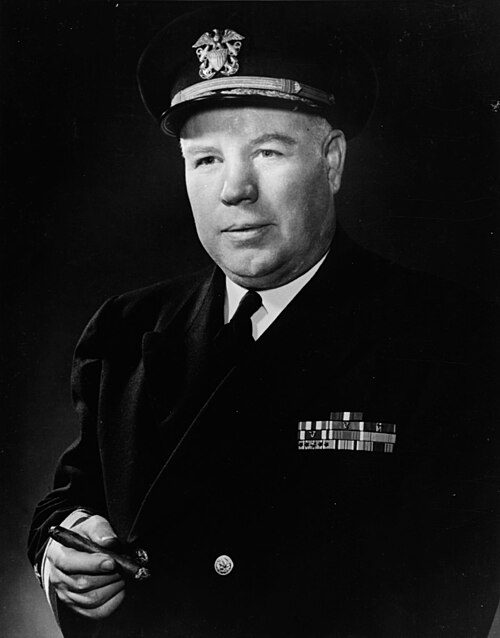
Edmund Battelle Taylor was born in Chicago, Illinois, on 4 April 1904, and spent his childhood in Ohio. He entered the United States Naval Academy from that state in 1921 and was commissioned an ensign on 4 June 1925. As a midshipman he captained the varsity football team in 1924, earned All-American honors in lacrosse, and also boxed and played basketball. His early sea duty was in the battleships New York, Texas, and Wyoming, followed by the destroyers Hatfield, Leary, and Perry.
Before the Second World War he was aide and flag lieutenant to Commander Destroyers, Battle Force, and served in the Officer Personnel Division of the Bureau of Navigation. In February 1942 he took a short course at the Fleet Sound School in Key West. On 16 April 1942 he placed the new destroyer Duncan in commission and became her commanding officer. He was promoted to commander that August. In September Duncan recovered men from the carrier Wasp after the carrier was torpedoed in the South Pacific.
At the Battle of Cape Esperance, on the night of 11–12 October 1942, Taylor took Duncan in close to a Japanese force. He maneuvered the ship so she could launch torpedoes that contributed to the loss of the cruiser Furutaka, and he kept her guns firing after she had been badly hit. Fire and damage finished Duncan, and the destroyer was lost. For that action he received the Navy Cross, and the Commander in Chief of the Pacific Fleet commended him.
His next ship was USS Bennett (DD-473), a Fletcher-class destroyer built at the Boston Navy Yard and named for the naval aviator Floyd Bennett. He took command when she was commissioned on 9 February 1943 and remained her captain until 31 July 1944. Some of the crew had already served with him in Duncan, and others came from O'Brien, another destroyer lost in the South Pacific in October 1942. On the shakedown cruise in the Caribbean, Bennett picked up 57 survivors of the American freighter John Sevier on 6 April 1943, after the German submarine U-185 torpedoed that ship southwest of Great Inagua. Taylor was promoted to the rank of captain on 20 May 1943.
Bennett arrived at Pearl Harbor on 31 May 1943 and patrolled in Hawaiian waters for about two months. She escorted a convoy to Efate in the New Hebrides and served there as a plane guard. In November 1943 she shifted to the Solomon Islands, where her work included the landings at Cape Torokina on Bougainville on 1 November 1943 and at Green Island on 15 February 1944, and bombardments of Kavieng on 18 February and Rabaul on 29 February. Philip Frederick Hauck and Jasper Newton McDonald also commanded Bennett during the war.
Beyond the Navy Cross, his Pacific fighting brought him the Silver Star, the Legion of Merit, and the Bronze Star Medal. In the last months of the war he was naval aide to Secretary of the Navy James Forrestal.
He was promoted to rear admiral on 1 September 1952. He later commanded the naval base at Guantánamo Bay, Cuba, for eighteen months, and in August 1955 became the Navy's Chief of Information. On 18 January 1958 he took command of the Destroyer Force of the Atlantic Fleet. From 31 January 1960 he led the Antisubmarine Defense Force, Atlantic Fleet, afterward called the Antisubmarine Warfare Force, in the temporary rank of vice admiral. During the Cuban Missile Crisis of October 1962 his ships and aircraft watched Soviet and bloc vessels across the Atlantic while still protecting the quarantine force. A Gold Star in lieu of a second Legion of Merit covered that command, from February 1960 to November 1963.
On 11 December 1963 he became Commandant of the Fifth Naval District and commander of the naval base at Norfolk, Virginia, and he held the permanent rank of rear admiral in that post. He received the Distinguished Service Medal for the Norfolk assignment. Taylor retired on 1 May 1966 and was advanced to vice admiral, the highest rank he had held on active duty. He died on 30 April 1973.