Ships
- USS Eaton (DD-510) Captain, 4 December 1942 – 3 September 1943
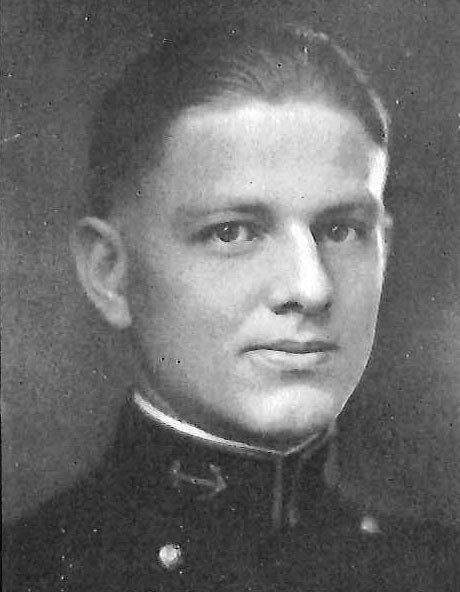
The Register of Commissioned and Warrant Officers of 1 July 1942, of 1 July 1944, and of 1 July 1945 all print Edward Louis Beck. The 1925 Lucky Bag prints Edward Lewis Beck, of Corfu, New York. Lewis is the yearbook. Louis is the register, and it is the name used here. By the time Eaton was commissioned he was a commander, not a lieutenant commander. Captain, on the command line, is the billet, and for most of the tour it is not his rank either. The dates match the commanding-officer compilations. A citation puts him in command of Eaton on 15 August 1943. No deck log of the relief on 3 September 1943 was read. The file number that belongs to this man is 59587.
Origins
He was born on 20 September 1902. That day is printed on his line in the Register of 1 July 1944 and again in the Register of 1 July 1945, in the column for date of birth: 20 Sept. 02. The same registers print his date of entry as 28 June 1921. They do not print a town.
The Lucky Bag of 1925 heads his page "Corfu, New York" and says he hails from Corfu. The Hall of Valor transcription of his Silver Star gives the same home, Corfu, and the same birth and death dates the cemetery memorial uses, 20 September 1902 and 23 January 1986. A Find a Grave memorial at the Naval Academy cemetery adds a birthplace the registers do not: Buffalo, Erie County, New York. Buffalo and Corfu are not the same fact. Corfu is a Genesee County village, not the Greek island, which is the joke the yearbook makes. It is the home a midshipman claimed. Buffalo is what a later memorial asserts. Neither is a birth certificate.
Nothing read for this essay names a father or a mother. The yearbook's joke that he has blonde hair and blue eyes and is not Swedish is classmate prose. It is not a record of parentage.
Formation
He entered the Naval Academy on 28 June 1921, the date of entry on the 1944 and 1945 registers. He is an ensign in the Register whose signal numbers ran from 1 July 1926, number 4833, with the date of rank 4 June 1925 printed on his own line, not dittoed, and the ship Memphis printed on that line. The class footnote in later registers, commissioned ensign 4 June 1925, agrees with the day set beside his name in 1926. Memphis was a cruiser. The register does not give his billet. He was an ensign on someone else's ship.
The Lucky Bag is a roast, and it should be read as one. The page numbers in the optical text are 195 and 196. It calls him Ed, Eddie, and Becky. It says Corfu is not a Greek island because there are no restaurants, and that he steps out there because there is no curfew. It puts a line in his mouth about Will Power, and another about a pitchfork and whether the fried cow is ready. It says he does not like peanuts, that bowling and peanuts are as distasteful to him as Castona and malted milk to a baby (the optical text's "Castona," almost certainly the baby remedy Castoria), and that bowling must have a big attraction for a man to forsake an oar. The credit line under the sketch is Gymnasium Squad in the plebe year; B-squad football and numerals in the youngster year; crew squad in the plebe, youngster, and second-class years; class crew and numerals in the first-class year. A regimental roster in the same book lists Beck, E. L., as fourth platoon leader of the Fifth Company. The sketch also prints the letters "gNAt" after the gymnasium credit. The book does not say what those letters mean, and they are not turned into a class standing here.
The sentence the classmates wanted about his private life is the one they dress up in French: the customary weakness of a Navy man, "les femmes," sometimes singular and sometimes plural, "but it can't go on that way forever." That is a joke in a yearbook. It is not a marriage. The registers do not give his class standing. They do not say he was turned back. He finished with the class he entered with, an ensign on 4 June 1925.
The next station the registers actually print is nine years later. On 1 July 1936 he is a lieutenant, signal 3296. The special-course figures on his line are 2 and 18. In that register's own key, 2 is designated naval aviator, heavier than air, and 18 is the Naval War College correspondence course in strategy and tactics. The ship on the same line is Blakeley. The column can be checked against the man above him in a way the dittoes of later books cannot. George John Dufek, on the line before, carries courses 1 and 2 and the duty "V. P. squadron 3-F, fleet air base, Coco Solo," which is the submarine qualification and the aviator's designation a known aviator-submariner would have. Beck's line is built the same way, and it does not give him Dufek's submarine number. It gives him wings, a correspondence course, and a destroyer. No squadron, no date of designation, and no flight log were found. The paper says he was an aviator. It does not say where he flew.
On 1 January 1938 the Navy Directory has moved him ashore: lieutenant, naval boiler laboratory, Navy Yard, Philadelphia. An aviator in a boiler laboratory is what the directory prints. It does not say he asked for the yard, or what he tested, or how long he stayed.
On 1 July 1939 the register index still has him a lieutenant, signal 2701. The registers of 1 July 1944 and 1 July 1945, in the permanent-rank column, date his lieutenant commander's rank 1 August 1939, dittoed down a block of the class of 1925. He was a lieutenant on the first of July and, on those later books, a lieutenant commander a month afterward. The day is a block date, printed at the head of the permanent-rank column and then dittoed. It is the best day those registers give.
The war, as the paper has it
On 1 November 1940 the Directory has him a lieutenant commander commanding Chew. On 1 April 1941 it has the same line: lieutenant commander, commanding Chew. Chew (DD-106) was an old Wickes-class destroyer, out of commission since 1922, recommissioned on 14 October 1940 and assigned to the Defense Force of the Fourteenth Naval District. The Dictionary of American Naval Fighting Ships says she arrived at Pearl Harbor on 17 December 1940 and then did patrol and training from that port. The November directory is dated after the recommissioning and before that arrival. He is the commanding officer on the Navy's own list while she is still on her way into the war, or not yet at Pearl. The directory does not say he stood on the bridge for the transit. The commanding-officer compilation on NavSource, the Hechler and Reeves list, dates him from 14 October 1940, the recommissioning day, to 12 December 1941.
The morning of 7 December is where that list and the signed reports pull apart. Chew's action report, dated at Pearl Harbor on 10 December 1941, is from the commanding officer and is signed H. R. Hummer, Jr. It says the ship, berthed at X-Ray 5, opened fire at 0803 with one 3-inch gun, scored a hit that disintegrated a plane, dropped twenty-eight depth charges on eight contacts, and lost Matthew J. Agola, seaman second class, killed while on rescue work aboard Pennsylvania, with Clarence A. Wise missing. Hummer's name is the one on that page. If Beck was still Chew's captain on the 10th, the signature does not show it. The Hechler and Reeves list gives Hummer the ship from 12 December, two days after Hummer signed as commanding officer. The two days are left as a conflict. The fight at X-Ray 5 is not claimed for Beck.
Phelps is the other ship, and the other report. On 30 December 1941 Lieutenant Commander E. L. Beck signed Phelps's report of the raid as commanding officer. The report itself says that on 7 December the ship was moored in a nest alongside the tender Dobbin in berth X-2, order from starboard Dobbin, Worden, Hull, Dewey, Phelps, MacDonough, cold iron, taking steam and electricity from the tender. General quarters at 0758. The forward 1.1-inch mount fired at 0802. Fires were lighted under the boilers at 0825. She got underway at 0926 with power for twenty-six knots, cleared the entrance at 0950, joined St. Louis as inner anti-submarine screen, and came back on 8 December. No damage, no casualties. One plane that caught fire and crashed ashore to the northward is the plane the ship claims, because the range was short. Two others were seen burning and were not seen to crash, and other ships were firing too.
Then Beck writes the sentence that places him. Lieutenant B. E. S. Trippensee, the engineer officer, "was the senior officer on board and when ready, he took the ship out" at 0926, and conned her almost continuously for thirty-three hours. Beck recommends him in the highest terms. He also names Ensign F. E. Bell of the squadron staff, and the gunner's mates Leslie T. Lovett and John H. W. Cotes, who opened fire on their own initiative, and the chief water tenders, the torpedoman, and the electrician who got the guns and the boilers and the electric load alive while the ship was still tied to a tender with her breech mechanisms apart. The report does not say where the commanding officer was that morning. It does say he was not the senior officer on board, and that another man took her to sea. A captain who is ashore on a Sunday, and a captain who has not yet reported, can both produce that sentence. The report of 30 December only proves that by then the Navy treated Beck as her commanding officer, and that on the morning of the attack the officer who fought the ship was Trippensee. The Hechler and Reeves list dates Beck from December 1941, not from 7 December. Uboat.net's start of October 1941 overlaps the months the Directory still has him commanding Chew, and it is not used.
If that December date is right, the next ten months of Phelps are his. The ship's DANFS history, which does not name him, says she aided Lexington in the air fighting off Port Moresby in February and March 1942, was in the Coral Sea from 4 to 8 May with no casualties, helped sink Lexington on 8 May, screened the carriers at Midway in June, and guarded the Guadalcanal landings in August, then visited the west coast in October. The Hechler and Reeves list relieves him on 4 November 1942, in favor of Trippensee, the same engineer who had taken her out at Pearl Harbor. No report signed by Beck for Midway or for Guadalcanal was found. Those battles are not retold here. The west-coast photographs of Phelps at Mare Island on 24 November 1942 are after the listed relief.
The Coral Sea is the day the documents do name him. The Office of Naval Intelligence combat narrative of the battle says the report of Phelps's commanding officer, Lieutenant Commander Beck, is not available for the air attack on the 8th. What it has instead is Captain Early, commander of Destroyer Squadron One, whose flag was in Phelps. When the carriers drew apart, Early kept Phelps with Lexington. The attacking planes came in over her at 1115. A plane crashed off her port beam, burning. What looked like a torpedo passed under her. A bomb struck the water close to her port beam. Phelps also picked up Lieutenant (junior grade) Richard Crommelin, a Lexington fighter pilot shot down in the combat air patrol. The narrative does not say Beck conned any of that himself. It names him as the commanding officer whose report was missing, and it puts his ship on Lexington's bow while the carrier was being hit.
The sinking is later, and it is an American order. After the gasoline explosion below, the fires, and the abandonment, the narrative says that at 1853 Phelps was detailed to sink Lexington. Five torpedoes were fired between 1915 and 1952. Four detonated. Lexington sank very suddenly at 1952, in 2,400 fathoms, at latitude 15°12' south, longitude 155°27' east. A few seconds later two underwater explosions were felt by ships ten miles away. The captain of Phelps thought for a moment that he himself had been torpedoed. The narrative had already identified that captain as Beck. It does not quote him. It does not say he argued with the order, or welcomed it, or who gave it to him in so many words. It says the destroyer was detailed, and that she fired, and that the carrier went down, and that her own captain, in the dark after the underwater blast, thought the torpedo had been meant for him. That is the whole of the inner record. The rest would be a motive, and the paper does not have one.
He left Phelps, on the secondary list, on 4 November 1942. A month later he has another new destroyer. Eaton (DD-510) was commissioned on 4 December 1942. The compiled list, NavSource, and uboat.net all give him to her from that day until 3 September 1943. The commissioning date is the ship's. That he was the commissioning commanding officer is the commanding-officer list, not a report read here. The rank is the register's. On 1 July 1944 he stands in the commanders' section, signal 2121, file number 59587. The temporary-rank date at the head of that block is 1 August 1942, then dittoed through the birth date that is his, 20 September 1902. His permanent rank in the same block is lieutenant commander from 1 August 1939. So from the summer before Eaton commissioned, the Navy's later register calls him a commander. The compiled list's "lieutenant commander," and the NavSource line that still styles him LCDR for the whole Eaton tour, are behind that book. The Silver Star citation, written in October 1943, also calls him commander.
What he did with Eaton before the middle of August 1943 is thinner than the ship's later reputation. The Naval History and Heritage Command DANFS page for Eaton did not open. The circulated ship history, which tracks that DANFS text, has her leave Casco Bay on 6 February 1943 and reach Efate on 7 March, then escort and patrol in the Solomons. Those dates are not copied here as if the page had been read. The citation is the page that was read.
On 17 October 1943, Commander South Pacific serial 002182, the President awarded the Silver Star to Commander Edward Louis Beck, Navy service number 0-59587, for 15 August 1943, as commanding officer of Eaton, in the operation against Barakoma, Vella Lavella. The citation says that while approaching Barakoma, during the unloading of the LSTs, and during their withdrawal, Eaton, as a unit of the screen, was under the same attacks as the rest of Task Unit 31.5.3: three daylight bombing attacks and one prolonged night attack. In daylight she helped with gunfire against the aircraft that got through the fighters. At night she helped lay smoke that frustrated the attacks, and she avoided the bombs aimed at her. The citation says the task unit's mission was greatly assisted by his heroism and by the skillful fighting and maneuvering of the ship. The closing sentence, that his actions were without regard for his own life and in keeping with the highest traditions, is the formula. The operational sentences are the ones that can be checked against the day: a destroyer on an LST screen, daylight guns, night smoke, bombs that missed. The Hall of Valor text is a transcription of that serial. The original citation card was not in hand. The Register of 1 July 1945, which records distinctions through 1 May 1945, marks him (E), Silver Star, Navy Department. That agrees with the citation.
The same register marks him (G-1), Bronze Star. No citation for the Bronze Star was found. Hall of Valor does not list it. The register is the evidence that the Navy had recorded one by May 1945. It is not evidence of which ship, which day, or which sentence of praise.
The Hechler and Reeves list gives Eaton to Edward Frank Jackson on 3 September 1943. Everything the ship did after that, the submarine contact off Vella Lavella in October, the Treasury Island landing, Empress Augusta Bay, the later Philippines, the collision with Wisconsin in 1956, is another man's command. It is not put on Beck.
On 1 July 1945 the register has moved him into the captains' section, signal 1793. The temporary-rank date printed on the first line of that block, Lewis Smith Parks, is 20 July 1943, and it is dittoed down through Beck. The permanent rank is still lieutenant commander from 1 August 1939. The birth and entry dates are his. This is the conflict in the rank. The book of 1 July 1944 still has him a commander, with a temporary commander's date of 1 August 1942, a full year after 20 July 1943. The citation of October 1943 still calls him commander. The book of 1 July 1945 calls him a captain and dates the temporary rank, by ditto, 20 July 1943. Both registers are official. They do not agree about when he became a captain. Uboat.net's "temporary captain, 20 July 1943" repeats the 1945 ditto and ignores the 1944 book. It is not adopted as the day he started wearing the rank.
No directory and no register line after the Eaton relief gives him a ship or a desk. From 3 September 1943, if that relief date is right, until the 1 July 1945 register, the only facts in hand are the commander's grade, then the captain's listing, the Silver Star, and the Bronze Star with no citation. Fitness reports, orders, and a shore station were not found.
The cost
The cost that can be documented is not a wound. No casualty list puts him among the injured. No letter home was found.
The first cost is the morning he did not have. On 7 December 1941 the ship he would sign for three weeks later was in overhaul, and the engineer took her out. Beck's prose gives the day to Trippensee and to the petty officers who reassembled the guns. Whether he was ashore from a command he already held, or not yet aboard, the report leaves him off the ship at the moment the war began. A commanding officer's first battle, written in the third person of other men, is a particular kind of record. It is honorable on the page. It is also a blank where his own conduct under the bombs would have been.
The second cost is Lexington. A destroyer captain is not usually ordered to put torpedoes into an American carrier. On 8 May 1942, if he was aboard, and the narrative treats him as the captain who felt the underwater explosions, he carried out that order. Five torpedoes, four of them hitting, and then a shock that made him think, for a moment, that his own ship had been the target. The narrative does not say he hesitated. It also does not say the decision was his. "Detailed" is the verb. The carrier had already been abandoned. The thing required of him was to finish her so the enemy would not have her. That is a choice in the sense that he was the officer who had to see it done. It is not a choice the paper shows him debating. The men of Lexington were off her. The ship was not. He, or his torpedo officer under his command, ended her. The combat narrative is explicit that his own report of the air attack that afternoon was not available when the narrative was written. Even the day for which he is most often remembered is partly missing in his own words.
The third is Barakoma, and it is smaller on the page than the citation's last sentence. Smoke, gunfire, bombs that missed, LSTs unloaded. The Navy called it gallantry and gave him the Silver Star. The citation does not say Eaton was hit, and it does not name a man of his killed. The cost it records is the exposure: a screen destroyer under four attacks, one of them a long night, while the landing craft did the work the operation existed for. He kept the ship from the bombs. That is the skill the citation is willing to specify. "Without regard for his own life" is the sentence they used for a great many officers. It is not a diary.
What he gave up to stay at sea is not written down. The yearbook's joke about women is 1925. The marriage, if the index citation is right, is 1932. A son was born in 1935. None of those facts says what the family lived through while he had Chew, Phelps, and Eaton. No address, no allotment, no letter, was found.
After
The last official line read is the Register of 1 July 1945: a captain on the temporary list, still a lieutenant commander on the permanent list, Silver Star, Bronze Star, born 20 September 1902, entered 28 June 1921. The Register of 1 July 1947 was searched in the optical text and did not yield a readable line for him, on the active list or the retired list. Uboat.net says he retired on 1 November 1946 as a rear admiral. The Hall of Valor page says he retired as a rear admiral. The Naval Academy cemetery memorial, Find a Grave 74170743, is inscribed "Rear Admiral, US Navy," and gives the death as 23 January 1986 in Manatee County, Florida, with burial at the Academy. Those three agree that he died an admiral, or was remembered as one. None of them is the register. A tombstone promotion on retirement would explain a captain of 1945 appearing as a rear admiral on a stone. That is a possible reading of the laws of the time. It was not confirmed from a retirement order.
No postwar job, no second career, no Florida address beyond the county on the memorial, and no obituary of his own were found. The war ends, in the paper, in a captain's listing and a missing retirement line.
The family, as far as it can be touched, is mostly other people's memorials. A compiled genealogy by Donald Newcomb cites a FamilySearch index entry for the marriage of Edward Louis Beck and Evelyn Crist Richardson on 2 July 1932 in Norfolk, Virginia, and an earlier index entry for William Nicholas Richardson, Jr., and Belle Evelyn Crist on 12 May 1914 in Richmond. The certificates were not opened. The Naval Academy memorial for Evelyn Belle Crist Beck, 74170765, gives her the dates 27 June 1902 to 31 March 1961 and the inscription "Beloved wife," and a note by the same compiler says she was actually born about 1895. Both cannot be right if she married in 1914. A girl born in June 1902 would have been eleven. The 1895 estimate, if it is right, makes the 1902 date on the memorial header wrong. The death date 31 March 1961 is what the memorial prints. It was not checked against a certificate. The compiler's database had once attached 31 March 1986 to her and cited the wrong memorial number. That date is rejected.
The same memorials link a son, Edward L. Beck, born 3 December 1935, died 2 December 2015. His own memorial quotes an obituary in the Naples Daily News of 5 December 2015: son of Rear Admiral Edward L. Beck, a Navy veteran of the Korean War, a retired New York City fireman and fire marshal, preceded by his wife Geraldine, survived by a companion, a son, and grandchildren. That is the son's life, not the father's, except for one thing. It is what the father left. A boy born while Beck was a lieutenant, who went to the Navy in a later war and then to the New York fire department. The obituary was not read in the newspaper. It is used here as the memorial quotes it.
The father's memorial also links a second wife, Thelma Rose Underhill Beck, 1904 to 1980, marriage year 1962. No license was read. If Evelyn died in 1961, a marriage in 1962 is possible. It is a cemetery link, not a proved wedding. Whether Thelma outlived him or he outlived her depends on those memorial dates: she in 1980, he in 1986. He would then have been a widower twice, or a widower and then a husband again, and the paper does not say which household he died in, or who buried him at Annapolis.
He was eighty-three if the birth and death dates hold. The stone says rear admiral. The last register that could be read says captain, temporary, and lieutenant commander, permanent. The sea duty that can be stood up next to a document is Memphis as an ensign, Blakeley as a lieutenant and an aviator on paper, a boiler laboratory, Chew before the war and perhaps not on the morning of it, Phelps from sometime in December 1941 through the Coral Sea and, if the list is right, through Midway and Guadalcanal until 4 November 1942, and Eaton from commissioning, or from whenever he actually reported, through the LST screen at Barakoma. The man in the yearbook who forsook an oar for bowling is not explained by any of that. The man who wrote the Pearl Harbor report, and gave the day to the officer who was there, is the closest the file comes to a voice.