Ships
- USS Barb (SS-220) Commander from late April 1944 · Detached in August 1945
On the night of 22–23 January 1945 the submarine Barb went into Namkwan Harbor, on the China coast, with almost no torpedoes left and almost no water under her. Her captain, Eugene Fluckey, had found more than thirty Japanese ships at anchor. The harbor was shallow, rocky, mined, and badly charted. He went in anyway. That attack is the center of his Medal of Honor.
The boat and the man
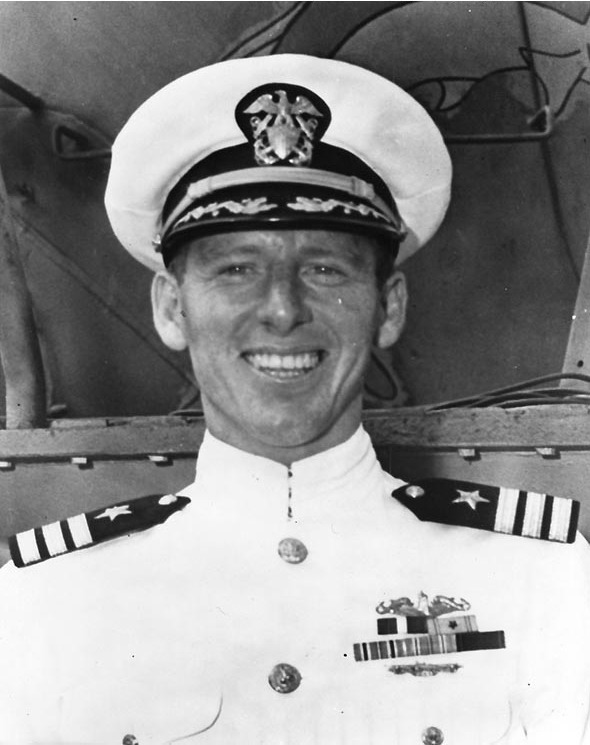
Barb was a Gato-class submarine, SS-220. Fluckey, born in Washington, D.C., in 1913, had graduated from the Naval Academy in 1935 and made five war patrols in the older submarine Bonita. He assumed command of Barb in late April 1944. His men called him Lucky. By January 1945 he was a commander, thirty-one years old, and Barb was on her eleventh war patrol, along the China coast from 19 December 1944 to 15 February 1945.
Two weeks earlier, on 8 January, she had fought a two-hour running battle at night against a convoy and sunk a large ammunition ship. After that she was down to the last torpedoes in the tubes.
Namkwan
Fluckey tracked a concentration of more than thirty ships into the lower reaches of the Nankuan Chiang, the anchorage the citation calls Mamkwan Harbor and later accounts call Namkwan. A safe retirement meant an hour at full speed through water nobody had properly mapped. He gave the order for battle stations anyway.
Barb went in on the surface, past the escorts. At one point she was in five fathoms, about thirty feet of water. A Gato draws about seventeen feet. The margin under the keel was the draft of the boat and not much more.
At 3,000 yards he fired the last forward torpedoes, swung her, and fired four from the stern. The crew counted eight hits on six ships. One was an ammunition ship. It blew up, and the shells in her went off across the harbor.
Every ship in the anchorage then knew where Barb was. Fluckey ran for it on the surface, through rocks and possible mines, with escorts astern. The citation says he cleared the harbor at high speed and brought her through. Four days later she sank a large freighter.
The wartime count of that night ran high, as submarine counts often did. Postwar Japanese records confirm fewer ships sunk than the crew believed. What the records do not touch is the decision to go in.
The medal
The Medal of Honor was for the whole patrol, not the harbor alone. The citation runs from the 8 January fight through Namkwan to the freighter four days later. Fluckey already had Navy Crosses. He finished the war with four, besides the Medal of Honor.
He had a card printed, signed a copy for every man aboard, and told them he was only the caretaker of an honor the crew and the ship had earned.
The train
In July 1945, on Barb’s twelfth patrol, he sent eight men ashore on Karafuto, the Japanese half of Sakhalin. On the night of 22–23 July they landed from about 950 yards out and blew the charge under a train. Fluckey later wrote that it was a sixteen-car train, that he picked the eight from every division, and that he took only unmarried men. It was the only ground fight by an American submarine crew on the Japanese home islands. Barb was also the first American submarine to fire rockets ashore, at an air station and factories on the same patrol.
The score, and after
The Joint Army-Navy Assessment Committee, which rescored the submarine war after the peace, credited Fluckey with 95,360 tons, the highest total of any American submarine commander. Wartime claims had been higher. The tally includes the escort carrier Unyo, sunk in September 1944 in the same salvo as a tanker. In Thunder Below!, published in 1992 and given the Morison award in 1993, he wrote that no man under his command received a Purple Heart, and that all of them brought Barb home.
He retired in 1972. He and his wife Marjorie then ran an orphanage in Portugal. He died on 28 June 2007, at 93. In 2020 the Navy gave the name Barb, not Fluckey, to the attack submarine SSN-804.