Ships
- USS Evans (DD-552) Captain, 11 December 1943 – 1 November 1944
Origins
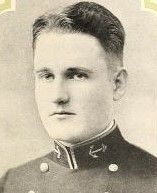
The Navy’s own registers, not a hometown story, are what fix Floyd Charles Camp in the world. He was born on 4 December 1904, in Arkansas. The state is given twice, as birthplace and as the state from which he entered the service, and no town is named. On 21 June 1922, still seventeen, he entered the Navy from Arkansas. The men listed beside him in later registers, Thomas Michael Dykers and William Henry Ashford among them, show entry dates in July 1923. Camp’s date sits a year earlier. The page of the 1 July 1942 Register that carries his birth line is footnoted “Commissioned ensign June 2, 1927,” the same class note that runs with that cohort in the registers of 1 January 1933 and 1 July 1940. His date of rank as lieutenant (junior grade) is 2 June 1930, the date given for those classmates and exactly three years after that ensign’s commission. The registers therefore carry him with the Naval Academy class commissioned on 2 June 1927, despite an entry a year before theirs. They do not say whether he was turned back, held out, or appointed early. They do not name a parent, a school, or a street.
What they do show is a sea career that began almost as soon as the commission existed. On 1 January 1933 the Register credited him with five years and ten months of sea service in all, and two years and six months of it in his present rank. A cruise that had ended in October 1929 was followed, on the same line, by another that began on 15 February 1930. By the opening of 1933 he was a lieutenant (junior grade), date of rank 2 June 1930, and his duty was the destroyer John D. Ford. The only qualification number printed on his line that year was 31, the Register’s mark for a completed course in torpedo instruction. The Asiatic Fleet’s old destroyers were a hard first seagoing school: long absences, small ships, and a station that was already the Navy’s distant frontier. The Register does not narrate his watches. It only puts him there, after nearly six years afloat out of the five and a half since his ensign’s commission.
Formation
By 1 July 1936 the same officer was still carried among the lieutenants (junior grade), his rank marked “(Y),” the Register’s sign that an officer was subject to examination, confirmation, or both. His duty that day was the battleship New Mexico. The course numbers clustered with his name in that scrambled table include 21, 31, and 32; from the 1 July 1940 Register onward those three numbers sit on his own line without ambiguity. In the Navy’s key they mean a postgraduate course in general line duties, the torpedo course he already held in 1933, and a completed course in chemical warfare. He was being finished as a surface line officer, not as an aviator and not as a submariner. Dykers, listed next to him for years, carried the submarine qualifications. Camp did not.
The promotion the 1936 Register still held at arm’s length is dated, in the 1 July 1940 Register, from 30 June 1936. From that day the later book calls him lieutenant. The one-day gap between the date of rank and a register that still printed him as a junior-grade lieutenant under examination is the sort of clerical seam the registers often leave. It is not a second officer. The birth date, the Arkansas entry of 21 June 1922, and the place in the lineal list stay continuous.
On 1 July 1940 he was lieutenant, signal number 3297, courses still 21, 31, and 32, and his duty was Mindanao, the Asiatic Fleet gunboat. The cruise column says that tour began on 3 December 1939. The previous cruise had expired in May 1938. Between those dates the Register is silent about the billet, so the silence should stay. Sea service in the rank of lieutenant was three years and six months; total sea service was ten years and eight months. Of the roughly thirteen years since June 1927, more than a decade had been spent in ships. The pattern is Asiatic and battleship service, then a gunboat on the station where the war with Japan would open. Mindanao’s later loss in the Philippines is the ship’s story. The Register of 1 July 1940 does not say he was still in her when the war came, and the 1 July 1942 Register, though it still shows a cruise commencement of December 1939 on his line, does not print a duty station beside his name.
That 1 July 1942 book is the last peacetime-style snapshot before command. He was a lieutenant commander, date of rank 16 December 1941, signal number 2905, permanent rank in a list that had just moved. Sea service “in rank and on the promotion list” was one year and four months, which is longer than the six and a half months since 16 December and so must include time on the list before the rank itself. Total sea service was twelve years and eight months. The footnote under the line is again the ensign’s commission of 2 June 1927. He was thirty-seven. The war was six months old. The next dated fact is a new ship.
War years as lived
On 10 September 1942 the Register’s later temporary-rank column dates his appointment as commander. The 1 July 1944 Register carries that temporary date as 10 September 1942, with his permanent rank still lieutenant commander from 16 December 1941. Less than a month after the temporary promotion, he stood on the deck of a destroyer that had not yet been a ship in commission.
Glennon (DD-620) had been laid down at Kearny on 25 March 1942 and launched on 26 August. She was commissioned at the New York Navy Yard, Brooklyn, on 8 October 1942. The Naval History and Heritage Command’s history says “Lt. Cmdr. Floyd C. Camp in command.” The same history’s commanding-officer table styles him “Cmdr. Floyd C. Camp” from that day. Clifford A. Johnson, who would later command her, said in a 13 July 1944 interview that he had been executive officer when the ship was placed in commission under Commander F. C. Camp in October 1942. Johnson’s “Commander” matches the temporary rank. The history’s “Lt. Cmdr.” matches the permanent one.
The first fortnight was yard work. On 22 October she took ammunition at Fort Lafayette and was depermed at Bayonne, the treatment that reduced a hull’s magnetic signature for a war of mines. The next day she ran trials in Long Island Sound, went back to the yard for repairs, and on 27 October sailed for Casco Bay. Training there was interrupted on 12 November. The senior officer present afloat ordered her to find a German submarine last reported well east of the Maine coast. At 1717 she made underwater sound contact. Closing, she lost it abruptly at 600 yards, searched on, made no further contact, and on 13 November was told to go back to training. It was a first lesson in how little a contact was worth: a bearing, a lost echo, no wreckage, no claim.
In December she was on oilers. With Roe and Butler she escorted Chemung, Housatonic, Pecos, Kennebec, and Cache toward Galveston under a secret operations plan. On 16 December, still short of the port, she left the convoy on a sound contact she took for a submarine’s propellers. The first depth charges failed because their fuses were set deeper than twenty fathoms. That night, near the Texas coast, she attacked again with settings of 100 feet and 50 feet. The charges detonated and brought oil to the surface. The history records no other trace of a submarine. Oil on the water was not a kill, and the Register never gave Camp a submarine-command qualification that would have made the distinction a matter of pride in a service jacket. The convoy arrived on 17 December. She took the oilers back to Hampton Roads for Christmas.
January and February 1943 were more of the same unglamorous work, which was the work that kept the Atlantic war fed: Galveston again, then Aruba, then a screen for commercial tankers out of Trinidad to Dakar and back. A fireroom lost oil suction on the way to Aruba on 3 February; Maddox and Nelson circled her at ten knots while her crew corrected it, and she went on into St. Nicholas Bay the same evening. On 9 March she was at Norfolk. The next day she sailed with South Dakota for exercises at Casco Bay, then down to New York for three weeks of repairs and alterations.
On 6 April she left New York in a large landing-ship convoy for Bermuda, and on 13 April that convoy, UGL-2, sailed for French North Africa. She passed Gibraltar on 30 April, went on to Casablanca, and was back at the New York Navy Yard on 14 May. Late May was spent learning the gunnery she would actually be judged by: Bloodsworth Island, night shore-bombardment practice, ammunition at Norfolk. On 8 June, in the screen of convoy UFG-9, she sailed for Mers el-Kébir. On 15 June at least five ships in the force reported submarine contacts and dropped charges. On 18 June Glennon intercepted radio traffic believed to be German contact and beacon signals and passed it to the cruiser Boise. On 21 June she was at Algiers. On 23 June she searched for a U-boat reported to have sunk an Allied tank landing ship, did not find it, and joined the rehearsals for the invasion of Sicily.
On the night of 27 June she was sent to a tanker torpedoed west of Algiers, the Royal Fleet Auxiliary Abbeydale. She found the oil slick at 2245, circled about a mile off, and stayed until a British tug took the ship in tow the next morning. Screening a wounded oiler through the night, with no certainty the submarine was gone, was as much the command as any bombardment.
Operation Husky began for her on 6 July. She joined the screen for the Dime assault area off Gela. On the evening of 9 July the convoy passed Gozo. At 2255 her crew saw gunfire on the southern Sicilian shore, read as the defense against paratroopers landing behind the beaches. In the first hours of 10 July she swept eight to twelve thousand yards to seaward of the transports, then patrolled the outer transport area. At 0325 the bombardment ships opened on shore batteries and searchlights. Two hours later Glennon fired on aircraft overhead. Bombs fell inside the transport area that afternoon. One Ju 88 was seen heading inshore at 1845 as the raid developed. When it ended she moved closer in, with Murphy and Butler.
On the morning of 11 July she relieved Jeffers as flank shore-fire-support destroyer for Dime. She watched bombs hit the transport Barnett. From late morning until evening she bombarded designated targets ashore, broke off to fire at sixteen twin-engine bombers, then resumed until 2054. The shore fire control party numbered 5 sent a message the history quotes: “Good shooting, thank you.” It is the only sentence in the record that answers him, and it answers the ship, not a speech of his. Three bombs fell close that night. She was not hit. Herndon relieved her on 12 July, and by the 15th she was back in Algiers, taking ammunition from Mount Baker.
She returned to Gela, escorted the buildup convoy NCS-3 in from Malta, screened Boise toward Bizerte, and on 28 July helped take Philadelphia and Savannah to Palermo. On the evening of 30 July she was ordered to replace Rowan on outside patrol and as a gunfire-support ship off the port. Butler relieved her the next morning and she entered Palermo.
At 0412 on 1 August 1943 enemy aircraft began bombing the inner harbor. Glennon answered with 20-millimeter and 40-millimeter guns. The raid moved to the outer harbor, where the cruisers lay, and she made smoke while maneuvering. At 0436 a plane passed over and strafed the starboard wing of the bridge. Two officers and six enlisted men were wounded. The history names them: Lieutenant Milton M. Perloff, Radioman Third Class Hyman Rabinowitz, Quartermaster Second Class Carl J. Blackwell, Radioman Third Class Alexander Borodenco, Seaman Second Class Jesse E. Savage, Signalman First Class Eugene I. Olson, Soundman Second Class Donald L. Mahannah, and Lieutenant Commander Clifford A. Johnson. Perloff and Rabinowitz were transferred to Philadelphia. Johnson was the executive officer who had commissioned the ship under Camp; he was not yet her commanding officer, and he was among the wounded. The ship’s damage was superficial, on that starboard bridge wing. She observed at least three enemy planes shot down, screened Philadelphia through the rest of the raid, and that evening sailed for Oran with Orizaba and the transports Evangeline, Mexico, and Shawnee.
Johnson, speaking a year later, remembered the Palermo attack as the night of 31 July and remembered sixteen men wounded rather than the eight the ship history names. He also remembered standing on the port side of the bridge and reaching the starboard side only after the plane had crossed. The history’s date, the named wounded, and the count of eight are the account used here. His memory at least places the executive officer on the bridge in the minute the ship was hurt. It does not say where Camp was standing.
From Oran she made one more sweep for an oil slick, escorted Samuel Chase toward Arzeu, and on 9 August joined the screen that took a transport convoy through Gibraltar to Casablanca. On 12 August, in Task Group 89.6 under the commander of Destroyer Squadron 17 in Nelson, she sailed for Gravesend Bay screening transports and, after a rendezvous, the oilers Salamonie and Chemung. On 17 August she and Nelson sighted a U-boat at 11,000 yards, watched it submerge, and dropped depth charges without regaining contact. On 21 August she slowed and hauled out of formation so that Nelson’s medical officer could operate on Torpedoman’s Mate Second Class Harold E. Parsons, a plankowner, for a duodenal ulcer, then she rejoined. On the morning of 22 August 1943 the task group entered New York. She anchored off Fort Lafayette, sent the surgeon back, unloaded ammunition, and moored at the New York Navy Yard.
The commanding-officer table dates Johnson’s assumption of command to 30 August 1943. Camp had brought the ship from the builder’s hand through the first Atlantic convoys, the North African run, the Gela bombardment, and the Palermo raid, and he left her in a yard availability in the port where he had commissioned her. Johnson later said he had commanded her for her last nine months. From 30 August 1943 to the mining off Utah Beach on 8 June 1944 is a little over nine months. The phrase is a recollection, not a date. The table is the date. Everything Glennon did after 30 August, including Normandy and the loss of the ship on 10 June 1944, is Johnson’s command in that history, and Camp’s name does not appear in it again.
What the record gives him next is another new destroyer, on the other ocean. Evans (DD-552) was launched at Chickasaw, Alabama, on 4 October 1942 and commissioned on 11 December 1943, Commander F. C. Camp in command. The Dictionary of American Naval Fighting Ships says that and then follows the ship: Majuro on 29 March 1944, a fueling rendezvous with Cimarron, antisubmarine patrols off Japanese-held Marshall atolls, the screen of the fueling and aircraft-replacement group for the capture of Saipan, the same duty for the Palaus, Ulithi at the end of October, and, long after, Iwo Jima and the kamikaze night off Okinawa in May 1945 in which four aircraft struck her, thirty-two men were killed, and twenty-seven wounded. That history never says when Camp left, and it never names him at Okinawa. Compiled commanding-officer lists give 1 November 1944 as the day he was relieved. Those lists are not used here as a cruise. What can be said is that he took her from the builder as commander, eleven months after he had taken Glennon the same way, and that by the summer of 1944 the Navy had already recorded a decoration for him.
Cost
The 1 July 1944 Register marks him “(H-1).” In that book’s key, (H-1) is a special letter of commendation with authority to wear the Commendation Ribbon. It is not a Navy Cross, not a Silver Star, not a Legion of Merit, not a Bronze Star. The 1 July 1945 Register, which states that the distinctions it shows are those issued and recorded through 1 May 1945, still shows only (H-1) after his name. No citation text has been found, so the letter cannot be pinned to Gela, to Palermo, to Evans, or to a staff job in between. The ribbon is a fact of the service record. The reason is not.
The human cost that can be tied to his command is the Palermo morning. Eight men wounded by a strafing run across the bridge wing, two of them moved to a cruiser for further treatment, his executive officer among the eight, the ship’s plates only superficially scarred. The depth-charge attacks of November and December 1942 and of August 1943 produced no confirmed sinking and no recorded casualties of his own. Glennon’s later dead, twenty-five killed and thirty-eight wounded when she was mined and then shelled off Quinéville, belong to the command that began on 30 August 1943. Evans’s thirty-two dead off Okinawa belong to a night the ship history does not place him in. He did not die in either ship. The registers do not record a wound.
There is a quieter cost in the way the war used him. From December 1939, if the cruise column is right, he was already on a long sea tour when the European war became an American one. He was made a lieutenant commander on 16 December 1941, nine days after Pearl Harbor. He was given a brand-new destroyer in October 1942 and another in December 1943. Between the yard at Brooklyn in late August 1943 and the commissioning at Chickasaw in December, the registers are blank about where he slept. The Navy’s habit was to spend a commanding officer who had just brought a ship through an assault, then hand him another hull. Whether he asked for Evans or was simply assigned her is not said.
After
On 1 July 1945 he was still on the active list, signal number 2270, in the block of captains. The temporary rank is captain from 20 March 1945. The permanent rank on that line is still lieutenant commander, the “do” that carries forward from the explicit “Lt. Cdr.” at the head of the block, and the permanent date of rank remains in the 1941 chain established earlier. Wartime stars outran the permanent list. He had been a temporary commander since September 1942 and a temporary captain since March 1945, while the peacetime rank on the books was the lieutenant commander’s commission of December 1941. Courses were unchanged: general line, torpedo, chemical warfare. Birth and entry were unchanged: 4 December 1904, 21 June 1922. The 1945 Register does not print a ship.
He is not in the local copies of the 1952, 1956, 1957, or 1958 registers under the name Floyd Charles Camp or Floyd C. Camp. That absence is an absence of these files, not a death date. No wife, no child, no obituary, and no place of burial has been established from a register, a citation, or a newspaper that can be tied to this officer. A widely repeated secondary note gives Yellville, Arkansas, as the birthplace and 1 March 1954 as the date of death. Neither appears in the Navy Registers consulted, and neither is used here as fact.
What the paper leaves is a line officer who spent most of his adult life at sea, who learned torpedoes and the general line before the war, who took one destroyer through the Atlantic and the Sicilian landing, and who took another out of an Alabama yard while the Pacific war was still short of the Marianas. The commendation ribbon is the only distinction the registers allow him through May 1945. The thanks of a shore fire-control party at Gela, and the names of eight wounded men at Palermo, are the closest the surviving narrative comes to the sound of his command.