Ships
- USS North Carolina (BB-55) Captain, 6 October 1944 – 26 January 1945
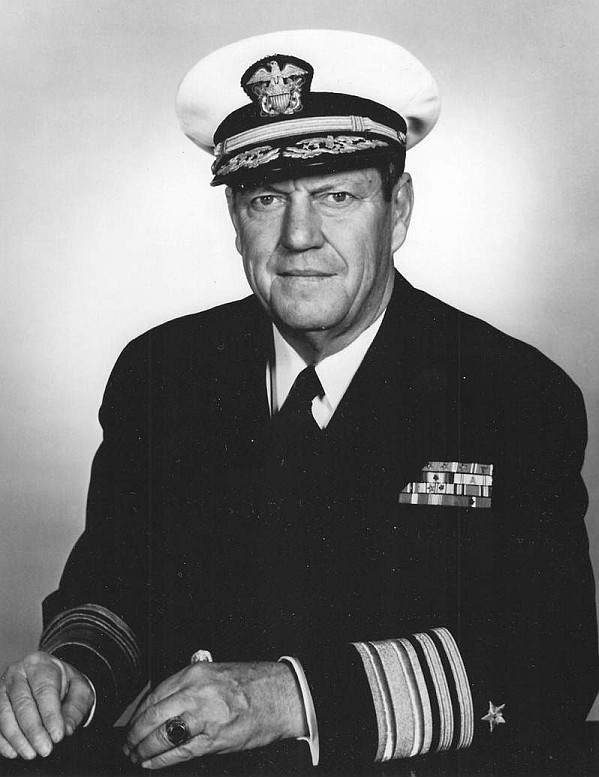
Frank George Fahrion (17 April 1894 – 16 January 1970) was a United States Navy officer who rose to the rank of admiral. He spent nearly four decades in the service, mostly with destroyers and surface forces, and commanded ships and task groups in the Pacific in the Second World War. The guided-missile frigate Fahrion (FFG-22) was named for him.
He was born in Pickens, Randolph County, West Virginia. He entered the Naval Academy and graduated with the Class of 1917, commissioned as an ensign as the United States entered the First World War. His early career was in destroyers. By 1940 he was commanding officer of the destroyer Warrington (DD-383). Before Pearl Harbor he led a destroyer division escorting convoys to Iceland and to mid-Atlantic handovers with British escorts.
In October 1941 he was embarked in the destroyer Anderson, as commander of Destroyer Division 3. He was not her captain. In the opening months of the Pacific war he was destroyer screen commander for the carrier Yorktown and Task Force 17 during the early Central Pacific raids on the Gilbert Islands. He was not her captain.
He then served as chief of staff to Commander, North Pacific Force, for which he received the Legion of Merit. From February 1943 to July 1944 he commanded the Naval Torpedo Station at Newport, Rhode Island, directing the research, development, and manufacturing work of the wartime torpedo program. A Gold Star in lieu of a second Legion of Merit followed.
On 6 October 1944 he took command of the battleship North Carolina. He left her on 26 January 1945. Through that command the ship covered fast-carrier raids from the Philippines to Iwo Jima and Okinawa. The citation for his Bronze Star Medal with Combat "V" credited him with fighting the ship so as to damage the enemy and help keep serious damage off American forces. He was advanced to flag rank in early 1945. Some wartime lists already style him a temporary rear admiral from February 1943. The list of her commanding officers styles him captain for the whole of this command. On 3 February 1945 he became commander of Cruiser Division Four. That was a flag, not the captaincy of a ship. For skillful, intensive naval gunfire support throughout the Okinawa campaign he received a Gold Star in lieu of a second Bronze Star with Combat "V."
After the war he commanded the naval groups of Joint Task Force One for Operation Crossroads, the atomic-bomb tests against ships at Bikini Atoll in July 1946. His flagship was the cruiser Fall River. He was not her captain. A Gold Star in lieu of a third Legion of Merit recognized his organization of the target and salvage units. In 1947 he was briefly inspector general of the Pacific and U.S. Pacific Fleet, then commander of Destroyers, Pacific Fleet, until 1948. From July 1948 to July 1950 he was superintendent of the Naval Gun Factory at the Washington Navy Yard. President Harry S. Truman visited the yard during its 150th anniversary while Fahrion held that post.
In July 1950 he took command of Destroyer Force, U.S. Atlantic Fleet, and was promoted to vice admiral on 28 December 1951. From 5 January 1952 until he was relieved for retirement he commanded Amphibious Force, U.S. Atlantic Fleet. He retired on 1 May 1956 and was advanced to the rank of admiral on the retired list.
His decorations included the Legion of Merit with two Gold Stars, the Bronze Star Medal with Gold Star and Combat "V," the World War I Victory Medal with the Destroyer clasp, the American Defense Service Medal with the "A," the American Campaign Medal, the Asiatic-Pacific Campaign Medal, the World War II Victory Medal, the Navy Occupation Service Medal with the Asia clasp, the National Defense Service Medal, and the Philippine Liberation Ribbon with one star.
He settled with his wife in La Jolla, California, and died there on 16 January 1970 at the age of 75. He is buried at Arlington National Cemetery. The frigate Fahrion was sponsored by his widow, Kathleen Dwyer Fahrion, and commissioned on 16 January 1982, the twelfth anniversary of his death. She served until 1998 and was then transferred to Egypt as Sharm El-Sheikh.
The day he left North Carolina, 26 January 1945, is the battleship's list of commanding officers. The October 1941 embarkation in Anderson is the division command, Commander, Destroyer Division 3, not the captaincy of the ship.