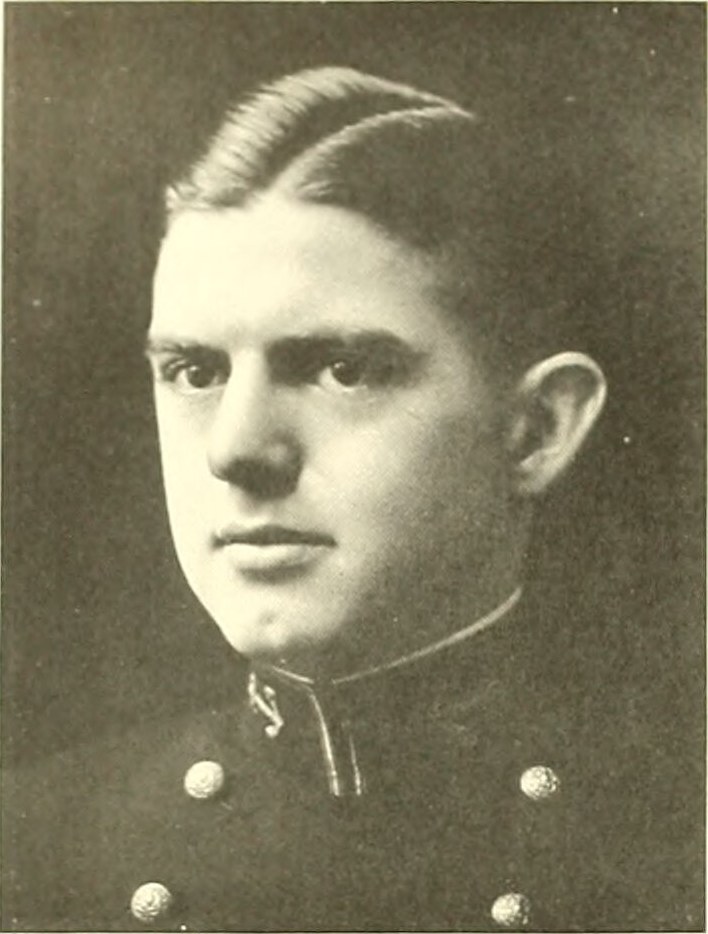
Ships
- USS Stevens (DD-479) Captain, 1 February 1943 – 1 September 1943
Compiled lists give him USS Stevens (DD-479) from 1 February 1943 to 1 September 1943.
The name on the list is the name the Navy’s own registers use. The Annual Registers of the Naval Academy for 1919–20, 1923–24, and 1924–25 print “Ball, Frank Haywood.” The Lucky Bag of 1924 heads his sketch the same way, though the scan reads the surname as “BALI.” The Navy Registers of 1 January 1933, 1 July 1940, 1 July 1941, 1 July 1942, 1 July 1943, 1 July 1944, and 1 July 1945 print “Frank Haywood Ball,” and the Registers of 1 January 1950, 1 January 1952, 1 January 1958, and 1 January 1959 print “BALL FRANK HAYWOOD,” file number 058703. A few later OCR passes garble the middle name to Hayhood or cut it to Haywoo. Those are the machine, not the book. No register read for this essay spells him Hayward. The spelling used here follows the registers.
“Captain” on the command line is the old word for the officer in command. It was not his rank in the months the lists give him. On 1 July 1943 the Register still places him in the commanders, temporary commander from 17 July 1942, permanent grade lieutenant commander. The captains’ pages of the Register of 1 July 1944 give the temporary captaincy as 1 June 1943, and the postwar Registers keep 1 June 1943 as his date of rank as captain. That date falls inside the Stevens tour the compilations give him, not before it. “Commander” is the nearer word for February 1943. By the day the lists end the tour, 1 September 1943, the temporary captaincy was already three months old, if the Register’s date is the one that governed his title on the quarterdeck. The registers do not say what the ship’s logs called him.
The dates 1 February 1943 and 1 September 1943 are not in the Dictionary of American Naval Fighting Ships text read for this essay, and they were not read off a deck log. NavSource’s command list, credited to Wolfgang Hechler and Ron Reeves, prints the same window, and calls him a 1924 Academy man. Uboat.net, which cites NavSource for the ship pages and not a log, prints 1 February 1943 to 8 September 1943 and calls the rank temporary commander. The ship’s own history, the public-domain DANFS account carried on the Wikipedia page that points at the Naval History and Heritage Command entry, dates the commissioning at the Charleston Navy Yard on 1 February 1943 and never names the officer who took her. The live Command page returned an error when it was opened for this essay. What can be said without the compilation is that a new destroyer was commissioned that day. What the compilation adds is that the man who had her was this one.
He is not Frank C. Ball, the aviation pilot whose number sits next to his in the 1944 index, and not Frederick O. Ball, the pharmacist and later hospital corps officer, file 058409.
Origins
The registers are exact about the day and silent about the house. On 1 July 1943, 1 July 1944, and 1 July 1945 the birth column on his line reads 15 October 1900. The same three numbers are there on 1 January 1950 and 1 January 1952, written 10 15 00 beside the captain’s date of rank, and again on the retired list of 1 January 1955 and 1 January 1956. They do not print a town.
The Lucky Bag does. Under the name it prints “Raleigh, North Carolina,” which is how that book marks the place a midshipman came from. It is not a birth certificate, and the Navy Register never confirms it. Uboat.net states the birthplace as Raleigh and the death as Morehead City, North Carolina, on 2 July 1980. The birth date matches the Registers. The city of birth, beyond the yearbook’s place line, and the death were not confirmed by an obituary, a cemetery record, or a newspaper found for this essay.
No source read here names a parent, a wife, or a child.
The yearbook is the only picture of him before the Navy had finished with him, and it should be read as his classmates talking. They called him Duke. The sketch says that on entering the Academy his roommates, already in a week or two, let him take charge of the room, and that the duty officer walked in on “evidence of unauthorized use of tobacco.” For that, “Frank packed up his belongings for a month’s cruise on the Reina.” The yearbook does not spell the ship’s full name. In the same book the Reina is the place a Christmas dinner was served to a man who had wanted to be a brakeman on the way home from the Army-Navy game, and the place another man took as part of a five months’ cruise with the Arkansas. It is the station ship the regiment used as a jail, and the Registers of the 1930s still list a Reina Mercedes among the Academy’s ships. The classmates do not call the month a disgrace. They say that from then on “his status as one of the elite was fixed.”
They also say he was “Regulation” to a fault. “Nothing would break his heart more than to see one of his roommates go to formation without a collar.” He “carried regulations to an excess as long as ‘Big-hearted Boh’ remained with us,” and “never missed a foraging party.” The yearbook does not say who Boh was. The sentence that matters more than the joke is the one about the numerals: “Duke sports numerals from the classes of Twenty-Two, Twenty-Three and Twenty-Four. The history given above, therefore, is of another age than ours. We claim him just the same.” They knew he had not come up with them. They took him anyway.
The activity line under the sketch is damaged in the scan. It seems to mention class baseball, numerals, and class football, and something that may be the Log staff. It is not used here as a billet list. The numerals in three class years are in the prose, and the Academy’s own registers explain how a man could wear them.
Formation
He did not enter with the class he finished with.
The Annual Register for the academic year 1919–20, in the section “Appointments, Deaths, Resignations, etc.,” covering 1 October 1918 to 11 November 1919, lists under Resignations: “Ball, Frank Haywood, class of 1922,” dated 24 May 1919, with a footnote marker. The only footnote printed on that page of the resignation list reads “i Readmitted with class of 1923.” The marker on his line is not clean in the scan. The same page puts the same sort of marker, often read by the machine as a numeral 1, on other men the footnote is plainly meant for. What is not in doubt is the rest of the book. On the roll of the fourth class that autumn, 720 midshipmen, his name is “Ball, Frank Haywood,” with the italic letter b, and the footnotes at the bottom of that list alone define b as “Readmitted.” The next page is a list of midshipmen “readmitted to the Naval Academy during the summer of 1919 or turned back into the class of 1923,” with the sea service they were to be credited. “Ball, F. H.” is on it, between Armstrong and “Ball, F. J.” The month-and-day columns are too broken to quote a figure. The name is enough.
The Navy’s later date of entry for him is 7 June 1919. That is two weeks after the resignation date in the Academy book. The Registers of 1943, 1944, and 1945 all print 7 June 1919, starred, and the footnote on the 1943 page says the starred men were commissioned ensign on 5 June 1924. The Registers of 1950 and 1952 print the same commissioning day in their own columns, 6 05 24, beside the birth date. He left the class of 1922 on paper at the end of May 1919 and was back in the new fourth class, the class of 1923, at the start of June.
He did not stay there either. The Annual Register dated 1 October 1923, in “Retained in next lower class,” records “Ball, Frank Haywood, class of 1923 to class of 1924,” turned back 13 February 1923. The line gives a date and not a cause. Other men on the same page carry a mark the book does not explain in the lines read here. His line has none. Illness, conduct, or a failed course would each have been a different kind of year, and this register does not say which. The Lucky Bag’s three sets of numerals are the classmates’ way of saying the same fact without the cause: he had been Twenty-Two, then Twenty-Three, and he finished Twenty-Four.
The graduating merit roll is in the Annual Register for 1924–25, “Merit roll of the midshipmen of the graduating class.” His name is on it, appointed from a state the columns do not yield cleanly in the scan, admitted on a date the same columns scramble. The order-of-merit numbers sit in a separate column the machine read before the names. Counting down that column to the twenty-second name produces 460, in a class whose numbers run past 500, but the prefixes on other lines, stars and corps marks, make the alignment too uncertain to call him 460th. It is not used. What the roll does prove is that he graduated with the class of 1924, and what the Navy Register proves is the date the Navy afterward treated as his first commission: 5 June 1924, ensign, line.
The promotion that followed was the slow one his class knew. On 1 January 1933 he is a lieutenant (junior grade), signal number 3522, date of rank 5 June 1927, the ditto of the date printed at the head of that page of the grade. The special-course column says 21. In the Register of 1 July 1944 the key for that number is “Completed postgraduate course in general line duties.” He is not marked as a naval aviator, not as qualified in submarines, not as a War College graduate. The same 21 is still the only qualification on his line in 1940, 1942, 1943, 1944, and 1945. His duty on 1 January 1933 is “Naval training sta., N. O. B., San Diego (instrn.).” He was teaching at the training station on the base, not commanding a ship.
The Navy Directory is where the sea duty becomes a named hull, and it abbreviates him “Frank H.” The link to Haywood is the signal number. The Register of 1936 indexes “Ball, Frank H., Lt.” as signal 3070. The Directory of 1 April 1937 uses 3070 for “Lt. F. H. Ball,” assistant naval inspector of machinery at Newport News Shipbuilding and Dry Dock Company. The Directory of 1 January 1938 still has “Ball, Frank H.” in that same inspector’s office, under a new number, 2736. The alphabetical neighbors do not change: Claude R. Ball of the Medical Corps, Frederick O. Ball the pharmacist, John Ball of the Supply Corps. One line officer named Frank H. Ball runs through these books.
Before the Newport News years the Directory already has him at sea as that same abbreviated name. On 1 January 1935, “Ball, Frank H, lt, u s s Elliot,” and on the ship’s roster signal 3335, lieutenant, not yet the executive. On 1 October 1935 the Elliot roster calls him executive. The 3335 is a directory number from before the 3070 link, so it is the name and the slot in the alphabet, not a jacket number, that carry the identification. On 1 January 1939 the Directory contradicts itself. The alphabetical list says “Ball, Frank H, lt, u s s Helm, exec.” The ship roster for Helm, commanded by Lieutenant Commander W. H. Mays, does not contain him. The roster for Gannet, commanded by Lieutenant Commander P. H. Talbot, lists “2659 Lt. F. H. Ball, exec.” Both lines are in the same volume. One of them is wrong, and the book does not say which. By 1 July 1939 the Register has promoted him. Signal 2006, Frederick Jackson Bell, is dated 1 July 1939, and signal 2007, Frank Haywood Ball, qualification 21, is “do.” Lieutenant commander, that day.
On 1 June 1940 and again on 1 November 1940 the Directory is consistent with itself and with the Register. He is lieutenant commander, executive officer of Winslow. The 1 June roster gives the number 1991, which is his signal in the 1939 Register, and names the commanding officer as Commander R. E. Dees. The November book repeats the duty. He had come up through an old four-piper’s wardroom, a shipyard inspector’s office, a disputed tour as exec of either a new destroyer or a minesweeper, and then the exec’s cabin of a flotilla leader. The next step the compilations give him is a command of his own. The directories in hand stop before they can show it.
War years
NavSource’s list for Litchfield (DD-336), again credited to Hechler and Reeves, and repeated by uboat.net, makes him commanding officer from 9 January 1941 to 21 December 1942, still a lieutenant commander at the start. Nothing in the Registers or the Directories read here names Litchfield beside him. The November 1940 Directory still has him as Winslow’s executive, so the compiled relief in January does not collide with the last official roster in hand. It is still a compiled date.
If it is the right one, the ship’s history becomes his, and the Dictionary of American Naval Fighting Ships is the history that can be used. Litchfield had been flagship of Submarine Squadron 4 at Pearl Harbor since before the war, tending the submarines and drilling with them through 1941. On 6 December she sailed in company with Thresher (SS-200). She came back on the 9th, “to the destruction wrought by the Japanese attack on Pearl Harbor.” The DANFS entry does not name her captain for that week, or for any week of the war. It says that after the outbreak her work was escorting American submarines in and out of port and patrolling against submarines off the harbor entrance. She made depth-charge attacks. No kill was confirmed before she left Pearl on 6 November 1943 for overhaul at Bremerton. That departure is ten months after the compiled end of Ball’s command. The months that would be his, if the list is right, are the last year of peace at Pearl, the morning the harbor was burning and his ship was still at sea with a submarine, the return into the wreckage, and a year of escort and patrol in which the depth charges did not produce a confirmed sinking. The Registers give him no decoration letter for any of it. On 1 July 1944 and 1 July 1945 his name carries the postgraduate code 21 and none of the parenthetical marks the same volumes use for the Navy Cross, the Silver Star, the Legion of Merit, the Bronze Star, or a commendation ribbon. Neighbors on the page have those marks. He does not.
The temporary commander’s date, 17 July 1942, falls inside the compiled Litchfield tour. The Register of 1 July 1943 lists him among the commanders, and the page of that section that still holds his name reprints the temporary date as 17 July 1942 and the permanent grade as lieutenant commander. His own line says “do,” not the date over again. By the time the compilations have him leaving Litchfield, 21 December 1942, he had been a temporary commander for five months and had not yet been given the new ship.
Stevens (DD-479) is the ship the lists record. She was a Fletcher, laid down at Charleston on 30 December 1941, launched on 24 June 1942, and commissioned there on 1 February 1943. She was one of three of the class finished with a catapult and a crane in place of the after torpedo tubes and the midships five-inch gun, so that a float plane could scout for a destroyer flotilla. DANFS, in the text Wikipedia reproduces from the public-domain entry, says the arrangement was not operationally suitable and that the three ships were later converted back to the ordinary Fletcher. The photographs on NavSource show the crane and the Kingfisher in the spring and summer of 1943, including a bomb being secured to the plane in July. Those pictures are not dated to a signature in a log. They do show what the ship was while the compilations say he had her: an experiment the Navy was already losing faith in.
The same DANFS narrative, still without his name, puts the ship’s first half-year in a straight line. Shakedown in the Atlantic in the spring of 1943. Coastal convoys. The Panama Canal on 26 July, Balboa the next day, departure on the 28th, Pearl Harbor on 9 August. In late August she went out with the carriers of Task Force 15. Their planes hit Marcus Island on the 31st. They hit Tarawa on 18 September, “but Stevens parted company with them and steamed for the West Coast before their 5 and 6 October raids on Wake Island.” Both compiled end-dates for Ball, NavSource’s 1 September and uboat.net’s 8 September, fall after Marcus and before Tarawa. If either date is right, the Marcus strike is the last fleet operation inside his tour, and the run to the West Coast, the conversion off the catapult, and everything Stevens did in the Solomons, New Guinea, the Philippines, and Borneo belong to other captains. NavSource names the next officer as William Magnus Rakow, from 1 September 1943. That name is not proved here, and it is not his story. The point for Ball is the shorter one. He commissioned her, shook her down, took her through the canal, and was gone before she became an ordinary destroyer in an ordinary Pacific war. The Register made him a temporary captain on 1 June 1943, while she was still on the Atlantic coast or just off it. No citation in the registers says why, or for what action.
Where he went on 1 September, or on 8 September, is not in any source read here. The Registers of 1944 and 1945 list his rank, his birth, his entry, and the old postgraduate code. They do not list a ship. There is no second wartime command in the NavSource lists that uboat.net repeats: after Stevens, the next hull those pages give him is Tidewater, and Tidewater was not commissioned until 1946. The last two years of the war are a blank in the public lists. That blank is not filled from Stevens’s later campaigns.
The cost
The cost that can be documented is mostly before the war, and it is institutional rather than a wound.
He gave the Academy five years and two false starts for a commission his classmates of 1924 took in four. The resignation of 24 May 1919 is in the book as a resignation, even if the footnote sent him back two weeks later. The turnback of 13 February 1923 dropped him a class in the middle of what should have been his first-class year, and the register will not say for what. The Lucky Bag treats both as a joke he had survived, numerals from three classes and a month on the Reina that made him “elite.” Jokes in that book are not the conduct record. The conduct record was not in hand.
Then the Navy made him wait. Ensign in 1924, lieutenant (junior grade) in 1927, and still that on 1 January 1933, teaching at San Diego. Lieutenant commander only on 1 July 1939, fifteen years after graduation, which was the ordinary pace for a line officer caught in the hump and not a judgment the registers explain man by man. The war undid the wait in two strokes, temporary commander on 17 July 1942 and temporary captain on 1 June 1943, and then gave him, if the compilations are right, an old destroyer that was at sea when Pearl Harbor burned and a new one he had to give up before the campaign that would have made her famous. The 1944 and 1945 Registers, which are not shy about printing medals, print none by his name. If there was a citation, it was not one of the awards those volumes track. No letter, no deck-log remark, no newspaper, read for this essay, says what he thought of the relief, or of the blank years after it.
Nothing read here says what the war took from a family, because nothing read here establishes that he had one.
After
The hull the compilations give him next is not a fighter. Tidewater (AD-31), a Shenandoah-class destroyer tender, was laid down at Charleston on 27 November 1944 and launched on 30 June 1945. DANFS, again as carried in the Wikipedia text that says it incorporates the public-domain entry, dates her commissioning at the Charleston Navy Yard on 19 February 1946 and says the war had been over for five months. She finished sea trials, did not report to the active fleet, and was decommissioned into the reserve group at Charleston, where she became accommodation ship for the staff of Commander, Submarine Group 3. That duty, the same account says, lasted through the outbreak of the Korean War and the first fifteen months of it. She was recommissioned at Charleston on 2 October 1951, under another captain.
NavSource’s narrative says she was commissioned on 8 February 1946 with “CAPT. Frank H. Ball” in command, decommissioned in 1946 after trials, and recommissioned on 2 October 1951. The same site’s command table says “CAPT. Ball, Frank Haywood,” 19 February 1946 to 15 January 1947, and then “Decommissioned 15 January 1947 – 20 October 1951,” with Harold Shepard Harnly taking her on 20 October 1951 rather than 2 October. Uboat.net repeats the table’s dates and cites NavSource. The 19 February commissioning agrees with DANFS. The 8 February date does not. DANFS does not name Ball, does not give 15 January 1947, and does not say the accommodation-ship duty ended when a particular captain left. If the table is right, he commissioned a tender the Navy immediately laid up, and he was still her commanding officer, or at least still carried as such, while she sat at Charleston as a barracks for a submarine staff. That is a command. It is not the Stevens command the lists remember. The Registers of 1 January 1950 and 1 January 1952 list him simply as captain, date of rank 1 June 1943, birth 15 October 1900, commissioned 5 June 1924, designator of the unrestricted line. They do not name Tidewater either.
He was still on the active list on 1 January 1952. He is on the retired list on 1 January 1955 and 1 January 1956. The retired-list columns in both of those Registers give the highest rank as captain, the date of rank as 1 June 1943, and the retirement as June 1954, month and year, no day. The alphabetical index of the same volumes marks him RET, file 058703, and repeats 5 June 1924. Uboat.net’s “Retired: 1 July 1954” is a day these columns do not print, and a month they do not quite match. The Registers of 1 January 1957, 1958, and 1959 still carry him as a retired captain under 058703. They do not say where he lived, or with whom.
The death date and the town, 2 July 1980 at Morehead City, are only on uboat.net. No obituary, no cemetery entry, and no local paper was found to test them. If they are right, he lived twenty-six years on the retired list, and the public record of those years, in the sources read here, is a line in a register that slowly stops mentioning him and a compilation that supplies a town the registers never did.