Ships
- USS Caperton (DD-650) Captain, 27 August 1944 – 12 July 1945
Origins
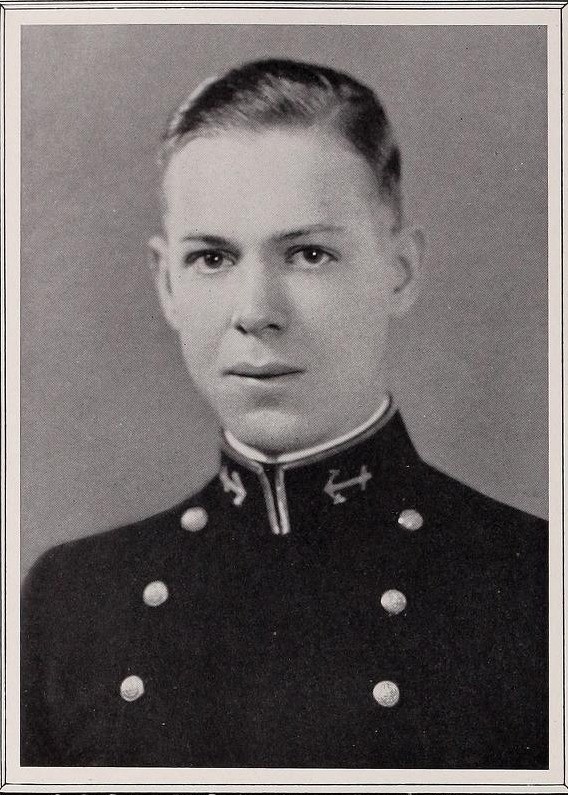
George Kennedy Carmichael was born on 9 October 1906 in Georgia and was appointed to the Naval Academy from North Carolina. The 1929 Lucky Bag gives his home as Charlotte. Nothing in the registers, the yearbook, or the wartime reports consulted here names his parents, a wife, or children.
The Academy knew him as a long, fair-haired midshipman, and his classmates tagged him Frisky, Pokey, and Sleepy. The yearbook sketch is the usual mixture of affection and teasing: good humor when it was not too soon after reveille, a place at the training table, basketball in all four class years with the Navy letter in his second-class year, and football on the B-squad in that same second-class year. Academically the Lucky Bag put him on “the golden middle path,” above any danger of bilging and not much given to showing the effort. That is a classmate’s portrait of a twenty-two-year-old, not a warrant for how he would behave on a sinking ship. It is the only picture of him before the Navy’s lists take over.
He entered the Academy on 16 June 1925. The page of the 1 January 1933 Register of Commissioned and Warrant Officers that carries his birth and his North Carolina appointment is footnoted for commissioning as ensign on 6 June 1929, the date of his class. From there the record is duty and rank, not family.
Formation
By 1 January 1930 the Navy Directory had Ensign Carmichael in Utah. He was still in the battleship on 1 July 1930. On 1 April 1931 the Directory lists him, still an ensign, in Arizona. The next fixed point is a disagreement. The Navy Register of 1 January 1933 places Lieutenant (junior grade) George Kennedy Carmichael in the destroyer Claxton. The Navy Directory of the same date places him in Hamilton. Both are official lists. They cannot both be his station on that morning, and neither explains the transfer. By 1 October 1934, and again on 1 January 1935, the Directory has him in Hamilton, still a lieutenant (junior grade). On 1 October 1935 he is in the oiler Salinas.
The 1933 Register, whatever ship one trusts for New Year’s Day, dates his rank as lieutenant (junior grade) from 6 June 1932, records seven months’ sea service in that rank and four years and two months’ sea service in all, and dates the cruise he was then serving from 15 July 1929. It also shows the two qualifications he would carry into the war: the Naval War College correspondence course in strategy and tactics, and the postgraduate course in communications. He was not an aviator and not a submariner. He was a deck officer who had been taught to handle a staff’s signals.
On 1 January 1937 and 1 April 1937 the Directory has him back at Annapolis as an instructor, still a lieutenant (junior grade). The Register of 1 July 1940 dates his promotion to lieutenant from 30 June 1937, and the Directory of 1 January 1938 already lists him as a lieutenant, still instructing at the Academy. A year later, 1 January 1939, he is lieutenant and radio officer on the staff of Commander, Atlantic Squadron, in New York. He is in the same billet on 1 June 1940. The Register of 1 July 1940 agrees: staff, Commander, Atlantic Squadron.
The 1 November 1940 Directory, which includes orders through 30 October, moves him. He is lieutenant and radio officer on the staff of the Patrol Force, U.S. Fleet, flagship Texas, under Rear Admiral H. Ellis. The staff roster prints the title in full: Patrol Force, and under it “Lt. G. K. Carmichael, radio officer.” Between that autumn and 1 April 1941 the Directory puts him in the cruiser Omaha, still a lieutenant. The communications officer had gone back to sea in a ship, in time for a neutrality patrol that was not yet a war.
War years as lived
On the morning of 6 November 1941, Task Group 3.6 — Omaha, Captain T. E. Chandler, and Somers, Commander J. C. Metzel — was on course for Recife when a darkened ship was sighted just north of the equator, roughly halfway between Brazil and Africa. She flew an American flag, showed “WILLMOTO, PHILADELPHIA” on her stern, and hoisted the international call of that merchantman. She would not answer signals properly. Asked where she was from, she said Capetown; where bound, New Orleans; what cargo, general. Chandler’s report says her appearance did not match Willmoto in the merchant-ship register, and that some of the people on deck did not look American. He sent a boarding party.
Carmichael’s own report, written five days later as Commander Salvage Detail, begins without ornament. At action stations shortly after dawn his captain told him to take an armed guard and board a vessel that had been stopped. She was showing United States colors and the name Willmoto of Philadelphia. With the party named in his appendix he went across. Shortly before they arrived he saw her lower boats. They came up on the starboard side, where two boats were already in the water and sea ladders were rigged. The first officer, in charge on that side, said, “We are sinking; we are a German ship.” Carmichael went aboard and asked for the captain. They said the captain had gone. He rounded up the men still on deck. The first officer, who spoke English with a British accent, said the ship had been blown up and was sinking. Carmichael had the signalman tell Omaha that she was being scuttled, put part of the guard on the crew, and took the first officer and the chief engineer toward the explosions.
Chandler’s report times the boat away at 0637 in about latitude 00°40' North, longitude 28°04' West, and records the hoist “Fox Mike”: “I am sinking. Send boats for passengers and crew.” One paragraph of that report calls the boarding officer George E. Carmichael. The enclosure list, the commendation, and the report Carmichael signed all use George K. or G. K. The initial is a slip in a single sentence.
Explosions were heard aft as the party boarded. Carmichael’s signal back to the cruiser, preserved in the task-group file, was plain: “This is a German ship. Their crew is trying to leave the ship. They say it is sinking aft. I tried to get down there but smoke prevented. I am bringing the crew back aboard.” In the motor room he found cans the first officer called smoke-making devices, a box of what looked like pyrotechnics, and five-gallon cans that smelled of gasoline or benzine. Those went over the side. The gas at the after bulkhead was thick enough that they could not see the damage, only that the motor room was flooding. The Germans said the sea cocks were shut and that the explosions had opened the bottom. The captain came back aboard from his boat and added nothing except that the ship was sinking.
Chandler gave him freedom of action and sent more men than had been asked, including Machinist Waltrip and an engineer’s detail. Carmichael credits Waltrip with closing a watertight door that had been left open to help the flooding, replacing two manhole plates, and shutting a sea suction that was filling the motor room. Shipfitter King went over the side to look for the hole. A shark was swimming there. Pistol shots were fired. King went anyway and found no rupture on the starboard quarter. Carpenter Alton dived later, with the same result. Pumps were started, cargo was shifted, and about four hundred bags of oats and peanuts were thrown off to ease the list and to get at the flooding under the after holds. Carmichael later added that he also jettisoned about seventy-five tires and twenty bales of rubber, partly because he then had very little hope she would stay afloat and thought tires and rubber might be picked up. One of her lifeboats was lost when a hoisting point carried away.
By early afternoon the ship was listing badly and settling. He sent papers and valuables to Omaha. The engines were got into commission. Control of the flooding was lost again around six in the evening and regained by draining a flooded tank into the motor room and pumping from there. Around half past seven she was underway. Chandler’s report has one engine working at 1740 and both engines by 1955, the list down to two and a half degrees, the group making good 9.2 knots, first toward a possible beaching at St. Paul Rocks and then, when she seemed out of immediate danger, for Trinidad rather than a Brazilian port. The task-group commander wrote that Carmichael and the armed boat party and salvage detail “undoubtedly saved the vessel,” boarding while bombs exploded and the German crew abandoned “in evident panic,” with no knowledge of what further charges might still be alight. No one, German or American, was injured.
The engineering narrative enclosed by Lieutenant (junior grade) William B. Wideman is harsher than Carmichael’s own summary about the German engineers. Wideman describes the chief engineer and another engineer as useless, and Second Engineer Wilhelm Seidl as professing ignorance until a pistol was used to make him start a stopped generator and then the starboard main engine. Carmichael’s report says only that the engineers first sent over were not helpful, that he returned them, and that Seidl too was uncommunicative. The pistol is Wideman’s statement, filed with the salvage report, not a sentence Carmichael signed. Seidl’s shipmates later treated him as a traitor for having been the German on board when the engines turned. Chandler recommended he not be confined with them.
The ship was the German motorship Odenwald, out of Japan with a cargo her papers put at 6,223 metric tons, most of it raw rubber, with oats, peanuts, tires, tannic acid, brass, copper, and steel. Her radio had got off a message that she was being overtaken and was scuttling. Carmichael’s second report, dated 12 November, still at sea, describes the passage as continuous pumping, a strange diesel plant traced valve by valve, a guard on the German officer kept aboard, and an abandon-ship bill written for a hull that was still leaking into the shaft alleys. He organized the prize crew under Wideman as executive and engineer, with Weatherwax, Wagenhals, Vance, Boatswain Ferreola, Carpenter Alton, and Machinist Waltrip over the departments. The First Circuit, in Hamburg-American Line v. United States, later found that the sixty-seven men of the prize crew brought Odenwald into San Juan on 17 November 1941, eleven days after the boarding. Chandler’s 12 November report was still discussing Trinidad. The court and the report at sea do not name the same port. What both support is that she did not sink under him.
The United States was not yet at war. Carmichael had forced a crew back aboard a ship they had mined and then kept her afloat through the eleven days the court counted to San Juan, on the chance of a submarine. The 1 July 1945 Register would list him with a special letter of commendation and the commendation ribbon, recorded by 1 May 1945. It does not say the letter was for Odenwald. Chandler had promised separate correspondence. The link is plausible and unproven.
The next three years of his own service are a blank in the registers and directories used here. The Register of 1 July 1942 lists him as a lieutenant commander: temporary rank dated 1 January 1942, permanent rank dated 30 June 1942. The Register of 1 July 1944 indexes him as a commander. It does not give a ship. Where he went after Omaha, and how he came to a new Fletcher-class destroyer, is not in these pages.
Caperton had been commissioned at Boston on 30 July 1943 under Commander W. J. Miller and had already been through the Gilberts, the Marshalls, the Marianas, and the Philippine Sea before Carmichael’s name attaches to her. Compiled command lists — uboat.net and the NavSource roster credited to Wolfgang Hechler and Ron Reeves — date his command from 27 August 1944 to 12 July 1945. No deck log or war diary was in hand to confirm the hour of relief. The Navy’s own citations put him in command by 30 August 1944 and still in command through 26 June 1945. The ship’s association repeats the dates but misprints the start as 27 August 1943 in one heading; Miller’s tour on the same page runs to 27 August 1944, so the 1943 is a slip. The Dictionary of American Naval Fighting Ships never names Carmichael. It does date the ship’s movements. From 30 August 1944 those movements and his citations occupy the same days.
DANFS has Caperton underway from Eniwetok on 30 August 1944 to meet Task Force 38 for the strikes that prepared the return to the Philippines. Palau, Mindanao, the Visayas, and Luzon were hit from the air. Peleliu, Angaur, and Ngesebus were shelled. She replenished at Ulithi and screened the strikes meant to keep the Japanese from using Okinawa and Formosa before the Leyte landings. In the three-day Formosa air battle, Canberra and Houston were torpedoed by aircraft. DANFS says Caperton was assigned to screen the cripples to safety and to guard them while they were used as bait for Japanese surface ships, then, once the cruisers were beyond enemy air range, to rejoin the screen of Task Force 38 for the Battle of Leyte Gulf. Strikes from the carriers of her group, DANFS says, inflicted the final losses on the Japanese Center Force. She went north with the pursuit and made no surface contact.
The Silver Star citation, Commander Third Fleet serial 0124 of 2 December 1944, as transcribed by the Hall of Valor, does not name the two ships. It rewards Commander Carmichael for 13 to 17 October 1944 as commanding officer of Caperton, screening a task group that protected the withdrawal of two severely damaged ships under tow from enemy waters. The ship rescued, transferred men in wind and sea and under air attack, and screened a salvage. The dates and the description match the Canberra–Houston tow. The citation itself does not make the identification; DANFS, for the same ship in that battle, does.
A Legion of Merit with Combat “V,” Commander Second Carrier Task Force serial 0948 of 15 January 1945, covers a longer stretch: 30 August to 11 November 1944, Palau and the Philippine landings, Caperton in a carrier task force. The citation says he fought the ship through more than thirty Japanese air attacks, a bombardment, and a surface engagement, “delivering certain damage to the enemy.” DANFS records the bombardment. It also says the northward pursuit was without surface contact. The citation’s “surface engagement” and the dictionary’s “without making surface contact” are not the same sentence. Both are left standing.
On 4 November, still inside the Legion of Merit dates, DANFS says Reno was torpedoed and Caperton took her injured and other survivors on board. On 18 December the ship weathered the typhoon. DANFS then has her in the strikes on Formosa, Luzon, Camranh Bay, Hong Kong, Canton, and Okinawa, without giving the days. An overhaul on the west coast, yard and dates unstated, came before picket duty off Okinawa through May and June 1945.
The second Silver Star, a Gold Star in lieu of a second award, is Commander Destroyers Pacific serial 04340 of 29 December 1945. It covers 1 to 26 June 1945 at Okinawa, Caperton on radar picket. The citation says he fought the ship through several suicide attacks, that her batteries shot down two planes and helped destroy at least two more, and that the ship’s work contributed to the occupation of the island. It still calls him commander. DANFS, not the citation, adds that she finished that picket tour unscathed, and calls radar picket off Okinawa one of the most dangerous duties of the war. On 29 June 1945 DANFS has her back with Task Force 38 for the last strikes on the home islands. If the compiled relief of 12 July is right, he left in the middle of that final series. The strikes after 12 July, and the occupation duty at Tokyo that followed, belong to the ship’s next commanding officer, not to this narrative. Lieutenant Commander Will P. Starnes is the name the same compiled lists put in his place.
The Register of 1 July 1945, distinctions current through 1 May, lists him among the captains. The running “do” of temporary rank, unbroken on that page from William Howard McClure’s explicit date, is 30 March 1945. His permanent status on the same line is still lieutenant commander from 30 June 1942. The parenthetical letters after his name are the Legion of Merit, the Silver Star, and the commendation ribbon. The second Silver Star, for June, was not yet in the book. The June citation’s use of “commander,” months after the Register’s temporary-captain date, is another unresolved difference of style or of paperwork. He was, on the Navy’s July list, a captain whose permanent rank had not caught up, still qualified in communications and in the War College correspondence course, file number 0-62674 on the Hall of Valor transcription of the citations. The 1944 Register’s index prints a jacket number the OCR reads as something like 32674; the digit that should be 6 is the likely casualty.
Cost
The cost that can be documented is not a wound or a letter home. Chandler recorded no injury on either side at the Odenwald. DANFS recorded Caperton unhit on the Okinawa picket. What the papers do show is the kind of hour he was given.
On 6 November 1941 he climbed a ladder while a crew abandoned a mined ship, was told the charges were finished and the ship was finished, and went into the smoke anyway. He had men search for explosives they could not be sure were all fired. He sent a shipfitter into the water with a shark alongside. He threw cargo overboard, including rubber the war would soon price very high, because he thought the hull was going. He then kept a leaking German diesel at sea with a prize crew that did not know the plant, under orders that treated the remaining German officer as insurance against another bomb. The task-group commander’s praise is specific: determination at the moment of boarding, and then the long work of making a strange, flooded, bombed ship steam. The legal aftermath, in the District Court of Puerto Rico and in the First Circuit, turned on the finding that the German crew had abandoned a ship they had tried to scuttle, and that the boarding party had kept her up. Carmichael’s name is in the district court’s recitation of who had command of the boat.
In October 1944 the work was the other end of salvage. Two cruisers, crippled and under tow, had to be screened out of reach of aircraft, and his destroyer did rescue work and personnel transfer in wind and sea while under air attack. In November Caperton took Reno’s wounded. In December she went through the typhoon. In June 1945 he had the picket station, the exposed ship whose radar the force used and whose loss the suicide planes were trying to buy cheaply. The citation’s count is two planes shot down and at least two more shared. DANFS’s word for the tour is unscathed. Unscathed is not the same as untested. The Register’s medals by May 1945 — Legion of Merit, one Silver Star, commendation ribbon — and the second Silver Star afterward are the Navy’s tally of those months. They are not a diary.
No source found here says what he thought of the Germans he put back aboard, or of the men he took off Reno, or of being promoted on paper while a citation still called him commander. The costly choices that are actually written down are operational: jettison or sink; force the crew back or let them leave a mined ship; stay and pump or abandon the prize; screen the cripples, including the hours when they were bait.
After
He was still a captain on 1 January 1952, 1 January 1956, 1 January 1957, and 1 January 1958. The registers of those years do not, in the entries read here, attach him to a ship or a staff. One postwar paper does have a place and a subject. The Naval History Division’s annotated checklist describes a twenty-page lecture, “The Strategic Employment of Allied Naval Forces in the Pacific During World War II,” given at the Naval War College on 6 March 1950 by Captain George K. Carmichael. The checklist says it covers the strategic background and the execution of the Pacific war. The lecture text was not in hand. It is the only postwar sentence of his that these sources preserve: the communications officer and destroyer captain, five years after Okinawa, talking at Newport about how the fleet had been used.
Caperton’s later life — decommissioning in 1946, Korea, NATO exercises, the Mediterranean — is the ship’s, under other captains. It is not his.
Secondary compilations say he retired on 1 June 1959 as a rear admiral and died in San Diego on 2 October 1967, aged sixty. The Hall of Valor, which prints the citations and the service number, says he retired as a rear admiral and gives the same birth and death dates, with Charlotte as home. No retirement order, no obituary, and no grave record were found in the sources actually read. The Navy Register still lists him as a captain on 1 January 1958. What he left, on the paper that can be checked, is the Odenwald file with his signature, two Silver Stars and a Legion of Merit for Caperton, a commendation the Register does not explain, a War College lecture title, and a class yearbook that remembered a tall midshipman from Charlotte who did not like mornings.