Ships
- USS Pringle (DD-477) Captain from 15 September 1942
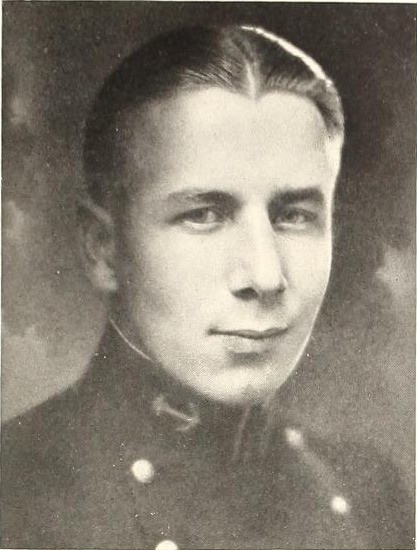
Harold O. Larson was born in Michigan on 23 August 1903. He graduated from the United States Naval Academy in 1925 and spent his career in the surface navy. Men who served with him called him Swede. He was a lieutenant commander by August 1939, and the first years of the Second World War found him already in command at sea.
From 21 January 1941 until 19 June 1942 he commanded the destroyer minesweeper Hamilton in the Atlantic. On 5 April 1942, off Currituck Inlet on the North Carolina coast, Hamilton took aboard twenty-five survivors of the American tanker Byron D. Benson after a German submarine torpedoed and sank her.
His next ship was built for him to take to war. The Charleston Navy Yard laid down Pringle on 31 July 1941 and launched her on 2 May 1942. She was named for Vice Admiral Joel R. P. Pringle, and his daughter sponsored the launch. Pringle was a Fletcher-class destroyer, one of three of that class finished with a catapult and a floatplane. The Navy commissioned her at Charleston on 15 September 1942, and Lieutenant Commander Harold O. Larson became her first commanding officer.
Early in December 1942 he took Pringle from Charleston toward Norfolk for shakedown. Winter weather gave the new crew a hard first cruise. Larson recorded that the passage had been a real trial of a lively, wet destroyer, and that the ship’s company had been badly seasick before the men got their spirits back. After that working-up, Pringle met convoy ON-154 in the mid-Atlantic on 1 January 1943 and escorted the ships bound for Halifax. On that duty she became the first United States destroyer to fly an airplane from a catapult. On 6 February 1943 she sailed for the Pacific.
Pringle arrived off Guadalcanal on 30 May 1943 and began patrols through the Solomon Islands. On the night of 17–18 July she joined Waller and Saufley in an attack on three Japanese destroyers off Vanga Point, Kolombangara. In the same season Larson took her on a mining raid pressed close under Japanese airfields. He told the force that the minelayers were going nearer the enemy than any earlier operation of the kind. Foul weather held Japanese aircraft on the ground, and the group reached the objective unseen. Pringle came into Espiritu Santo with the task group on 2 July 1943, and Larson held a meritorious mast for three crewmen whose work on the raid he wanted recognized.
He stayed in command of Pringle into September 1943. On 20 July 1943 the Navy gave him the temporary rank of captain. George DeMetropolis, who had reported in April as executive officer and navigator, relieved him that September. Larson remained in the Navy and later reached flag rank. As a captain he commanded the heavy cruiser Helena from 26 July to 23 October 1950, in the first months of the Korean War, and for that command he received a Gold Star in lieu of a second Legion of Merit. He retired as a vice admiral. On 5 October 1991 he wrote a letter to a reunion of the men who had served with him in Pringle.