Ships
- USS Claxton (DD-571) Captain, 8 December 1942 – 1943
- USS Richard P. Leary (DD-664) Captain, 31 August 1945 – 2 September 1945
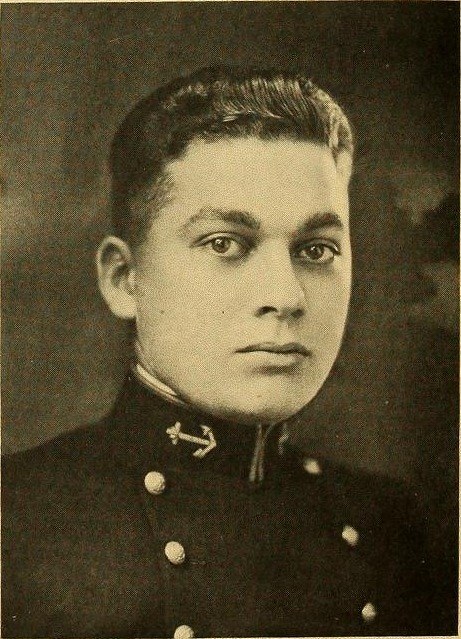
Herald Franklin Stout was born in Dover, Ohio, on 15 June 1903, the son of Franklin Lee Stout and Jemima Mae Tong Stout. He led his class at Roosevelt High School in Dover and in 1922 entered the United States Naval Academy on an appointment from Ohio. He graduated on 3 June 1926, was commissioned an ensign the same day, and married Louise Frederica Finley, whom he had known at home. They had three sons, Herald Jr., Bruce, and Peter.
His first ship was the light cruiser Cincinnati. From graduation until June 1931 he worked in her engineering division, in communications and radio, as ship’s secretary, and in a gun division. As a lieutenant he then served about a year as torpedo and communications officer in the destroyer Breckinridge. From June 1932 to April 1933 he was torpedo officer and first lieutenant of the destroyer Hatfield.
On 9 November 1940 he took command of the destroyer minelayer Breese and stayed in her until 20 September 1942, advancing from lieutenant to lieutenant commander during the tour. He was ordered next to a new Fletcher-class destroyer. On 8 December 1942, at Orange, Texas, he became the first commanding officer of Claxton (DD-571). Through the early months of 1943 the ship worked up, patrolled in Casco Bay while the fleet watched for a possible sortie by the German battleship Tirpitz, and took one convoy escort as far as Casablanca. The crew’s catchphrase under Stout was Click with the Claxton, and dice were painted on the bridge wings. She left Charleston on 17 May 1943 for the Pacific and joined Destroyer Squadron 23, the Little Beavers.
In the Solomons Claxton hunted Japanese shipping, screened troops and transports, shelled shore targets, and covered landings. On the night of 31 October–1 November 1943 she joined the first bombardment of the airfields at Buka and Bonis and of the Shortland Islands, service for which Stout received the Silver Star. On the night of 1–2 November, off Empress Augusta Bay, he took her into the fight with a cruiser and destroyer force that met a Japanese squadron steaming to strike the transports off the new Bougainville beachhead. The American ships turned that attack back and inflicted heavy loss, and Stout’s handling of Claxton brought him the Navy Cross. A second Navy Cross followed for his command of the ship in the Bougainville fighting that November. On 25 November 1943 Claxton was one of the destroyers in the squadron’s night interception off Cape St. George, where the Japanese ships lost went down in the combined attack. Claxton and the rest of Destroyer Squadron 23 received the Presidential Unit Citation for the Solomons campaign. Maxim William Firth was among the officers who later commanded her.
By December 1944 Stout was commander of Destroyer Division 10, holding the temporary rank of captain. On 7 December, at Ormoc Bay on Leyte, he directed ships that bombarded in support of the landing force, screened the assault area, and handled fighter direction. A second Silver Star followed. He returned to a ship’s bridge for a short tour at the end of the war. From 31 August to 2 September 1945 he was commanding officer of the destroyer Richard P. Leary (DD-664).
After the war he commanded the destroyer tender Sierra. In January 1952, during the Korean War, he commanded Mine Squadron 3, the Western Pacific minesweeping force, and Task Group 95.6 in the combat zone. His decorations also included the Navy Distinguished Service Medal. He retired in 1956 as a rear admiral.
Stout died in San Diego on 23 March 1987 and was buried at Dover Burial Park in his hometown. The guided-missile destroyer Stout (DDG-55), commissioned in 1994, was named for him.