Ships
- USS Heywood (AP-12) In command, 7 August 1942
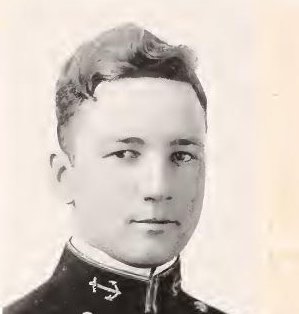
Herbert Bain Knowles was born in North Newburgh, Maine, on 20 March 1894. He entered the Naval Academy at Annapolis in 1913, graduated with the class of 1917, and was commissioned an ensign that year. In the First World War he served in the battleship Arkansas and joined the submarine force. He married Helen Kamp in 1919.
His first command was the submarine S-9, which he received in 1922. Through the mid-1920s his duty still mixed that battleship with submarines, and on 14 November 1926 he became commanding officer of S-37. From 1928 to 1940 he went on serving in submarines and in surface ships, held a tour in the Bureau of Engineering, and finished as operations officer of the Fourteenth Naval District in Hawaii.
On 17 December 1941 Knowles took command of the transport Heywood (AP-12). She had been built in 1919 as the freighter Steadfast, had sailed for years as the passenger liner City of Baltimore, and had been commissioned at Portland, Oregon, in November 1940. In April 1942 he brought her out of the Atlantic. After a stop on the California coast she went to Wellington, New Zealand, took Marines aboard, and trained them for a landing. On 7 August 1942, with Knowles in command, Heywood put those Marines ashore at Tulagi and Guadalcanal.
The ship spent the rest of 1942 on the Guadalcanal run. She loaded in the New Hebrides, New Caledonia, and Australia, put reinforcements ashore under repeated air attack, and carried wounded Americans and Japanese prisoners on the way out. On 8 August, the morning after the first landing, she shot down a Japanese plane. The Navy promoted Knowles to captain in 1942 while he still had Heywood. In January 1943 she reached San Pedro for repairs, and on 1 February she was reclassified as an attack transport, APA-6.
Heywood sailed north that April. Fog covered Attu on 11 May 1943 when her boats took soldiers in toward Massacre Bay, and Knowles worked the ship through the landing. He received the Legion of Merit for the way he handled her there, one of five awards of that decoration in the war. On 6 June the transport reached San Francisco with nearly 500 wounded. In August she landed occupation troops on Kiska, where the Japanese garrison had already withdrawn. Knowles left Heywood on 13 October 1943.
His next duty placed him over a group of transports. At Tarawa in November 1943 he commanded the transport group of the Southern Attack Force and, inside that group, Transport Division 18. The ships carried the 2d Marine Division to Betio. Through 1944 and 1945 he commanded Transport Division 18, Transport Squadron 12, and Transport Division 34 as the advance moved on to Kwajalein, Saipan, Guam, Leyte, Lingayen Gulf, Okinawa, and Nagasaki. He put close attention into the details of getting assault troops ashore, and later landings used methods he had pressed in his orders and reports.
From 1945 to 1946 he was assistant chief of staff for operations in the First Naval District at Boston. Promotion to rear admiral came with his retirement in 1947. In Maine he joined the board of the National Investigations Committee on Aerial Phenomena and said publicly that unidentified flying objects were real. From his home in Eliot he helped his neighbor Frances Swan send her claims of contact with such craft to the Navy in 1954, and he tried to arrange a meeting between her and Betty and Barney Hill. Knowles died on 3 March 1976 at the Maine Medical Center in Portland, at the age of 81. Helen Knowles survived him, together with a daughter, a brother, and two sisters.