Ships
- USS West Virginia (BB-48) Captain from 15 January 1944 · Relieved on 2 May 1945
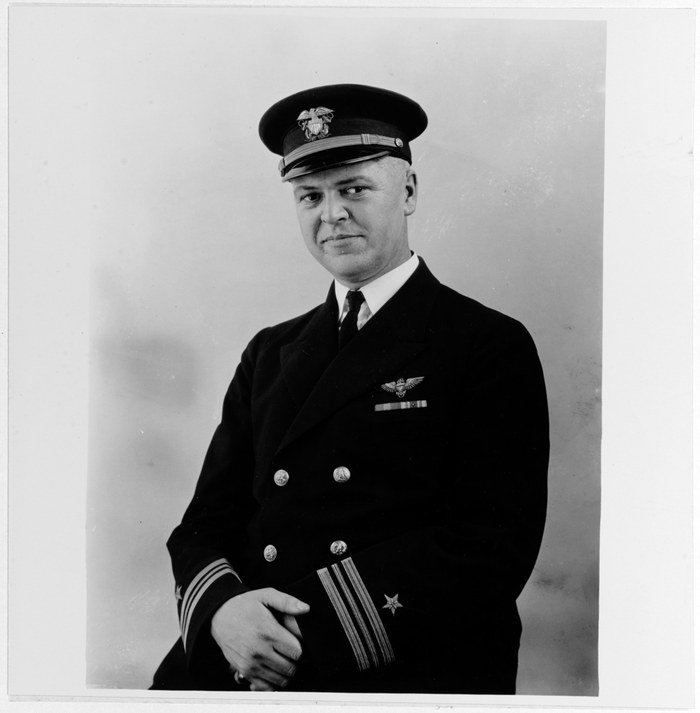
Herbert Victor Wiley was born in Wheeling, Missouri, on 16 May 1891. He entered the U.S. Naval Academy in 1911, graduated with the Class of 1915, and was commissioned an ensign that June. In the First World War he served in the destroyer Wickes on Atlantic escort duty.
After the war he moved into lighter-than-air aviation and was designated a naval aviator in that specialty on 5 February 1925. He served in the rigid airship Shenandoah and later in Los Angeles, which he commanded from May 1929 to April 1930. On 4 April 1933 he was executive officer of Akron when the airship was lost in a storm off Barnegat Light, New Jersey. Wiley lived through the crash and was the only officer among the survivors.
In June 1934 he took command of Macon, sister ship of Akron. Macon went down off the California coast in February 1935. Two of her crew were killed, and Wiley was picked up with the others. The Navy then ended its rigid-airship program. He returned to surface ships, with duty in the battleship Mississippi and, from 1938, at the Naval Academy. He was promoted to commander on 1 November 1935 and to captain on 1 July 1941.
At the start of the Pacific war, Captain Wiley commanded Destroyer Squadron 29 of the Asiatic Fleet, with his flag in the destroyer Paul Jones. The squadron fought through the opening campaign in the Netherlands East Indies, including the Battle of Makassar Strait and the Battle of the Java Sea, and reached Australia in 1942.
On 15 January 1944 he assumed command of the battleship West Virginia (BB-48). The ship had been sunk at Pearl Harbor on 7 December 1941, then raised and rebuilt on the West Coast with modern fire control. Under Wiley she rejoined the fleet for the drive across the Pacific.
In October 1944 West Virginia supported the landings on Leyte. On the night of 24–25 October, in the Battle of Surigao Strait, she lay in the American battle line that met a Japanese force bound for Leyte Gulf. Her new radar let her open the battleship gunfire, and her 16-inch battery kept up a rapid, accurate fire on the enemy column while the American ships destroyed that force. Wiley received the Navy Cross for his handling of the ship and for the gunnery he had trained into the crew. He also received the Legion of Merit for his command from 17 October 1944 to 2 May 1945, a span that covered the Philippines campaign and the bombardment of Iwo Jima.
In the spring of 1945 West Virginia went to Okinawa. A kamikaze hit her on 1 April. She stayed on station and continued to cover the troops ashore. Wiley remained on the bridge through about thirty days and nights of the campaign and received the Bronze Star for his service off Okinawa from 25 March to 20 April 1945. He was relieved as commanding officer on 2 May 1945. Promoted to rear admiral, he next commanded a naval facility at Trinidad. A heart attack there brought his active career to a close. He died in Pasadena, California, on 28 April 1954, and was buried at Golden Gate National Cemetery.