Ships
- USS Nevada (BB-36) Captain from 25 August 1942 · Relieved on 25 January 1943
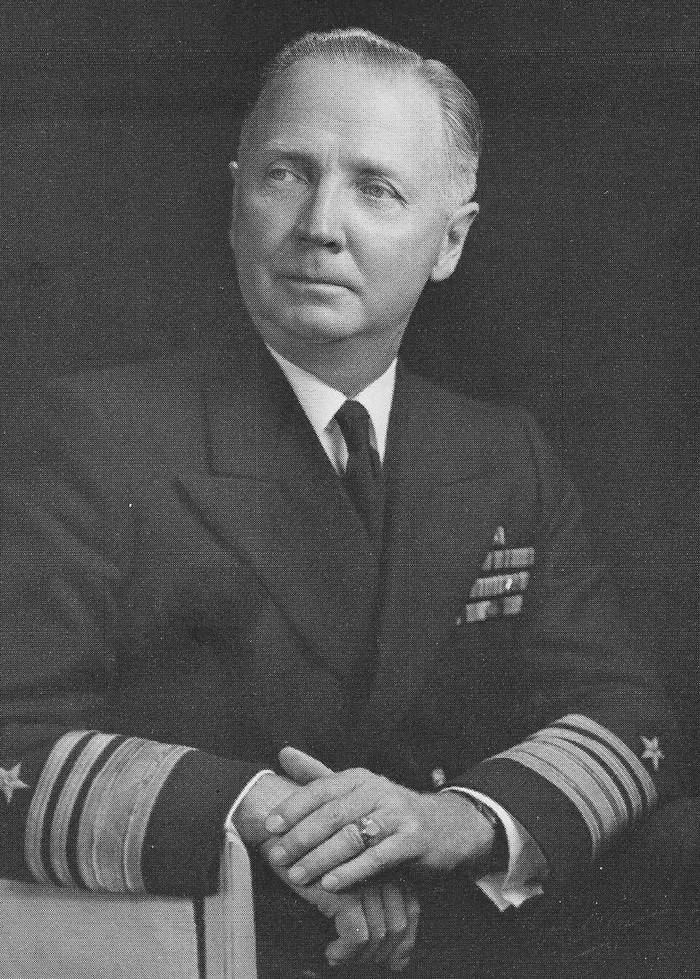
Howard Fithian Kingman was born on 5 May 1890 in Hillsboro, North Dakota. His grandfather was Rear Admiral Edwin Fithian, who had sailed to Japan with Commodore Perry's expedition. Kingman graduated from the United States Naval Academy with the class of 1911 and was commissioned in the Navy that year. In the First World War he served in the battleship New York while she operated with the British Grand Fleet, service marked by the Victory Medal with Grand Fleet clasp. He also served in the destroyer tender Black Hawk on the Asiatic Station and received the China Service Medal.
In 1933, while a commander, he chaired a Navy committee concerned with radio intercept and radio intelligence. He later became a captain and commanded Destroyer Squadron 29. When the war with Japan began, he was on duty in the Office of the Chief of Naval Operations, working in naval intelligence.
On 25 August 1942 Kingman took command of the battleship Nevada (BB-36) as captain. Salvage crews had raised the ship after the attack on Pearl Harbor, and during his months aboard she lay on the West Coast, under repair and modernization for a return to the fleet. He was relieved on 25 January 1943.
He next commanded Battleship Division 2 in the Pacific. The division's ships supported the assaults on Attu, Tarawa, Roi-Namur, Kwajalein, Eniwetok, Saipan, Tinian, Guam, and Angaur. At Tarawa he also led the gunfire support group of battleships, cruisers, and destroyers. Before the landing he told his commanders, "It is not our intention to wreck the island. We do not intend to destroy it. Gentlemen, we will obliterate it." The bombardment put many of the heaviest coastal guns out of action, broke the defenders' communications, and killed the Japanese commander. A large part of the garrison lived through the shelling in covered positions, and the Marines who landed fought a short, very costly battle for the island. Admiral Chester W. Nimitz commended Kingman for his handling of the ships there.
Kingman received the Legion of Merit for commanding a fire-support section at Roi, Namur, Kwajalein, and Eniwetok. A Gold Star in lieu of a second Legion of Merit followed for his command of a bombardment group from 14 June to 1 August 1944, during the capture of islands in the Marianas. He was a rear admiral during those operations.
On 3 November 1944 he became Commandant of the Fifteenth Naval District at Balboa, in the Canal Zone, and at the same time commanded the Panama Sea Frontier and the Southeast Pacific Force. He held those duties until August 1945. A Gold Star in lieu of a third Legion of Merit recognized that service, during which shipping continued to pass from ocean to ocean in the last year of the war.
In August 1945 he assumed command of Battleship Division 9. On 22 November 1945, after the Japanese surrender, he relieved Admiral William F. Halsey, Jr., as Commander, Third Fleet, and hoisted his flag in South Dakota in the harbor at San Pedro, California. He left the Third Fleet on 30 November 1946 and retired on 1 February 1947 as a vice admiral. Besides the Legion of Merit with two Gold Stars and the commendation for Tarawa, his decorations included the American Defense Service Medal with Fleet clasp, the American Campaign Medal, the Asiatic-Pacific Campaign Medal, and the World War II Victory Medal. Venezuela awarded him the Order of the Liberator in the grade of Official, and Ecuador awarded him the Abdon Calderón decoration, first class.
On 7 April 1947 he married Adelaide Bledsoe Cormack. Kingman died in Los Angeles on 4 July 1968, at the age of 78, after a long illness. A service was held at All Saints Episcopal Church in Beverly Hills, and he was buried with full military honors at Arlington National Cemetery.