Ships
- HMS Indomitable (92) Captain from 30 January 1944 · Relieved on 28 December 1945
John Arthur Symons Eccles was born in Marylebone, London, on 20 June 1898. He joined the Royal Navy on 15 September 1916 as a special-entry cadet and was promoted midshipman on 31 March 1917. His first ship was the battlecruiser Indomitable, serving with the Second Battle Cruiser Squadron at Rosyth alongside Australia, Inflexible and New Zealand. The squadron patrolled the North Sea and covered minelayers working to close the routes U-boats used into the Atlantic. The duty was hard and repetitive. He was promoted sub-lieutenant in 1918 and spent the second half of that year on courses in seamanship, navigation, torpedo and gunnery.
In late March 1919 he joined the newly commissioned destroyer Wallace and remained until April 1920, qualifying as an officer of the watch. His captains found him keen and reliable. He was then chosen for study at Cambridge, where he showed a gift for languages, and he was promoted lieutenant in May 1920. Navigation training at Dryad followed, and in January 1921 he joined the battleship Revenge in the Atlantic Fleet, where he was judged a competent watchkeeper and a capable leader. Late in 1921 he went to the School of Oriental Studies in London to learn Japanese, with part of the course spent in Japan. He was in Tokyo on 1 September 1923 when the earthquake destroyed much of the capital and Yokohama and killed more than 100,000 people. The Foreign Office later commended him for his help to the British Embassy after the disaster.
After the language course he trained in intelligence and, during 1924, at the Government Code and Cypher School. From April 1925 to December 1926 he served in the battleship Benbow, first with the Mediterranean Fleet and from March 1926 with the Atlantic Fleet. In 1927 he joined the China Station in the heavy cruiser Hawkins, flagship of the Fifth Light Cruiser Squadron, for interpreting, intelligence and code work. Promoted lieutenant-commander on 15 May 1928, he transferred in August to Kent when that ship became the flagship. He came home late in 1930, served briefly in the battleship Valiant, and took the staff course at Greenwich in 1931. In 1932 the Admiralty employed him on special duties as a Japanese interpreter. Over the next six years he alternated between the Naval Intelligence Division and service on the East Indies Station in Hawkins, in 1932 and 1933, and on the China Station in Kent, in 1934 and 1935, and Cumberland, in 1936 and 1937. Much of the time in Asia was spent ashore, on wireless telegraphy, with the Foreign Office staff in Peking, and on further language study in Japan. He was promoted commander in December 1933.
In January 1938 he became executive officer of the aircraft carrier Ark Royal, then with the Home Fleet. After the declaration of war on 3 September 1939 she sailed for the Western Approaches to search for U-boats. On 14 September her escort destroyed U-39 after the submarine attacked the carrier. On 26 September German aircraft came close enough for Berlin to claim that Ark Royal had been sunk. From October to December she operated in the South Atlantic with Force K in the hunt for the pocket battleship Graf Spee. The German ship was scuttled by her own crew off Montevideo on 18 December, and Ark Royal returned to Scapa Flow. Eccles was promoted captain on 31 December 1939. In the spring of 1940 he was given command of the light cruiser Durban, which escorted convoys in the Indian Ocean and searched for German merchant ships and raiders, then worked from Singapore on patrol and escort duty in Southeast Asian waters. He left Durban in October 1941 and returned home as Director of the Operations Division (Home) at the Admiralty, holding that post into the opening days of 1944.
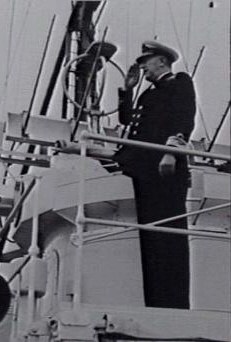
On 30 January 1944 he took command of the fleet carrier Indomitable. She was completing repairs in the United States for the torpedo damage received in July 1943, ahead of the invasion of Sicily. In the spring of 1944 Eccles carried out gunnery, radar and flying trials off Chesapeake Bay, and in July Indomitable joined the Eastern Fleet at Colombo. With Victorious she launched air attacks on Sumatra in August during Operation Banquet, and on 17 September struck the railway yards at Sigli in Operation Light. Between 17 and 19 October the carriers attacked Japanese positions in the Nicobar Islands. On 20 December, in company with Illustrious, Indomitable sent her aircraft against Medan in Operation Robson. A flag officer flew his flag in the ship for long stretches of this commission, and Eccles commanded her under that flag.
In January 1945 Indomitable was serving with the British Pacific Fleet. On 4 January, in Operation Lentil, her aircraft joined those of Victorious and Indefatigable against the oil installations at Pangkalan Brandan in Sumatra. Later that month Operation Meridian took the force against the refineries at Pladjoe and Sungai Gerong, near Palembang. The fleet then moved into the North Pacific to operate with the United States Navy. On 4 May, during Operation Iceberg off Okinawa, a kamikaze struck Indomitable. The armoured flight deck limited the damage, and she remained at sea and in action. After the Japanese surrender the carrier took part in the return to Hong Kong, and she reached the United Kingdom in November 1945. Eccles was appointed a Commander of the Order of the British Empire on 1 May 1945 for his service in Meridian, and he was mentioned in dispatches on 23 October 1945 for Iceberg. He was relieved in command of Indomitable on 28 December 1945.
Early in 1946 he was promoted commodore second class and appointed chief of staff to the Commander-in-Chief at Portsmouth. He reverted to captain in 1947 to attend the Imperial Defence College. In 1948 he was again a commodore second class, commanding the Royal Naval Barracks at Chatham. Promoted rear-admiral on 8 January 1949, he became Flag Officer Commanding the Australian Fleet on 5 October 1949, as the Royal Australian Navy was learning to operate its first aircraft carrier, Sydney. He was often at sea with the fleet. In April and May 1950 he visited Australian ships in Japan serving with the British Commonwealth Occupation Force, and after the Korean War began in June he directed the training that sent destroyers and frigates to the war and held the rest of the fleet to the same standard. Sydney sailed for Korean waters in August 1951 after a work-up carried out under his eye. He was made a Companion of the Order of the Bath in the 1951 New Year honours, handed the Australian Fleet to Rear-Admiral John Eaton on 10 October 1951, and returned home.
He was promoted vice-admiral on 22 April 1952 and that year became Admiral Commanding Reserves. In 1953 he was Flag Officer Air (Home), and on 16 July 1953 he was appointed a Knight Commander of the Royal Victorian Order. The 1955 New Year honours made him a Knight Commander of the Order of the Bath. Promoted admiral on 1 December 1955, he became Commander-in-Chief of the Home Fleet, the appointment that also carried NATO command in the eastern Atlantic. He was advanced to Knight Grand Cross of the Order of the Bath in the 1958 New Year honours and retired on 28 February 1958. Admiral Sir John Arthur Symons Eccles died at Winchester, Hampshire, on 1 March 1966. His wife Madeline and his son Jonathan survived him.