Ships
- USS Pittsburgh (CA-72) Captain from 10 October 1944
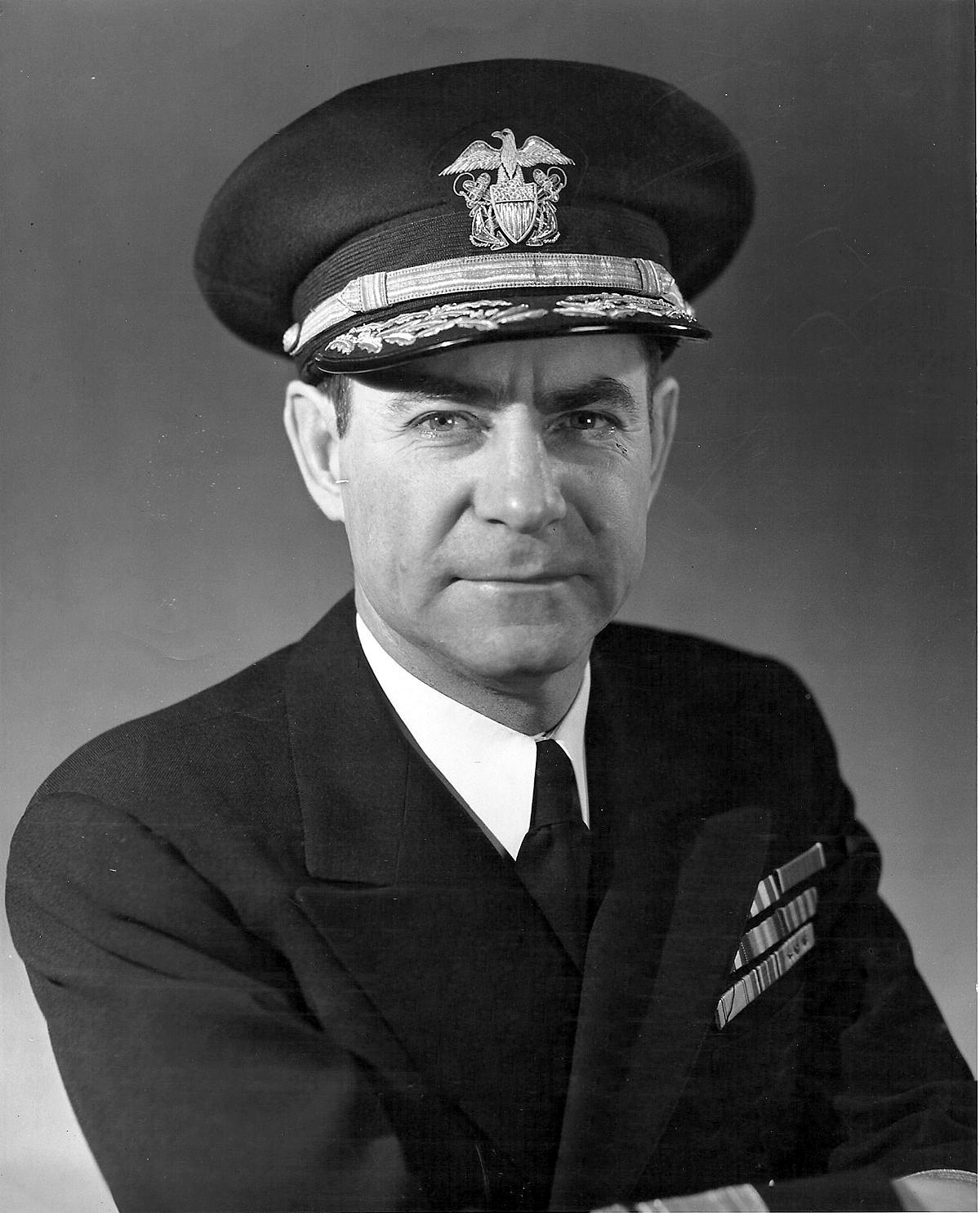
John Edward Gingrich was born in Dodge City, Kansas, on 23 February 1897, the son of Edward G. and Bertha Allen Gingrich. He attended the University of Kansas and in 1916 was appointed to the Naval Academy from Kansas. He graduated with the Class of 1920 and was commissioned an ensign on 7 June 1919, one of the classes hurried through during the World War.
His first duty was in the battleship Pennsylvania, flagship of the Atlantic Fleet. From January 1920 until July 1921 he served as assistant communications officer on the fleet commander's staff while still attached to that ship. He then went to the battleship Maryland, where he remained until June 1925, and spent the next two years teaching navigation at Annapolis. In May 1927 he joined the cruiser Rochester as gunnery officer, serving until July 1930, and from that period he wore the Second Nicaraguan Campaign Medal. He afterward was assigned to the Naval Reserve Officers' Training Corps unit at Northwestern University.
His first command was the fleet tug Algorma, from June 1932 to April 1934. He next served in the cruiser Indianapolis, then ashore in the Hydrographic Office in Washington. At sea again, he was aide and flag secretary to the commander of Battleship Division 3 in the battleship Idaho, and he finished that tour as navigator of the battleship New Mexico. In August 1940 he returned to the Navy Department as aide to Under Secretary James Forrestal, and from May to July 1944 he was aide to the Secretary of the Navy. A secretarial letter of commendation praised his work on material, logistics, and discipline while the Navy was expanding for war.
He left Washington to fit out a new heavy cruiser. Pittsburgh (CA-72), a Baltimore-class ship laid down at Quincy, Massachusetts, as Albany, was commissioned at Boston on 10 October 1944 with Captain John E. Gingrich in command. She trained on the East Coast and in the Caribbean, sailed from Boston on 13 January 1945, and after the Panama Canal and gunnery practice in Hawaiian waters joined the fast carrier force in the western Pacific. In the screen of the carrier Lexington she took part in the February strikes on airfields near Tokyo and in the air support flown for the Marines on Iwo Jima.
On the morning of 19 March 1945, off the southern coast of Honshu, a Japanese air raid left the carrier Franklin ablaze and without power. Pittsburgh ran in at high speed, took 34 men from the water, and with the light cruiser Santa Fe passed a towline to the burning ship while Japanese aircraft were still trying to finish her. Gingrich kept his guns in action against those attacks and remained at the conn for forty-eight hours. At noon on 20 March Franklin cast off the tow and went on under her own power. He received the Silver Star for that rescue.
From 23 March through 27 April, Pittsburgh guarded the carriers that prepared the Okinawa landings and then covered the troops ashore. She drove off air attacks and sent her scout planes out for downed carrier pilots. After replenishing, the force sailed again on 8 May against the Nansei Shoto and southern Japan. The Legion of Merit with Combat V recognized his command in the Kyushu-Okinawa fighting, and a Gold Star in place of a second Legion of Merit covered sustained operations from 23 March to 25 May 1945, including Okinawa and the carrier raids on Tokyo, southern Japan, and Japanese fleet units in the Inland Sea.
Early in June the same force ran into a typhoon. On 5 June, in winds near 70 knots, the sea tore Pittsburgh's bow away for 104 feet and left the section tossing ahead of her. No one was lost. Gingrich reversed the engines to pull clear of the drifting wreckage, held the ship to the seas while the crew shored the open forward bulkhead, and brought her into Guam on 10 June. Sailors nicknamed the lost bow McKeesport. It was later salvaged and towed in. Fitted with a temporary bow, Pittsburgh left Guam on 24 June and reached the Puget Sound Navy Yard on 16 July, still under repair when the war ended. Gingrich was relieved on 3 September 1945. When the cruiser was recommissioned on 25 September 1951, Preston Vigginius Mercer was her commanding officer.
After a short tour as chief of staff to the commander of the Second Carrier Task Force, he reported on 24 October 1945 to the Bureau of Naval Personnel to set up the postwar personnel program. On 7 December he became Assistant Chief of Naval Personnel for the reserves, and in August 1946 Assistant Chief of Naval Operations and Director of the Naval Reserve. Ordered on 18 August 1947 to duty with the Atomic Energy Commission, he served as the first director of its Division of Security and Intelligence. In July 1949 he became chief of staff to the Commander in Chief of the Pacific Fleet.
In October 1951 he took command of the Pacific Fleet Training Command. From 31 May 1952 to 12 February 1953 he commanded the United Nations blockading and escort force off Korea, directing ships of the Republic of Korea and of Britain, Canada, Australia, New Zealand, the Netherlands, Thailand, and Colombia. He was often under fire while visiting the islands his ships held. The Navy Distinguished Service Medal followed. He reported in February 1953 as Deputy Chief of Naval Operations for Administration, was promoted to vice admiral on 30 July 1953, and on 1 August became Chief of Naval Material. He retired on 1 October 1954 and was advanced to admiral on the retired list on the basis of his combat awards. He then served as a vice president of the International Telephone and Telegraph Corporation. He died at his home in New York on 26 May 1960 and was buried at Arlington National Cemetery.