Ships
- USS Shangri-La (CV-38) Flag, not her captain, from 18 May 1945
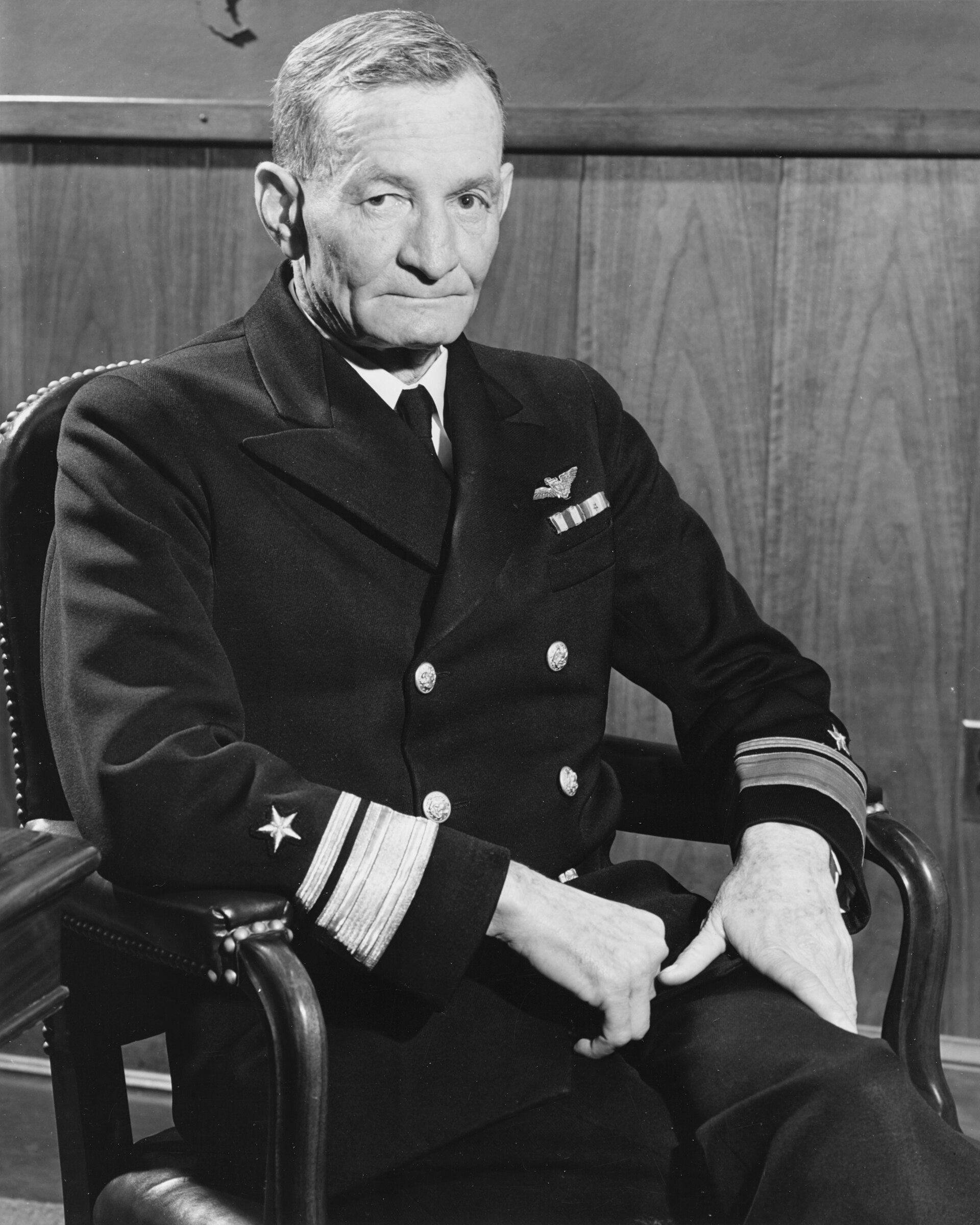
John Sidney McCain was born on 9 August 1884 at Teoc, in Carroll County, Mississippi. After a year at the University of Mississippi he entered the Naval Academy and graduated with the class of 1906. He is the Vice Admiral John Sidney McCain of the Pacific carrier war, the father of submarine commander John S. McCain Jr. and the grandfather of the later senator and naval aviator of the same name. Officers called him Slew. His early duty was in surface ships, including Atlantic convoys in the First World War, and his first command was the cargo ship Sirius.
In 1936, already a captain past fifty, he learned to fly so that he could take an aviation command. He commanded the carrier Ranger from 1937 to 1939, in the years when the Navy was still building the carrier tactics the war would use. He was promoted to rear admiral in 1941. In May 1942 he was given command of Aircraft, South Pacific, and through the Guadalcanal campaign he directed the Navy's land-based aircraft in the Solomons, including the planes at Henderson Field. That air effort helped hold the island. The night defeat off Savo Island brought him hard criticism over air searches that were not flown, yet Admiral Ernest J. King kept him in the job. In October 1942 he went to Washington as chief of the Bureau of Aeronautics. In August 1943 he became a vice admiral and Deputy Chief of Naval Operations for Air.
He returned to the Pacific in the summer of 1944 and took a carrier group with the fast carriers, the duty he held with those ships in the last year of the war. Off Formosa in mid-October, after Japanese aircraft torpedoed the cruisers Canberra and Houston, he placed his group between the damaged ships and further attack. Both cruisers were brought clear, and the Navy awarded him the Navy Cross for those days. At Leyte Gulf he was still a group commander. He sent his planes a very long distance against the Japanese force that had come out through San Bernardino Strait. The attack did little damage. It reinforced a retirement that the Japanese commander was already weighing. The carrier he used as his flagship in that battle was a different ship. His flag did not go up in Shangri-La until the following May.
From the end of October 1944 he and Vice Admiral Marc Mitscher alternated command of the fast carriers. McCain had them when Admiral William F. Halsey's Third Fleet was at sea and the force was numbered Task Force 38. In that stretch his aircraft struck targets in the Philippines and, in January 1945, harbors and shipping along the Indochina coast in the South China Sea. On 18 December 1944 a typhoon overtook Task Force 38. Three destroyers sank, and nearly eight hundred men were lost. The decision to keep the fleet in the path of the storm was examined afterward.
The landings on Okinawa opened on 1 April 1945, with the fast carriers then under Mitscher as Task Force 58. McCain is not placed in command of that fight. On 18 May 1945, at Ulithi, he broke his flag in Shangri-La (CV-38). Her captain was James Duke Barner. McCain was not her captain. On 28 May he relieved Mitscher as commander of Task Force 38, and Shangri-La stayed his flagship as Halsey's Third Fleet took the carriers back. In the first days of June the force struck Kyushu. Another typhoon then met the ships south of Japan.
From 10 July to 15 August 1945 he kept Task Force 38 against the Japanese home islands, with his flag still in Shangri-La. His staff worked out searches for aircraft dispersed and hidden on the ground, and the raids destroyed them by the thousand. By late July the major Japanese warships still afloat had been sunk or crippled. During those weeks enemy air attack damaged one destroyer in the force. On 2 July, on the flight deck of Shangri-La, John L. Sullivan took the oath as Assistant Secretary of the Navy for Air, with McCain and Captain Barner present. On 16 July Richard Francis Whitehead became captain of Shangri-La. The flag remained in the ship, and command of the ship itself remained the captain's. On the morning of 15 August, strike planes were already outbound for airfields around Tokyo when Japan’s surrender was announced and the attacks were recalled.
The last year had left him dangerously thin, down to about a hundred pounds, and he asked to go home. Halsey wanted him present for the surrender. On 2 September 1945 he stood aboard Missouri in Tokyo Bay and saw his son, Commander John S. McCain Jr., for the last time. He flew back to California at once. On 6 September, at Coronado, he died of a heart attack on the day he arrived. He was buried in Arlington National Cemetery and was later advanced to the rank of admiral. For his carrier commands he also received the Distinguished Service Medal.