Ships
- USS Hall (DD-583) Captain, 19 May 1944 – 31 May 1945
Compiled lists give him USS Hall (DD-583) from 19 May 1944 to 31 May 1945.
The name on the list is the name the Navy’s own registers use. The 1926–27, 1928–29, and 1929–30 Annual Registers of the Naval Academy print “Baldauf, Laurence Charles,” appointed from Pennsylvania. The Register of Graduates for 1941 prints the same three names. The Navy Registers of 1941, 1944, 1947, 1950, 1958, 1959, and 1960 do too, once the OCR is allowed to put the broken letters back together, and they tie him to file number 62633, later printed 062633. The classmates’ yearbook does not. The 1929 Lucky Bag heads his page “LAWRENCE CHARLES BALDAUF.” That is a real difference, visible on the page, not an OCR slip. The spelling used here follows the registers, not the yearbook.
“Captain” on the command line is the old word for the officer in command, and it is also, later, his rank. It was not his rank for most of the year the lists give him. On 1 July 1944 the Navy Register’s index lists “Baldauf, Laurence C.,” commander, file 62633. The Silver Star written for Okinawa still calls him commander. A temporary captain’s date, 30 March 1945, falls inside the Hall tour the compilations give him, not before it. He did become a captain in the lineal sense, and on 1 January 1960 the Register lists him a retired rear admiral.
The dates 19 May 1944 and 31 May 1945 are not in the Dictionary of American Naval Fighting Ships, and they were not read off a deck log for this essay. They are the dates printed by uboat.net and by NavSource, which credit the same sort of compiled command list. What the citation does prove is narrower and better: he was commanding officer of Hall from at least 25 March through 28 May 1945. DANFS names the commissioning captain, J. F. Delaney, and then never names another. The ship’s famous first year in the Pacific — the Iowa crossing with Roosevelt, the Marshalls, the sailor killed off Wotje on 4 April 1944 — sits before the compiled relief, under Delaney. The rescue of Twiggs’s survivors on 16 June 1945 sits after it. Those months are left with the ship.
He is not Carl W. Baldauf, the ensign and later lieutenant commander whose file number in the same registers is 198068.
Origins
The registers are blunt about the day and almost silent about the house. On 1 January 1947, in the captains’ section, the birth column on his line reads 10, 15, 05. The same three numbers are there on 1 January 1950 and on 1 January 1958: 15 October 1905. They do not print a town beside them.
The Academy does. He was admitted 16 June 1925, appointed from Pennsylvania, and the third-class merit roll in the 1926–27 Annual Register gives his age at admission as 19 years and 8 months. Counted back from 16 June 1925, that age lands on 15 October 1905, which is the birth date the later Registers print. The Lucky Bag heads the sketch “Reynoldsville, Pennsylvania,” and the classmates say the high school there was his. Hometown and appointing state are what those books are for. They are not a birth certificate. Uboat.net and the Military Times Hall of Valor both state the birthplace as Reynoldsville and the death as Glendora, California, on 13 May 1986. The birth date matches the Registers. The city of birth, beyond the yearbook’s “native” high school, and the death were not confirmed by an obituary or a cemetery record found for this essay.
No source read here names a parent, a wife, or a brother or sister.
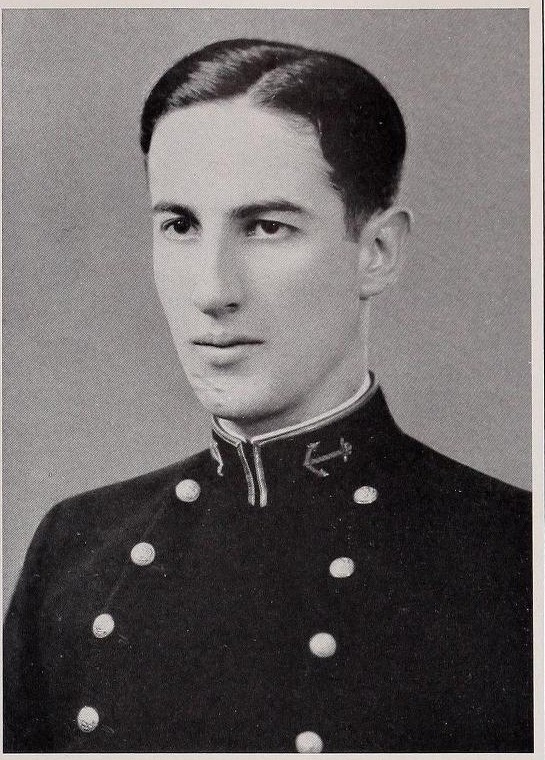
The yearbook is the only picture of him before the Navy had him, and it should be read as his classmates talking. They called him Larry and Baldy. “Out of the sky, down from the mountains, before the winds, came the silhouette of this Quaker teuton from Bucknell University.” The “Quaker” and the “teuton” are their words. Nothing in the registers makes either one a genealogy or a church. What the sentence does claim, and what can be kept, is that he came to Annapolis after preparation at Bucknell, and that the preparation followed the high school in Reynoldsville. The yearbook does not say he took a degree there. It says the preparation “placed him in commanding stead” for the Academy’s courses, that his opinions were “fast and accurate,” and that he had arrived believing everyone who entered was of “the intelligentsia,” then found, “very pleasantly alarmed,” that he could describe, study, and reason more readily than “the many who compromise the majority.” The rest is flourish: “Strange experiences and adventures have a dart-like attraction for his daring eyes,” and a hope that the paragraph might someday soothe “the thoughts of some dismal day’s labor.” They were not writing a fitness report. They were twenty-two, and showing off.
The activities printed under that sketch are firmer than the prose. Black N. Boxing in fourth, third, and second class years. Class football as a plebe. Glee Club in second and first class years. Lucky Bag staff. Pep Committee. A star in fourth class year, the plebe year. Buzzard in second class year. Track all four years. Two stripes. The company page of the same book puts L. C. Baldauf as company sub-commander of the Fourth Company, under company commander E. H. Hutchins. Two stripes are that office. A midshipman’s stripe is not a decoration.
A later page of the track section captions a photograph “Baldauf Easton Briner” and, under it, “Good Work, Whitey!” The yearbook does not say which of the three is Whitey. Baldauf’s own nicknames, on his own page, are Larry and Baldy. The caption is not used here as a third name.
Formation
He entered with the class he finished with. The Annual Register does not show a turnback. On 16 June 1925 he was a midshipman, fourth class, class of 1929. The Navy’s later habit of dating his first commission 6 June 1929, and his pay-entry base date the same day, is the other end of those four years.
The starred roll is the part the Academy thought worth a symbol. The regulations printed in the 1926–27 register say that a midshipman who attained 85 percent of the year’s multiple “shall be distinguished by a star affixed to their names on the annual merit rolls.” On the merit roll of the present third class, class of 1929, for that academic year, his line is marked with a star beside 32: order of general merit 32, Pennsylvania, admitted 16 June 1925, age 19 years 8 months. The asterisk is on the page. Whether it is the star the regulation describes is taken up with the numbers below, because the four-year roll does not make the arithmetic obvious.
The graduating merit roll, in the register published in 1930, is cleaner. The class had 243 members, of whom 240 graduated. Baldauf, L. C., stands 58. The yearly multiples, against maxima of 100, 200, 300, and 400, read 85.11, 159.54, 251.71, and 305.89. The general aggregate for four years is 802.25 out of 1,000. The same volume’s rule for diplomas is explicit. Eighty-five percent of the maximum or better read “Passed with distinction.” Seventy-five percent and under eighty-five read “Passed with credit.” Under seventy-five read “Passed.” His aggregate is just over eighty percent. If that rule was applied to him, the diploma said he passed with credit. The diploma itself was not in hand.
He was commissioned with the line, not the staff and not the Marine Corps. The 1929–30 register’s summary for 6 June 1929 counts 204 ensigns of the line, four ensigns of the Supply Corps, and nineteen Marine second lieutenants. His name appears in the list of members “appointed ensigns,” arranged in order of merit, between Perkins and Mains. On the merit roll itself the Marine and Supply Corps markers sit on other men’s numbers. His, 58, has none. The Registers of 1947 and 1950 print the first-commission date as 6 June 1929. The 1958 Register, in the line captains, gives source code 1 and year group 29, which is the Academy’s way of saying the same thing, and designator 1100, unrestricted line.
The summer of 1926, when his class was the third class, the Academy had no practice squadron of its own. The register says the first, second, and third classes embarked 4 June and came off 27 August, assigned to Wyoming, New York, and Utah of the Scouting Fleet, and that the cruise touched Newport, Marblehead, Portland, Charleston, New York, Philadelphia, Guantanamo, and Annapolis. It does not say which of the three ships had midshipman Baldauf. The cruise is the class’s, not yet his.
The first ship that is his is a destroyer, and he was a very junior officer in her. The Navy Directory of 1 October 1930 lists “Baldauf, Lawrence C, ens, u s s Trever,” and the ship’s roster, under TREVER, lists “Ens. L. C. Baldauf” beneath Commander C. H. Davis. The Directory of 1 January 1931 has him there again, still an ensign. The Directory of 1 January 1933 has him there as lieutenant (junior grade), still in Trever, under Lieutenant Commander R. J. Weeks. The early directories’ OCR reads the given name Lawrence, the yearbook’s spelling. The Academy registers of those same years read Laurence. The page image of the 1930 and 1931 directories was not opened, so the directory spelling is reported as the digitized text, not as a second official christening. Trever is the Clemson-class destroyer DD-339. The directories do not print the hull number. They also do not say what he did aboard her beyond being one of the watch-standing lieutenants junior grade and, before that, one of the ensigns. Three years in a flush-deck destroyer is an education the registers do not narrate.
By 1 July 1934 he had left her. The Directory of that date rosters him, lieutenant (junior grade), in USS Tennessee, Captain M. S. Davis commanding, Commander C. M. James executive officer. The alphabetical list in that volume did not yield his name in the OCR, but the ship roster is his initials, his rank, and his place in the junior-officer block. A battleship after a destroyer was the ordinary widening of a line officer’s twenties. The directory does not give him a billet title on Tennessee, the way it gives Slocum and Shumaker and Kriner theirs. He is a name in the wardroom list.
The 1 January 1936 Directory, as digitized, does not contain his name at all. The next fixed point is 1 January 1937: “Baldauf, Laurence C, lt (jg), instrn, naval academy, Annapolis, Md.” He is back at the school, still a lieutenant junior grade, and the spelling in this directory is the register spelling. On 1 January 1938 the same billet is there and the rank has changed. He is “Laurence C, lt, instrn, naval academy.” The 1941 Register dates his rank as lieutenant from 3 June 1937, which sits cleanly between those two directories. He was promoted while he was teaching. The registers do not say what he taught.
On 1 January 1939 he is no longer at Annapolis. The Directory lists “Baldauf, Laurence C, lt, instrn, navy yd, Washington, D C,” and the yard’s own roster, under instruction, lists “Lt. L. C. Baldauf” among the lieutenants. Shore duty in Washington, still an instructor, is the last peaceful line the directories give him before the staff job that is harder to read.
On 1 November 1940 and again on 1 April 1941 he is “lt, staff, comdr base force, u s s Argonne.” Both rosters of Argonne, flagship of Commander Base Force, list “Lt. L. C. Baldauf, conn fleet camera party.” The abbreviation is the same in both printings, and this essay has not seen the printed page, so “conn” is not expanded. The next officer down on both rosters is an assistant communications officer, a different man, so the camera-party line is not that billet misspelled. A fleet camera party was a real organization; an earlier generation of the battle-force version had been a lieutenant’s command on the same ship. That history is not Baldauf’s orders. What the directories support is that for at least those six months he was a lieutenant on the Base Force staff, embarked in Argonne, with a duty the Navy printed as the fleet camera party.
The 1941 Navy Register, the one whose signal numbers were to be used through calendar 1942, still calls him a lieutenant, date of rank 3 June 1937, signal number 3426. The duty columns on his line read 14 June 1939 for “present shore duty, leave, or commencement of cruise,” and June 1936 for “expiration of last cruise or tour of sea service.” Those two dates do not survive contact with the directories. June 1936 is too early to be the end of a sea tour if he was in Tennessee in July 1934 and the gap after that is undated, and it is much too early if he was in Argonne in November 1940 and April 1941. June 1939 is too late to be the start of the Washington yard tour, which the 1 January 1939 Directory already records, and it is the wrong kind of duty if by late 1940 he was on a flagship. The date-of-rank column on the same line is right, because 3 June 1937 is confirmed by the directories on either side of it. The two cruise dates are not used as a station list. They are recorded because they are what the register printed, and because they conflict with better evidence of where he was.
From the spring of 1941 until Hall, the stations go dark. Rank does not entirely. On 1 July 1944 he is a commander. The 1 January 1947 Register, listing him among the captains, gives his permanent status as lieutenant commander dated 30 June 1942, and a temporary rank dated 30 March 1945. So the commander of July 1944 was a temporary grade above a permanent lieutenant commander. Uboat.net supplies the missing steps — temporary lieutenant commander on 1 January 1942, lieutenant commander on 30 June 1942, temporary captain on 30 March 1945 — and the two later dates match the 1947 Register. The 1 January 1942 date does not appear on a register opened here. It is not used as a fact. Where, between Argonne and Hall, he learned to command a destroyer, the registers do not say.
The war as he lived it
Hall was already a veteran when the compilations say he got her. Boston Navy Yard laid her down on 16 April 1942, launched her on 18 July 1942, and commissioned her on 6 July 1943 with Commander J. F. Delaney in command. DANFS then takes her to the Atlantic escort of Richelieu, to the Iowa crossing for the Teheran conference, out to Pearl Harbor on 11 January 1944, through the Marshalls, and, on 4 April 1944 near Wotje, into two 6-inch shells from a shore battery that killed one of her sailors while she was looking for a downed Marine flyer. She left Majuro on 12 May and reached Pearl Harbor on 18 May 1944. The compiled date on which Baldauf relieved Delaney is the next day, 19 May. DANFS does not say the relief happened, and it does not say it happened at Pearl. The coincidence of the dates is noted and not turned into a scene.
If those command dates are right, the war he lived in Hall is the war DANFS tells from the sentence after Pearl Harbor, and not the war before it.
She next escorted a group of twelve fleet oilers whose work was to fuel the Fifth Fleet during the Marianas operations. Two fueling voyages ran from Majuro to the Marianas. On 26 August 1944 she shifted her base to Seeadler Harbor, in the Admiralties, and until 24 November screened the refueling and replacement groups for the capture of the Carolines. This is not a battle narrative. It is the logistics war, the one destroyer captains fought by staying on station while other ships became famous. DANFS gives him no quotation and no decision. It gives the ship the duty.
On 29 November she left Manus for Humboldt Bay, New Guinea, to join the Seventh Fleet for the Philippines. She convoyed the amphibious ships into Leyte Gulf on 7 December 1944. Four days later she went out of San Pedro Bay with the Mindoro Attack Group. Through Surigao Strait and into the Sulu Sea the formation took frequent, severe air attack. DANFS says the escort ships, not Hall alone, had downed four aircraft by 13 December. On 15 December Hall and the other escorts supported the landings at Mangarin Bay. Japanese planes bombed and strafed the first wave. Hall, in the sentence DANFS spends on her rather than on the formation, “patrolled and fired from her station to seaward of the landing craft.” The gunfire and the covering aircraft together splashed fifteen dive-bombers during the initial landings. The history does not say how many of the fifteen were hers.
After two escort voyages back to Leyte Gulf she joined Admiral Oldendorf’s support force for Lingayen. She sailed on 30 December by the Sulu Sea for Luzon. On 3 January 1945 the group met air attack and beat it off with fighters and gunfire. The attacks then intensified, and the ships stayed at nearly continuous battle stations for more than four days. On 4 January kamikazes fatally hit the escort carrier Ommaney Bay; the abandoned ship was sunk by American torpedoes. The next two days were worse. DANFS’s clause is worth quoting because it is the closest the official history comes to putting Baldauf’s ship in the center of something terrible: “Despite the withering curtain of fire laid down by Hall and other ships of the group, the suicide raiders crashed more than 16 ships, including California and New Mexico.” The curtain was not enough. The history’s next sentence, about undaunted ships saving the transports “from certain destruction,” is the Dictionary in its rhetorical mood. The fact underneath it is that the formation got through and that more than sixteen ships in it were hit anyway. Hall is not named among the hit. She is named among the ships that fired.
The landings in Lingayen Gulf were on 9 January. Hall stayed as escort and screen, then later in the month returned to Leyte and departed for Ulithi on 29 January. At Ulithi she prepared for Iwo Jima. On 15 February she joined a fire-support unit that included the flagship Texas, west of Saipan, and arrived off Iwo the next day. She took part in the heavy shore bombardment, covered the underwater demolition teams, and furnished close fire support for the minesweepers until the troops went ashore on 19 February. More patrol and close support followed. She was back at Ulithi on 12 March.
Okinawa was the cruise the Navy chose to decorate.
Hall left for Okinawa on 21 March 1945 with Task Force 54 and began patrolling off the island on 25 March. On 30 March her gunfire drove off two Japanese torpedo boats. On 6 April she shot down two aircraft. Between and after those two sentences DANFS has her covering minesweepers, screening heavy ships, and firing in close support, until she steamed for Leyte on 28 May. The Silver Star’s action dates are 25 March to 28 May 1945. They are the same window, to the day.
The citation, as printed by the Military Times Hall of Valor from a compilation of award cards, reads:
The President of the United States of America takes pleasure in presenting the Silver Star to Commander Laurence Charles Baldauf (NSN: 0-62633/1100), United States Navy, for conspicuous gallantry and intrepidity in action while serving as Commanding Officer of the U.S.S. HALL (DD-583), during operations against the enemy in the assault and capture of Okinawa from 25 March to 28 May 1945. Despite frequent attacks by enemy aircraft both day and night and in the face of tremendous difficulties, he directed the operations of his ship with a high degree of professional skill in such a manner that every mission was accomplished effectively. The destruction of aircraft and shore installations by his command contributed greatly to the success of the operation. His unfailing determination to inflict maximum damage upon the enemy was in keeping with the highest traditions of the United States Naval Service.
The file number is his. The ship is his. The rank in the citation is commander, which matches the 1 July 1944 Register and does not match a reading in which he had already been a captain for months. The 1947 Register’s temporary rank is dated 30 March 1945, five days after this action opened and the same day DANFS says Hall drove off the two torpedo boats. The citation does not notice the promotion. Citations often keep the rank held when the action began, or the rank in which the man was best known to the board. This one does not say which.
The citation is also a genre. “Highest traditions,” “tremendous difficulties,” and “every mission was accomplished effectively” are the language of a board that was summarizing a cruise, not describing an hour. What is specific is still worth keeping: air attack by day and by night, and destruction of aircraft and of shore installations by the ship under his command. DANFS supplies the two aircraft on 6 April and the shore fire that was her ordinary work off the island. It does not supply a moment in which he personally did something the citation can be hung on. The decoration is for the cruise as he directed it.
The serial line on the Military Times page is “Commander Task Unit 52.4.2: Serial 014 (March 17, 1945).” That date is eight days before the action the same page says the medal covers. A recommendation cannot be dated before the events it recommends, not honestly. The serial date is treated here as a transcription error in the compilation, or as a different document’s date that has been attached to the wrong citation. The original letter was not found. The award is real in the sense that two independent compilations, Military Times and the file number they print, agree with the ship and the man. It is not real in the sense that the signed citation was read.
The compilations end his command on 31 May 1945, three days after Hall left Okinawa for Leyte. They name the relief as John Daly Pye Hodapp, Jr. That name and that day were not checked against a log. DANFS’s next sentences are the ones that must not be given to Baldauf if the date is right. Hall was back at Okinawa on 13 June. On 16 June her lookouts saw Twiggs strike a mine, and Hall took forty-eight survivors from the water. On 23 June she was detached for the United States, overhauled at San Pedro while the war ended, and decommissioned at San Diego on 10 December 1946. She received eight battle stars for the whole of her World War II service. The Dictionary does not divide them by captain. Some of the eight belong to Delaney’s year, including the Marshalls. How many belong to the year from May 1944 to May 1945 is not stated. The stars are the ship’s.
The cost
Nothing in the record says what the year cost him in the way a letter or a casualty list would. Hall is not named as hit at Lingayen, when ships around her were. The one death DANFS attaches to her by name of circumstance, the sailor killed off Wotje, belongs to the cruise before his, if 19 May 1944 is the right day. No deck log, no action report, and no list of her dead under his command was opened for this essay. The citation’s “frequent attacks by enemy aircraft both day and night” is the Navy saying the cruise was dangerous and that he stayed effective in it. It is not a count.
The choice the records do show is the ordinary, irrevocable one of the line: he stayed. From ensign in Trever in 1930 to commander of a Fletcher off Okinawa in 1945 is fifteen years of other men’s orders, and then one year in which the orders were his. The Lucky Bag had promised him strange experiences and a horizon scanned “for excuses for participation.” Okinawa was not an excuse. It was the station. The citation praises “unfailing determination to inflict maximum damage.” That is the board’s motive, assigned after the fact. He left no statement of his own that was found here. The yearbook’s hope that its paragraph might soothe a dismal day’s labor is the only sentence in the whole record that imagines him tired.
What he gave up inside the war is visible only as absence. There is no diary, no quoted order, no described argument with a senior, no refusal. The temporary captaincy of 30 March 1945 arrived in the middle of the cruise the medal covers, which is a promotion under pressure rather than a prize after it. The permanent rank underneath it, on 1 January 1947, was still lieutenant commander, dated 30 June 1942. The Navy was willing to call him captain while the war still needed destroyer commanders, and slower to make the grade permanent.
After
The stations after Hall were not found. No directory was being published in the old way by then, and the postwar Registers consulted here print rank, date, birth, and designator, not the ship or the desk.
On 1 January 1950 he is in the captains’ section of the line. His permanent rank on that page is commander. His date of present rank is 30 March 1945. His birth date is 15 October 1905. His first commission is 6 June 1929. Signal number 1612. On 1 January 1958 he is simply a line captain: source code 1, year group 29, designator 1100, date of present rank 30 March 1945, born 15 October 1905. The 1 January 1959 Register’s index still lists him a captain, file 062633, designator 1100, not retired. The 1 January 1960 Register’s index lists “BALDAUF LAURENCE C,” file 062633, “RADM,” “RET.”
So the retirement fell between 1 January 1959 and 1 January 1960, and the retired grade was rear admiral. Uboat.net dates the retirement 1 April 1959 and the grade rear admiral on the retired list. The day was not on a register page read here. The grade and the fact of retirement were. A captain retired as a rear admiral is a familiar tombstone of that era, often tied to a combat decoration. The Silver Star would be the obvious basis. No retirement order was found that says so, and the basis is not asserted.
The only family trace is another officer. The Registers of 1 January 1958 and 1 January 1960 list a Lauren Charles Baldauf Jr. — the OCR drops a syllable; the 1966 case styles him Laurence C. Baldauf, Jr. — Naval Academy class of 1955, designator 1310, a naval aviator. In 1958 he is a lieutenant junior grade. In 1960 he is a lieutenant, file 595824. In November 1966 he is the plaintiff in Baldauf v. Nitze, a lieutenant commander of the regular Navy, 1955 Academy graduate, two years at the Naval Postgraduate School in 1960–62, trying and failing to resign so he could finish an education, and by then flying jets out of Atsugi to the Philippines for use in Vietnam. The court opinion does not say he is anybody’s son. “Junior,” the shared name, the Academy, and the California litigation are the reasons to think he was this man’s. They are strong reasons. They are not a sentence in an obituary that says “survived by.”
No such obituary was found. Uboat.net and the Hall of Valor page both say he died on 13 May 1986 in Glendora, California, aged eighty. Both pages are compilations, and they agree with each other more readily than either agrees with a document. The birth date they print is the Registers’ date, which makes the age right if the death date is right. The death date and the town are theirs until a certificate or a newspaper turns up.
What survived, on the paper that can be checked, is the file number, the retired rank, the Silver Star citation in its compiled form, and a son’s career that repeated the Academy and then broke with the Navy in a courtroom. What he was like after the war, where he lived between the retirement and Glendora, whether a wife outlived him, what he thought of the year in Hall: the records used here do not say. The Lucky Bag had asked that its paragraph be readable on a dismal day. There is no evidence he ever went back to read it.