Ships
- USS Paul Hamilton (DD-590) Captain, 25 October 1943 – 17 November 1944
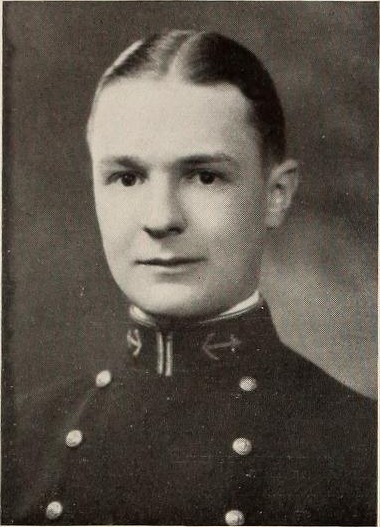
Leo George May was born in New York on 24 July 1909. He was a member of the United States Naval Academy class of 1930 and spent his career in the Navy. He was promoted to lieutenant on 2 June 1938. After the United States entered the Second World War he rose again, to temporary lieutenant commander on 15 June 1942 and to temporary commander on 15 October 1942. He died on 26 February 1995, at the age of eighty-five.
His first wartime command was the destroyer USS Tattnall (DD-125), a ship completed after the First World War. He took her on 11 July 1942 as a temporary lieutenant commander and left her on 21 August 1943. That tour closed a little more than two months before he was ordered to a new fleet destroyer still fitting out on the Atlantic coast.
Paul Hamilton (DD-590) was a Fletcher-class destroyer, the second Navy ship named for Paul Hamilton, who had been Secretary of the Navy from 1809 to 1813. Charleston Navy Yard laid her keel on 20 January 1943 and launched her on 7 April 1943, with Mrs. William Dewar Gordon as sponsor. The Navy commissioned her at Charleston on 25 October 1943. Commander Leo George May became her first commanding officer that day and kept the ship until 17 November 1944.
After commissioning, Paul Hamilton carried out shakedown training off Bermuda. From 8 January to 19 April 1944 she worked in the lower Chesapeake Bay out of Norfolk with a destroyer training unit. She sailed from Norfolk on 25 April, called at Aruba in the Dutch West Indies, passed the Panama Canal, and arrived at Pearl Harbor on 21 May 1944.
Her Pacific duty began with the logistics ships that kept the fast carriers at sea. From 13 June to 12 August 1944 she screened replenishment groups supporting the Third Fleet during the landings on Saipan, which opened on 15 June. East of the Marianas the formation fueled the invasion ships, and Paul Hamilton fired at enemy dive bombers and torpedo planes that remained at long range. On 18 June dive bombers hit two oilers in the group, and one attacking plane was brought down. She went west with Task Force 58 for the Battle of the Philippine Sea on 19 and 20 June. On 20 August she left for Manus, in the Admiralty Islands, with escort carriers and fleet oilers.
From 1 September to 3 October she screened the same kind of replenishment force while the Third Fleet covered the capture of the southern Palau Islands. From 4 October to 15 November she stayed with those groups as carrier aircraft struck Okinawa, Luzon, Formosa, the Visayan Islands, and ships of the Japanese fleet. Those weeks included the fleet battles around Leyte in late October, and Paul Hamilton remained with the oilers and escort carriers that sustained the striking forces. May left the ship on 17 November 1944.
Daniel Carlson, who later became a rear admiral, relieved him that day and commanded Paul Hamilton through the rest of the fighting, including the later Philippine operations, Iwo Jima, and Okinawa. George Francis Dalton took command on 1 September 1945. The destroyer was decommissioned on 24 September 1945 after a war cruise for which she received seven battle stars. May's own time in her covered commissioning, Atlantic training, and the first Pacific months, from the Marianas through the opening of the campaign in the Philippines.