Ships
- USS Franklin (CV-13) Captain from 7 November 1944 · Relieved on 30 July 1945
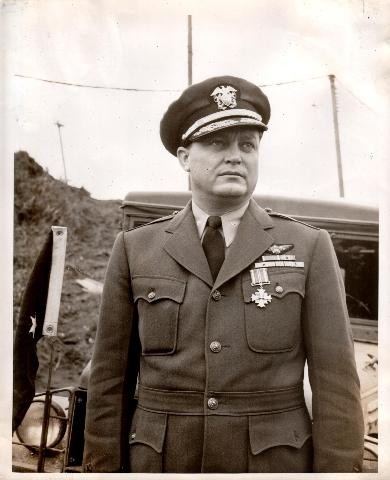
Leslie Edward Gehres was born on 23 September 1898 and died on 15 May 1975. He came into the Navy through the New York naval militia, learned to fly, and rose from the enlisted ranks to rear admiral. He is remembered as the captain of the aircraft carrier Franklin on 19 March 1945, when Japanese bombs set the ship afire off the Japanese coast and killed about eight hundred of her men.
He joined the naval militia in 1914. When the United States entered the First World War his unit was mobilized, and he served in the cruiser Salem and the battleships Massachusetts and Indiana. In 1918 he completed a reserve officers course at the Naval Academy and was commissioned an ensign in the Naval Reserve on 24 May. That September he transferred to the regular Navy. He served in the battleship North Dakota on Atlantic escort duty until June 1919, then spent five years in the destroyers Tingey, Gillis, Aulick, and Jacob Jones. From June 1924 to November 1926 he was stationed at the navy yard at Pearl Harbor.
Sent next to Naval Air Station San Diego, he qualified as a naval aviator in 1927. Aboard the carrier Langley he led the exhibition team known as the Nine High Hats. In 1932 he served with Fighting Squadron 5 in Saratoga and then with Fighting Squadron 6 in Lexington. Duty in Yorktown and Enterprise followed. Promoted to commander, he became air officer of the carrier Ranger.
In November 1941 he took command of Fleet Air Wing 4, the patrol-plane command whose reach ran from the Aleutians down the Pacific coast. From May 1942 into 1944 his aircraft searched for Japanese forces in the Aleutians and struck targets in the Kurile Islands. The flying was dangerous and the losses were heavy. Men who served under him in Alaska tended either to respect his drive or to resent how hard he drove them. In July 1943 he was made a commodore, the first naval aviator to hold that rank. He received the Distinguished Flying Cross and the Legion of Merit for the wing’s work. In the autumn of 1944 he gave up the commodore’s rank, reverted to captain, and took a fleet carrier.
On 7 November 1944 he relieved James Marshall Shoemaker as captain of Franklin. The carrier had lately been hit by a kamikaze. At the change of command Gehres told the crew they had failed to stop the attacker. He ran a severe ship. Officers and men who had known him in the Aleutians already described a disciplinarian who punished quickly.
On the morning of 19 March 1945, Franklin was with the fast carriers, striking the Japanese home islands near Kobe, when a Japanese bomber dropped two bombs into the flight deck and the hangar. Fueled and armed aircraft on deck and below cooked off in a chain of fires and explosions. About eight hundred men were killed and hundreds more were wounded, the heaviest loss suffered by any American ship that remained afloat. Communications and much of the firefighting equipment were smashed. Gehres stayed on board, directed the fight against the fires, and kept men at the work until power came back and the carrier could be drawn away from the coast. The light cruiser Santa Fe and other ships of the force took off the wounded and stood by the burning carrier. For his conduct that day he received the Navy Cross.
Only the forward part of the ship was fit to live in. Gehres had ordered men who could be spared to leave, and the order, passed from man to man, was heard in different ways. Many who went into the water or across to other ships believed they were doing what he had told them to do. He afterward treated a number of those departures as abandonment of the ship. At Ulithi he recommended general court-martial for seven officers, then withdrew the charges while the Navy inquired into the bombing and into his accusations. The inspector general found his judgment in bringing those charges unsound, and also recorded that he had been trying to save a wrecked ship after a terrible day. Franklin reached Pearl Harbor and, in late April 1945, the Brooklyn Navy Yard, after a passage of about twelve thousand miles, part of it under tow and part under her own power. Some survivors were left behind in the Pacific, and those allowed back aboard at Pearl Harbor had only a short time to gather what remained of their belongings. That treatment divided the crew’s memory of their captain as sharply as the attack itself.
He was relieved as captain of Franklin on 30 July 1945 and assigned to command Naval Air Station San Diego. His remaining duty was ashore. He advanced to rear admiral and retired at that rank, with no further command at sea.