Ships
- USS Chicago (CA-29) Captain from 9 March 1931
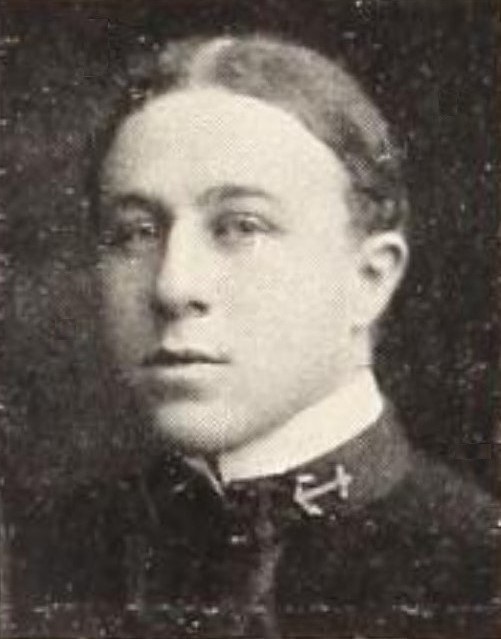
M. H. Simons, Manley Hale Simons, was born in Portland, Maine, on 11 May 1879, the son of a naval surgeon. He entered the United States Naval Academy and graduated with the class of 1901, then was commissioned an ensign in 1903. On 17 October 1907 he married Katherine V. Nazro. Their sons were Manley Hale Simons, Jr., who followed his father into the Navy, and Arthur. Simons completed the Naval War College course in 1924 and rose steadily through the line.
In the First World War he commanded the transport Kroonland. The Navy took the former liner over and commissioned her on 22 April 1918 with Commander Simons in command, and she joined the Cruiser and Transport Force. Before the Armistice she made five voyages to France and carried more than fourteen thousand soldiers through waters sown with submarines and mines. On 10 July 1918, bound home, a lookout saw a periscope rise close aboard. Kroonland opened fire, and a shell burst in a heavy cloud of smoke where the periscope had been. After the fighting stopped, Simons kept the ship at the work of bringing troops home until she left naval service in the autumn of 1919. The Navy Cross recognized that command.
On 9 March 1931 he took a new cruiser. Chicago had been built at the Mare Island Navy Yard and launched on 10 April 1930. She was commissioned that March day with Captain M. H. Simons in command, rated at first as the light cruiser CL-29. Her main battery was nine 8-inch guns, and on 1 July 1931, under the terms of the London Naval Treaty, she was reclassified as the heavy cruiser CA-29. Simons was still her captain.
The shakedown took Chicago to Honolulu, Tahiti, and American Samoa. Near Pago Pago she crossed the equator, and Simons received King Neptune and his court on board. After voyage repairs at Mare Island she sailed on 27 July 1931 for the Atlantic and reached Fort Pond Bay, on Long Island, on 16 August. There she became flagship of Commander, Cruisers, Scouting Force. In February 1932 she drilled at gunnery with that force ahead of the fleet problem off the California coast. For the rest of his tour she worked in the Pacific, from Alaska to the Canal Zone and the Hawaiian Islands. He left the command in June 1933.
He next served as chief of staff to Vice Admiral Harris Laning, who commanded the cruisers of the Scouting Force, and he was still embarked in Chicago. On the morning of 24 October 1933, from the flag bridge, he watched the cruiser meet the British freighter Silverpalm about twenty miles west of Point Sur, California. At the first alarm he looked at his watch, and at the instant the ships struck he recorded the time to the second. The blow opened a hole in Chicago's port side some forty feet long, reaching from the deck nearly to the keel, and three of her officers were killed. Simons was promoted to rear admiral in 1934.
From 22 November 1937 to 17 June 1941 he was commandant of the Norfolk Navy Yard at Portsmouth, Virginia, through the yard's expansion before the United States entered the war. When President Franklin D. Roosevelt visited on 29 July 1940, Simons reported that the workforce had grown from about 7,600 the previous September to 12,000, and that the battleship Alabama, the first modern battleship built at the yard, was under construction.
He then commanded the Chesapeake Task Group of the Eastern Sea Frontier. From 7 December 1941 to 31 May 1943 he directed the ships and aircraft covering the approaches to Chesapeake Bay. The Legion of Merit for that service credited the measures he set in place with the destruction of three enemy submarines, damage to others, and a marked fall in attacks on shipping along that coast. On 30 January 1943, while he still held the Chesapeake command, Chicago was sunk by Japanese aerial torpedoes in the Battle of Rennell Island, south of Guadalcanal. He retired in 1943 as a rear admiral and died on 15 May 1963.