Ships
- USS Craven (DD-382) Captain, 15 June 1939 – 1 July 1940
Mead Saltonstall Pearson (18 July 1899 – 21 February 1984) was a United States Navy officer from Lowell, Massachusetts, a graduate of the Naval Academy in the class of 1920, who commanded the destroyer Craven from June 1939 to mid-1940 and then, as a captain, the amphibious force command ship Ancon from March 1943. In that ship he served three of the great invasion commanders of the European war: Rear Admiral Alan Kirk at Sicily in July 1943, Vice Admiral H. Kent Hewitt at Salerno in September 1943, and Rear Admiral John L. Hall Jr. off Omaha Beach in June 1944. He retired as a rear admiral, received a Bronze Star, and died at Bethesda, Maryland, at eighty-four.
He was born on 18 July 1899 in Lowell, Massachusetts, the mill city on the Merrimack. The sources examined here do not name his parents, describe the household, or say how he came to the Naval Academy.
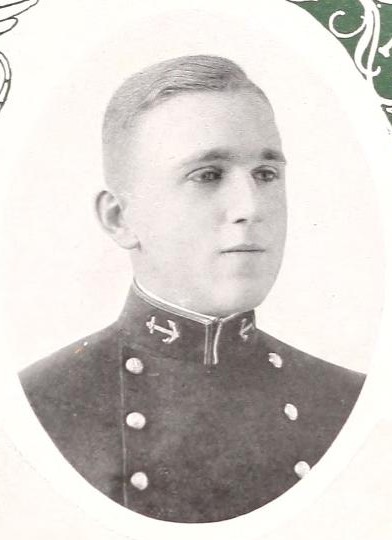
The 1920 Lucky Bag gives his home as Lowell and his nicknames as "Foxy," "Buster," and "Sully." Its sketch opens with a joke about the mess hall: "Here goes mess gear and here comes Pearson, the man that made mess gear famous. He is so anxious to get at that chow that his feet can't keep up with his body." The writers picked out his walk - "that extraordinarily, peculiarly individual gait of his" - and read a character into it. "Just as his eagerness to arrive at his destination keeps his heels off the deck, so his whole mode of living keeps him on his toes." He did not bluff: "He couldn't get away with it if he tried." But he was gullible, they said, "unquestionably so," and a frequent victim of practical jokers, "from soap in his gum to Limburger in the pocket of his fussing blouse." The sketch closes on the cinder path: "Pearson is essentially a man of action, a worker," and "no race is easy and 'Foxy' picked the hardest of the lot" - the quarter mile, in which he won his varsity letter. The honors line under his name lists the track team, track letter, and expert rifleman.
He graduated with the class of 1920. The sources examined here do not give his graduation date, his first ships, or his course through the interwar years. The Navy's Register carried him as a lieutenant commander from 1 July 1935 and as a commander from 1 April 1941, according to a compilation of those dates. The only prewar post that can be placed is the command of the destroyer Craven, a destroyer commissioned in 1937, which he took on 15 June 1939 from Lieutenant Commander Watson O. Bailey. He was thirty-nine. The Craven was then working between the Caribbean and the Pacific coast; from 1 April 1940 she was based at Pearl Harbor, screening carriers. Pearson was relieved on 1 July 1940, according to NavSource's list of her commanding officers.
On 13 March 1943 he took command of the Ancon, and NavSource lists him there as a captain. The ship had been the Panama Railroad liner Ancon, built at Quincy, Massachusetts; the Army took her over in January 1942 and the Navy in August 1942, and she took part in the North African landings that November. She was being converted into an amphibious force command ship, work that ran from 16 February to 21 April 1943 at the Norfolk yard. Her new task was to carry an admiral, a general, and the staff and radio rooms that ran an invasion.
The photographic record preserves some of the work. On 3 July 1943, shortly before the invasion of Sicily, the Navy photographed the Ancon's Joint Operations Room, with its plotting tables, its sound-powered telephones, and a board showing the disposition of Task Force 85. Chalked on the status board was the sentence "Again we have been asked to do the impossible. Let's do it as usual." Lieutenant General Omar Bradley stood on her bridge on 7 July en route to Sicily, and Rear Admiral Alan Kirk is photographed on the bridge of his flagship. The landings ran from 9 to 15 July 1943.
Two months later, in September, she was the flagship for Vice Admiral H. Kent Hewitt at the Salerno landings, 9–21 September 1943. A photograph taken on 9 September shows Kirk inspecting her crew in dyed "white" hats and pneumatic life belts. Lieutenant General Mark Clark of Fifth Army was aboard on 12 September, as was the correspondent Quentin Reynolds with Hewitt, and the ship lay off the Salerno beachhead with submarine chasers laying smoke to protect the larger vessels.
The last great operation of his tenure was Normandy. In March 1944 the ship was off Slapton Sands, in Devon, for the landing rehearsals. On 25 May, a few days before the invasion, King George VI inspected her. A photograph in the Naval History and Heritage Command's collection shows the king with Rear Admiral Hall and, at the right, "Commander Mead S. Pearson, USN, Ancon's Commanding Officer." On the same day the Navy photographed Admiral Sir Bertram Ramsay and Hall aboard. On 6 June 1944 the ship was Hall's flagship for Assault Force O, off Omaha Beach, and was still there on 7 June, when a photograph shows her with a patrol craft in the foreground. He was forty-four years old.
The sources examined here do not give the date he left the ship, or a narrative of his own experience of the three operations. No action report in his name and no letter or diary was found.
The compilations give no further wartime service after the Ancon. His later rank and honors are recorded in outline. He retired as a rear admiral, and the Military Times Hall of Valor lists a Bronze Star Medal awarded to him for World War II, with no citation text available. The year of his retirement, any other decorations, any postwar commands, and the date and ceremony of his promotion to flag rank were not found.
He died on 21 February 1984 at Bethesda, Maryland, at eighty-four. The sources examined here name no wife or children, and the place of burial is not recorded in them.
What survives of Pearson is a series of posed photographs on a command ship's bridge and in her operations room. The man himself - the quarter-miler who was said to take any bait, the captain who had Kirk, Hewitt and Hall in turn on his bridge - is seen only at a distance.