Ships
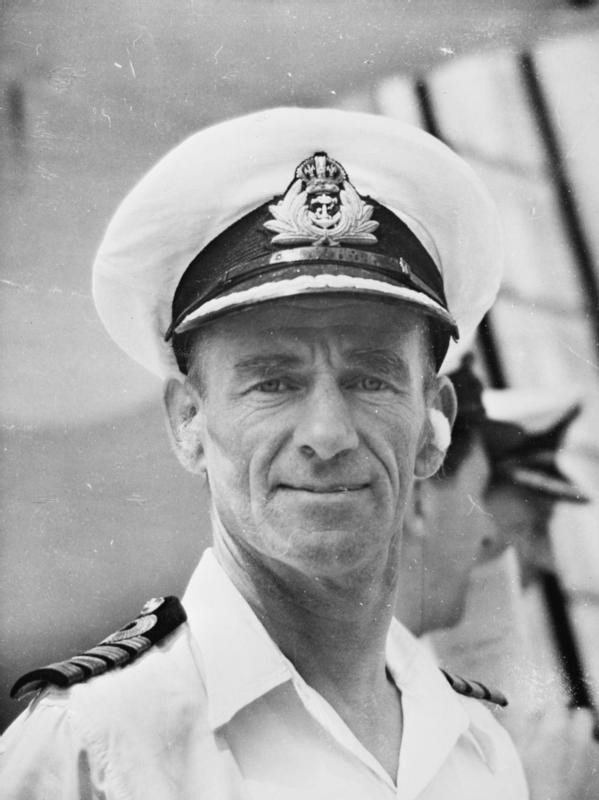
- HMS Victorious (38) Captain from 8 December 1943 · Relieved on 15 August 1945
Michael Maynard Denny was born at Kempley, Gloucestershire, on 3 October 1896, the youngest son of the Reverend Edward Denny. He was educated at Queen Elizabeth's School in Wimborne Minster and at the Royal Naval Colleges at Osborne and Dartmouth, and he entered the Royal Navy in 1909. He passed out of the training establishment as a midshipman on 15 May 1914 and joined the battleship Neptune in the First Battle Squadron. On 18 April 1916 he transferred to the new battleship Royal Sovereign and spent the rest of the First World War with the Grand Fleet in the North Sea. He was made acting sub-lieutenant in March 1916, sub-lieutenant that September, and lieutenant on 15 October 1917.
After the war he specialised in gunnery. In 1920 he won the Commander Egerton Prize for the best practical examination among officers qualifying as gunnery lieutenants. Shore appointments in experimental and instructional work followed, including command of a gunnery-school tender named Excellent. On 15 October 1922 he joined the battleship Emperor of India as gunnery lieutenant and stayed until she paid off on 11 May 1925. Promotion to lieutenant-commander came on 15 October 1925. From 12 December 1928 to 16 April 1930 he was gunnery officer of the battleship Nelson. He was promoted commander on 30 June 1930, and from October 1932 to August 1934 he served as fleet gunnery officer in the Mediterranean. He became a captain on 31 December 1936. In the late 1930s he was deputy director of Naval Ordnance at the Admiralty.
In the spring of 1940, during the German invasion of Norway, Denny was senior naval officer for the Allied landing at Åndalsnes. He then served as chief staff officer for the evacuation of the army from Dunkirk. He was appointed a Companion of the Bath on 7 June 1940 and was mentioned in despatches that December. On 18 July 1940 he took command of the new light cruiser Kenya, saw her through trials, and remained her captain until 1 April 1942. The Norwegian Order of St Olav was gazetted for him on 2 February 1943.
He next became chief of staff to the Commander-in-Chief, Home Fleet. That staff service was recognised by his appointment as a Commander of the Order of the British Empire in the New Year honours of 1944. By then he was already back in a seagoing command. On 8 December 1943 he assumed command of the armoured aircraft carrier Victorious as captain.
In April 1944 aircraft from Victorious joined Operation Tungsten, the Fleet Air Arm strike on the German battleship Tirpitz in a Norwegian fjord. Denny was mentioned in despatches for that attack on 30 May 1944. Victorious afterwards went out to the British Pacific Fleet. In the spring of 1945 she spent weeks striking Japanese-held islands in support of the landings on Okinawa, the operation known as Iceberg. In May two kamikaze aircraft hit her, one near the forward aircraft lift and one among the aircraft parked on the after flight deck. She was repaired at Sydney and was back in service before the end of the war. The Distinguished Service Order, gazetted on 23 October 1945, recognised two months of operations against Japanese islands and the resolution with which her action damage was made good so that operational needs were met. Denny was promoted rear-admiral on 5 July 1945 and remained in Victorious until he was relieved on 15 August 1945.
After the war he became Assistant Chief of Naval Personnel and Director of Personal Services. From 1947 he was flag officer commanding the destroyers of the Mediterranean Fleet. He was promoted vice-admiral on 22 October 1948. In 1949 he joined the Board of Admiralty as Third Sea Lord and Controller of the Navy, the member responsible for the material of the fleet, and he held that post until 1953. He was knighted as a Knight Commander of the Bath on 8 June 1950 and promoted admiral on 22 April 1952.
In 1954 Denny was appointed Commander-in-Chief of the Home Fleet and, in the NATO appointment that went with it, Commander-in-Chief, Eastern Atlantic. He was advanced to Knight Grand Cross of the Bath on 10 June 1954. In 1956 he went to Washington as chairman of the British Joint Services Mission and as the United Kingdom representative on the NATO Standing Group. He retired on 28 July 1959. Sir Michael Denny died on 7 April 1972, aged seventy-five. He had married Sara Welman in 1923, and she died the year before him.