Ships
- IJN I-58 (I-58) Captain from 7 September 1944
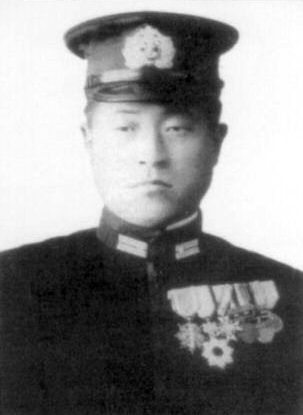
Mochitsura Hashimoto was born in Kyoto on 14 October 1909, the son of a Shinto priest. His father expected him to follow into the shrine. Hashimoto entered the Imperial Japanese Naval Academy at Etajima instead and graduated with the 59th class in 1931.
His first combat service was in China. In 1937 he served aboard the river gunboat Hozu on the Yangtze during the fighting around Nanjing. He then volunteered for submarines. As torpedo officer of I-24 he was at sea in December 1941, when that boat sent a midget submarine in toward Pearl Harbor. In 1942 he finished the Navy's submarine course and began a series of small commands: Ro-31 that year, I-158 in 1943, and Ro-44 later in 1943, used mainly for coastal patrol and training in home waters. He was promoted to lieutenant commander in November 1942.
In June 1944 he was assigned to the new submarine I-58 while she was still being completed, and he took command on 7 September 1944. I-58 had been altered in the yard so she could carry Kaiten, the manned torpedoes Japan sent out in the last year of the war. Hashimoto worked the crew through repeated drills, with little time ashore, before the boat went on patrol.
Through late 1944 and the first half of 1945, I-58 searched the central Pacific and launched Kaiten against Allied anchorages. In January 1945 she closed Apra Harbor at Guam and sent her Kaiten in. Hashimoto later saw two columns of smoke in the direction of the port. No Allied ship was afterward credited to those launches, and I-58 came home without a confirmed sinking.
In mid-July 1945 I-58 sailed from Hirao for the waters east of the Philippines, again with Kaiten pilots on board. On the night of 29 July, about 250 miles north of Palau, Hashimoto sighted a large darkened warship and took her for a battleship. Just after midnight on 30 July he fired six torpedoes from roughly 1,500 meters. The ship was hit and sank in about a quarter of an hour. She was the heavy cruiser Indianapolis, which days earlier had carried uranium and other parts for the atomic bomb used at Hiroshima and was crossing unescorted toward Leyte. Of the nearly 1,200 men on board, 879 died, most of them in the water before rescue came. It was the worst loss of life from a single sinking in the history of the United States Navy, and the only ship sunk under Hashimoto's command. He took I-58 deep and learned the cruiser's name only later.
I-58 was still at sea when Japan surrendered. On 15 August Hashimoto received a news dispatch carrying the imperial rescript and kept it from the crew until the boat reached Hirao on 17 August. He then read it aloud and took I-58 into Kure the next day. She was one of the few large Japanese submarines still afloat. In April 1946 she was scuttled off the Gotō Islands with other surrendered submarines. Hashimoto's final naval rank was commander.
The United States Navy brought him to Washington to testify at the court-martial of Captain Charles B. McVay III, who had commanded Indianapolis. Hashimoto told the court that the cruiser had been holding a steady course, and that at the range and in the conditions that night a change of course would not have kept the torpedoes off her. McVay was convicted of hazarding his ship. He retired under that verdict and died in 1968. Long afterward Hashimoto wrote American officials asking that McVay be cleared.
After the war Hashimoto worked in the offices that sent Japanese servicemen home, and for a time he commanded a repatriation ship. In 1954 he joined Kawasaki Heavy Industries and became a dockmaster. With former members of the I-58 crew he took part in trials of Oyashio, the first submarine built for the Maritime Self-Defense Force. He also published a memoir of the Japanese submarine campaign. Late in life he returned to the priesthood, serving in Kyoto as honorary chief priest of Umemiya Taisha. He died there on 25 October 2000, eleven days after his ninety-first birthday and days before Congress voted to clear McVay.