Ships
- USS North Carolina (BB-55) Captain, 9 April 1941 – 23 October 1941
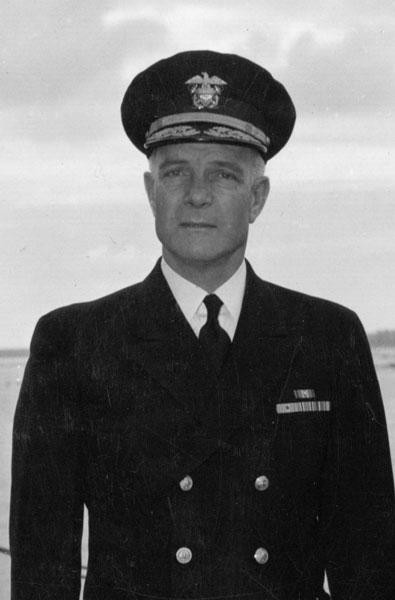
Olaf M. Hustvedt was born on 23 June 1886 in Chicago. His parents had come from Norway. He graduated from the United States Naval Academy in 1909, in a class that included Alan G. Kirk, Jesse B. Oldendorf, and Theodore S. Wilkinson. His first sea duty was in the armored cruiser West Virginia, on a cruise from the West Coast to ports across the Orient.
In 1914 he finished a master of science degree at George Washington University and joined the battleship Utah. Two years later he became aide to the commander of Battleship Division Six in the Atlantic Fleet. The division went to European waters and operated with the British Grand Fleet during the First World War. Hustvedt spent the last part of the war, and the months after it, as gunnery officer of the battleship Oklahoma, leaving that ship in 1919. Britain appointed him an Officer of the Order of the British Empire for his Grand Fleet duty.
Gunnery and ordnance shaped the next twenty years. He took charge of the experimental section in the Bureau of Ordnance, and in 1921 he observed the bombing trials that used the old battleship Alabama as a target. That year, as a lieutenant commander, he commanded the destroyer minelayer Burns. He was gunnery officer of the battleship Colorado in 1927, served afterward in the battleship California, and in 1930 was assigned to the Naval Gun Factory. Promoted to commander in 1933, he became executive officer of the heavy cruiser Louisville. In 1935 he moved to the staff of the Chief of Naval Operations in Washington. Promotion to captain in 1938 gave him command of the light cruiser Detroit.
In 1939 Captain Hustvedt joined Admiral James O. Richardson, Commander of the Battle Force, as operations officer in the flagship Pennsylvania. He then reported to the New York Navy Yard to oversee the fitting out of the new battleship North Carolina (BB-55). When the ship was commissioned on 9 April 1941, he became her first commanding officer. He remained in command through her early trials in Chesapeake Bay and the Atlantic, and he left the ship on 23 October 1941.
He went from North Carolina to the staff of Admiral Ernest J. King as chief of staff to the Commander in Chief, United States Atlantic Fleet. After Admiral Royal E. Ingersoll succeeded King, Hustvedt stayed on and served until 8 May 1943. He helped put the Atlantic Fleet and its bases on a wartime footing and helped fix how the commands would work together. For that duty, from 25 October 1941 to 4 May 1943, he received the Legion of Merit. A selection board called by Secretary of the Navy Frank Knox in March 1942 gave him a top rating.
Promotion to rear admiral came on 8 May 1943, with orders as Commander, Battleships, Atlantic Fleet. His flagship was the heavy cruiser Tuscaloosa. The task force he led was built around the battleships Alabama and South Dakota and worked with the Royal Navy's Home Fleet from Scapa Flow, cruising off Norway in hope of drawing the German battleship Tirpitz out to fight. On 1 November 1943 he took Battleship Division 7 in the Pacific. The division consisted of Iowa, in which he flew his flag, and New Jersey. The command covered the Marshalls campaign. In February 1944 the ships were in the Truk area on the 16th and 17th and off Saipan, Tinian, and Guam on the 21st and 22nd. He received a Gold Star in lieu of a second Legion of Merit for that service.
On 24 October 1944 Hustvedt joined the General Board, and he remained a member until his retirement in 1946 as a vice admiral. He died on 22 December 1978. He had married Irene Sherwood Cooper in Honolulu on 16 February 1912. A son, Erling H. Hustvedt, followed him into the Navy as a captain, and a grandson, Frederick Hauck, became a naval aviator and an astronaut.