Ships
- USS Samuel B. Roberts (DE-413) Captain from 28 April 1944 · In command when she was lost, 25 October 1944
The name the Navy's own books will support is longer than the list line and not the same as the card's navy. The Navy Directory of 1 April 1941, which includes Naval Reserve officers on active duty and orders through 23 March, lists "Copeland, Robert W, ens, NR, comdg, u s s Pawtucket," and the ship's roster in the same volume has one line under Pawtucket: "Ens. R. W. Copeland, NR, comdg." That is the expansion of R. and of W. as far as the directory goes. The middle name Witcher is not in that book. It is on the Naval Historical Center's biographical sketch, headed "Copeland, Robert Witcher," and it is in the Navy Cross citation as printed by the Hall of Valor and, in a shorter form, in the citation text the Samuel B. Roberts survivors' association reproduces from J. Henry Doscher's Little Wolf at Leyte. His own action report, written 20 November 1944, signs "R. W. Copeland" and, on the wounded list, "Lieut. Comdr. Robert W. Copeland, D-V(G), 74559, USNR."
He is not Thomas Henry Copeman. In that same 1 April 1941 directory the next line is "Copeman, Thomas H, lt, u s s Greer, exec." Copeman is the following name on the captains list and is a different officer, on a different ship, in the regular line as the directory prints him. He is not Richard G. Copeland, lieutenant (junior grade) on Richmond in that directory, not Howard G. Copeland, a Naval Reserve captain in the Navy Department, not Ralph L. Copeland or Jefferson D. Copeland, Jr., both reserve ensigns in the same list, not Nathaniel C. Copeland, and not Samuel Hall Copeland of the Supply Corps in the wartime registers. Robert Copeland Brown, who appears in the regular registers for years, is another man whose middle name happens to be Copeland. Later register indexes that read Robert Lee, Robert Enders, Robert Munroe, and Robert K. Copeland are not this file. The project card's "USN" is the wrong navy. Every document that styles him styles him Naval Reserve.
Origins
The Naval Historical Center sketch says he was born at Tacoma, Washington, on 9 September 1910, and that he died at Tacoma on 25 August 1973. No birth certificate, no death certificate, and no newspaper obituary were in the sources read for this essay. The dates are the Center's, repeated on its photograph page as mirrored by HyperWar. They are not invented here, and they are not a civil record in hand.
Nothing in the directory, the action report, or that sketch names a father, a mother, a brother, or a sister. The Center says he practiced law. It does not name a school, a bar, or a firm.
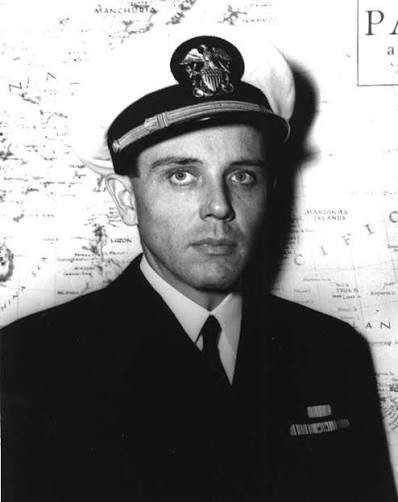
A wife is documented later, and only as a wife. Photograph NH 90680, a portrait released 13 December 1944 while he was recuperating at the Naval Hospital, San Leandro, California, is credited "Courtesy of Mrs. Harriet N. Copeland, 1980." The survivors' association newsletter for May–June 1999, written by Dick Rohde, reports that on 1 May 1999 Harriet Copeland cut the ribbon at Copeland Hall, a new building at the Naval Reserve Center in Tacoma named for "her late husband," Rear Admiral Robert W. Copeland. The newsletter does not give her birth name. No child of his is named in the Center's sketch, the action report, or that dedication account. A sentence in the same newsletter about "Whit's children" belongs to another man the association was mourning. It is not a Copeland family.
Formation
The Center's sketch is the only continuous account of the years before the war, and it is short. He enlisted in the Naval Reserve in 1929. He was commissioned a Naval Reserve officer in 1935. He practiced law from 1935 until 1940, when he was ordered to active duty in the Navy's expansion before the war. The sketch does not say where he enlisted, what rank the 1935 commission carried, or whether the law practice was in Tacoma. Tacoma is the birthplace the same paragraph gives. It is not, by itself, the town of the office.
The directories that exist locally test the active-duty sentence and do not fill it in. The Navy Directory of 1 June 1940 includes reserve officers on active duty. He is not in it. The next directory in hand is 1 April 1941. He is in that one, an ensign, commanding. If the Center is right that the orders came in 1940, they came after the June directory's cutoff. The books do not give the day.
What they do give is the first command, and it was not a warship. Pawtucket in the April 1941 volume is indexed to the Commandant of the Thirteenth Naval District and to Puget Sound. The roster lists no other officer. The Center identifies the ship as Pawtucket (YT-7). A district tug at Puget Sound, one reserve ensign, "comdg." That is the whole of his recorded duty in the last directory published before the wartime volumes stopped naming ships. He was thirty, if the Center's birth date is right, a lawyer who had been a reservist since he was about nineteen, and the Navy had given him a tug in his own naval district. The directory does not say he asked for her, or how long he had been aboard, or what the tug did that spring.
The next dated command is a schooner, and the rank has changed.
Black Douglas had been built at Bath, Maine, in 1930. The Dictionary of American Naval Fighting Ships, as reprinted in a 2007 public-domain text of the article, says the Navy acquired her on 2 January 1942 from the Fish and Wildlife Service, designated her IX-55, converted her at Winslow, Washington, and placed her in service in the Thirteenth Naval District on 18 April 1942, "Lt. Robert W. Copeland in command." On 1 April 1941 he had been an ensign. On 18 April 1942 the dictionary calls him a lieutenant. No register line with the lieutenant (junior grade) date, or the lieutenant date, was found. The jump is what the two books say a year apart. It is not a promotion warrant.
The same DANFS article says that for the following thirty months she patrolled the Thirteenth Naval District, that she was reclassified a coastal patrol yacht, PYc-45, on 8 April 1943, placed in full commission on 19 April 1943, and kept at that patrol until late summer 1944, going out of commission at Puget Sound Navy Yard on 20 September 1944. The thirty months are the ship's. They cannot all be his. On 1 September 1943 he was somewhere else, taking a new destroyer escort. A NavSource commanding-officer table, credited to Wolfgang Hechler and Ron Reeves and not a deck log, gives him Black Douglas from 18 April 1942 and then jumps to a Fish and Wildlife Service master in 1944. That table does not date his relief. What can be said is that the dictionary puts him in command when she went into service, that the Center's sketch lists Black Douglas (PYc-45) among the ships he commanded, and that he had left her before he commissioned Wyman. The Aleutian seal-research story, the later scientific career of the hull, and the decommissioning in September 1944 are the schooner's. They are not his cruise.
Wyman (DE-38) was laid down at Puget Sound Navy Yard on 7 September 1942 as a ship intended for the Royal Navy, launched on 3 June 1943, kept by the United States, named on 23 June, and commissioned at the yard on 1 September 1943. NavSource's building data, and a DANFS sentence quoted in secondary notices of the same article, put "Lcdr. Robert W. Copeland, USNR," in command that day. One designator that has been attached to the DANFS sentence in a search condensation reads "DE-V(G)." His own 1944 report uses "D-V(G)." The report is the one followed. The Hechler and Reeves list gives him the ship from 1 September 1943 to 1 February 1944, and then Lieutenant Commander Edwin Peter Parker. Those end dates are a compilation. They were not found in a log.
If both the commissioning sentence and the February relief are right, his Wyman was a new short-hull escort in the first months after she left the builder, not the ship that later wore six Pacific campaign stars. A National Archives photograph reproduced on NavSource shows her on 19 September 1943, eighteen days after commissioning, underway in Measure 21 camouflage. The caption, drawn from the ship's movement that morning, says she left a Seattle pier at 0812, loaded ammunition at Indian Island, fired near Point Wilson, and anchored off Port Townsend at 2035. The caption does not say he was on the bridge. The commanding-officer list still has him aboard. Her later war, the decommissioning at San Francisco on 17 December 1945, and the sale for scrap are after the date that list says he left, and they are not narrated here as his.
Between 1 February and 28 April 1944, if the list is right, there is no station in the sources read. The next fact is the ship the encyclopedia card already names.
War years as lived
Samuel B. Roberts (DE-413), a John C. Butler-class destroyer escort, was laid down on 6 December 1943 at Brown Shipbuilding, Houston, launched on 20 January 1944, and commissioned on 28 April 1944. The Dictionary of American Naval Fighting Ships says "Lt. Comdr. R. W. Copeland, USNR, in command." The current Naval History and Heritage Command history of the ship, as its commanding-officer table is reported, gives Lieutenant Commander Robert W. Copeland, USNR, from 28 April 1944 to 25 October 1944, which is the day she was lost. The project stub says the same start and the rank lieutenant commander. He was the commissioning captain, and he was still the captain when she went down. There was no later cruise of this hull to peel away from him.
The dictionary's short history is the cruise before the battle. Shakedown off Bermuda from 21 May to 19 June 1944, availability at the Boston Navy Yard, then Norfolk on 22 July, the Panama Canal on 27 July, Pearl Harbor on 10 August. Training, a convoy to Eniwetok sailed on 21 August and arrived on the 30th, back to Pearl Harbor with a convoy by 10 September, more training, another convoy to Eniwetok from 21 to 30 September. Then Manus, and Task Unit 77.4.3, the Northern Air Support Group off Samar. His own report, which is the document for the last day, adds that the unit sortied from Seeadler Harbor, Manus, with Rear Admiral C. A. F. Sprague, joined the Leyte movement, and that on 18 October the task unit began independent operations as the northern air support group about fifty miles east of Samar, screening escort carriers. On 24 October Roberts picked up a survivor from Fanshaw Bay. The report calls that man an operational casualty. It does not give his name.
The fight is in "Combined Action Report, Surface Engagement off Samar, Philippine Islands, and Report of Loss of U.S.S. Samuel B. Roberts (DE-413), on 25 October 1944," serial X001, file DE413/A16-3, dated 20 November 1944, from the commanding officer to the Secretary of the Navy. The logs, he wrote, went down with the ship. Times are Zone minus 9. The narrative was reconstructed from memory, interviews, and a few records, and he says he was assisted by all the surviving officers. A talk-between-ships log enclosed with it is labeled as reconstructed from the memory of the radioman and the executive officer and the combat information officer. What follows is that report, not a later retelling. Where a figure is a reading of a dark National Archives photostat, it is a reading, and the conflicts with the dictionary are left for the last section.
He told the crew, over the loudspeaker, at the beginning, what he thought the morning was. The sentence in the report is not set off as a transcript. It is his later account of the estimate he gave them: "a fight against overwhelming odds from which survival could not be expected, during which time we would do what damage we could." The shorter sentences that now circulate as a direct quotation are the same thought tightened by other hands. The report's wording is the one he signed.
About 0650 a message said one of their aircraft had contacted the enemy task force. The ship went to general quarters at 0655. By 0658 the carriers were launching what aircraft they had, and splashes from heavy shells were falling. The gunnery officer identified the ships as Japanese. The report's estimate of the enemy, which is his and not a later order of battle, was four battleships, several cruisers, and from six to twelve destroyers, sighted to the northeast. He names classes and, in places, individual ships. Those names are what a destroyer-escort captain, under fire, put in a report three weeks later. They are not corrected here from a history of the battle written afterward.
The unit commander ordered smoke. Johnston made it at once. Roberts began making it a few minutes later, heavy black funnel smoke laid down on the white chemical smoke, which he calls one of the most effective screens he had seen. The smoke, he writes, threw the enemy fire control off. For ten or fifteen minutes the enemy fire slackened to almost nothing. A rain squall did part of the same work.
At 0735 the task unit commander told the screen commander to deliver a torpedo attack. The reconstructed voice log, as read, has the small ships asked whether the "little fellows" were to go in with the big ones, and the answer "No," and then, on a second call, the little fellows forming for a second run. His narrative of his own ship is the next decision. The screen commander, he writes, replied in the negative when asked if the escorts were to come, because of the difference in speed, torpedo armament, and fire control, and ordered the destroyers in, Heermann, Hoel, and Johnston. After about five minutes, with other escorts forming, the commanding officer found Roberts in a position from which a torpedo attack could be made, called the unit commander for a course, and followed about 3,000 yards astern of Hoel and Johnston, passing Johnston as she turned away after firing. The approach was from the starboard quarter of the column, through the smoke Hoel, Johnston, and Roberts had laid, and he writes that it was apparently undetected. The director was not opened. Number 1 five-inch gun was not trained out, though he says the targets were good. Fire control was set up and the guns were loaded. An unexpected delay inside the ship, with the tubes, put the firing later than he had meant. He had intended to shoot from about 5,000 yards at a relative speed of about fifteen knots. The ship closed to about 4,000 yards. A stray shell cut the radio antenna. The torpedoes, which he had meant to fire at high speed, were fired at intermediate speed as the ship, still under fire, slowed and steadied in a trough. A column of water was seen at the waterline of the second cruiser in the column.
The summary at the front of the report, as read, says the torpedoes went out at a range of 4,000 yards, one hit from the spread of three, and that the ship then fired a total he gives as 608 rounds of five-inch. An ordnance paragraph later in the same report was read as about 600 rounds of common, antiaircraft common, and Mark 32, three Mark 15s, all torpedoes hot, straight, and normal. The two figures are both in the document as it was read. They were not averaged. He believes the hit, and the damage, fell on the cruiser leading that column, of a class he calls Aoba, and that the other two torpedoes missed. When the column came out of the smoke it was led by a Tone-class heavy cruiser. He believes major damage had been done to the first one. "Believes" is his word. He does not report a ship sunk by the torpedo.
From about 0805 Roberts fired the five-inch battery at the Tone-class cruiser that had been selected as the target. The opening range was read as 10,500 yards, closing, for a time, toward 8,500, and later varying between about 6,000 and 7,500. The fire-control installation was the limited one a destroyer escort carried. He says the fire was the heaviest, fastest, and most accurate of which the ship was capable, checked against the splashes when their own smoke or the rain hid the target, and that it was shifted sometimes to other ships maneuvering between them and the carriers. About 0830, still under the unit commander's order to interpose, Johnston and Heermann crossed close aboard, all three making smoke and firing. At 0851 Roberts took her first hit.
What the first hits did is in the report in sequence, and the sequence is the cost. A salvo put a hole below the waterline in number 1 lower handling room and opened main steam lines in number 1 fireroom, putting that fireroom out of commission. The ship slowed. The figure read for the speed that remained is 17 knots. About 0900, as the range closed to something read as 8,000 yards, hits came in a rush. Number 1 engineroom was hit and knocked out. A heavy shell, eight-inch or fourteen-inch, hit the after twin 40 mm and the Mark 51 director. He records no further trace of the mount, the gun, the shield, or the director. About the same time a hit he reads as two or three fourteen-inch shells, high-capacity, opened a hole some thirty to forty feet long and seven to ten feet high in the port side at the waterline. That salvo, he writes, wiped out number 2 engineroom, ruptured the after fuel-oil tanks, and started fires on the fantail. All power was lost. The ship was an inert mass. There was no offensive measure left, and no defensive one except the decision to leave her.
Before the word to abandon was passed, the crew of number 2 gun, which he says had distinguished itself through the action, loaded, rammed, and fired six charges by hand, knowing the gas-ejection system had no air. On the seventh round the powder cooked off. The gun and the mount were blown clear of the ship. He writes that from the men in that mount, one survived. Two of the gun's crew died later on the rafts. Whether the cook-off or a Japanese shell did it, he says he cannot tell. The pointer of the forward five-inch, on the other gun, had already been killed by shrapnel and the sight shattered, and the trainer had fired the rest of that gun in manual control.
He estimates more than 200 rounds of various calibers came at them or near them. About twenty of those were direct hits of five-inch, eight-inch, and fourteen-inch. Several, he believes, passed through the ship without exploding. The dictionary later says "at least 40 gunfire hits" and a hole forty feet by ten in number 2 engineroom. His report, as read, says approximately twenty hits on the enemy cruiser from his own five-inch, and approximately twenty direct hits received. The dictionary's forty and his twenty are not the same sentence. The report is the one he signed. A Tone-class cruiser, he writes, was hit hard enough that he will claim it from the hits he saw: on fire, bridge holed, superstructure alight. He does not claim that his torpedo and his gunfire won the morning. He writes that the enemy gunnery was, on the limited look they had, inferior to what a force of that size should have done, that the Japanese were slow to shift targets, and that colored splashes and a habit of not immediately following one salvo with another let a 24-knot ship, handled with a great deal of rudder, live longer than she should have. He also writes, in the same report, that the ship stayed afloat under the guns of Japanese cruisers inside 7,500 yards for over an hour, and that he does not think the explanation is a mystery except the concrete fact of her size and her turning, "as well as the kindness of providence." The providence is his phrase. It sits next to the inventory of holes.
The summary page puts the abandonment after all power was lost, the ship on fire aft, listing about ten degrees to starboard and down about four feet by the stern, with the forward five-inch out of use and 142 rounds of five-inch ammunition still aboard. Abandonment, delayed by the care of the wounded, was completed about 0935. She kept falling to starboard, listed to about eighty degrees, hung, then went down by the stern, bow up. The next page, as read, says she sank very slowly at 1000. Men in the water saw three enemy ships, a Nachi-class light cruiser and two Asashio-class destroyers in his identification, pass close, look at them, take photographs, and not fire.
They were in the water about fifty hours. The report says most of the survivors gathered in two groups, each a pair of rafts and a floater net, and that others were in small groups of two to five, often holding five-inch powder cans. None of that second set, he writes, had been rescued by the time he signed. Friendly aircraft saw them the afternoon of the action and did not indicate a search. On the 26th, formation flights of friendly planes passed and, so far as the men in the water could tell, were not searching either. He thought another twenty-four hours would have left a handful alive. The dictionary says 120 survivors clung to three life rafts for fifty hours and were then rescued. His report does not, in the pages read, give the number 120, and it describes rafts and floater nets, not three rafts alone. It also does not name the ship that took them up. The rescuing ship's name was not in the sources used here, and it is not supplied.
The casualty enclosure is explicit about its weakness. No complete muster roll survived. The list was compiled with names and service numbers as shipmates remembered them, so some numbers and initials are missing. He refuses to sort the wounded into serious and slight. "All survivors, including those listed above, were in the water for fifty hours or more and received treatment for shock, exposure and immersion." He signs that page "R. W. COPELAND." His own name is on the wounded list: lieutenant commander, D-V(G), service number 74559, USNR, with Lieutenant William S. Burton and Lieutenant (junior grade) Thomas J. Stevenson, Jr. The dead, the died of injuries, and the missing are names on that enclosure, including officers the copy reads as missing. A clean total was not retallied from the dark photostat, because he had already said the muster was memory. The dictionary's 120 is the survivor figure in print. It is not a count made for this essay off his list.
The report's last judgment of his own men is the part that is easy to turn into a speech and should be left as what a commanding officer wrote three weeks later, after he had been in the water with them. Officers and crew, many of them less than one year in the service, newly inducted, married, unaccustomed to navy ways, behaved so that he would have been proud of them as average Americans. He names the engineers in particular. Both engineering officers, he writes, knew their jobs, the division was the best trained on the ship, and a few of them escaped from the spaces. "Only a few escaped from engineering spaces, but all at their posts and performed their duties so cooly and efficiently that the engineering performance of the vessel exceeded any expectations previously entertained by the Commanding Officer." The spelling "cooly" is the reading of the page. He also writes that the five-inch battery and the torpedoes, which he had been told might be taken off ships of this type, were a large part of what the ship could hit with, and that the gunnery officer's recognition training was what let them tell their own ships from the enemy in the smoke. Those are arguments about how a destroyer escort ought to be armed, written by a man whose ship had just been sunk, and they are addressed up the chain. They are not a claim that the design saved her. She was lost.
The chain answered on paper. On 14 December 1944 the Commander of Destroyer Escort Division 69 forwarded the report and wrote that her performance was in keeping with the highest traditions of the service, and that he considered that Lieutenant Commander R. W. Copeland, USNR, had distinguished himself conspicuously by gallantry and intrepidity at the risk of his life above and beyond the call of duty, without detriment to the mission. The endorsement uses that language. It does not, in the copy read, name a medal. On 21 December, C. A. F. Sprague, Commander Carrier Division 25 and commander of the task unit, forwarded it with no added comment beyond the forward. A later endorsement from Commander Seventh Fleet, T. C. Kinkaid, called the performance of the commanding officer, officers, and crew a credit to the service, and pointed a reader to Copeland's remarks on smoke, on keeping torpedoes on this kind of escort, and on recognition training. The decoration that the citation record attaches to him is the Navy Cross, not the medal whose statute uses the phrase "above and beyond the call of duty." No paper in hand says the division commander's sentence was a recommendation that was reduced. The two facts are left side by side: the endorsement's words, and the cross.
The citation itself does not exist in one agreed text in the sources read. The Hall of Valor prints a Navy Cross to Lieutenant Commander Robert Witcher Copeland, USNR, for extraordinary heroism as commanding officer of Samuel B. Roberts off Samar on 25 October 1944, and says that with cool deliberation he closed to within 4,000 yards of a heavy cruiser to deliver a torpedo attack while under fire from large-caliber guns, drew fire onto himself and off the ships he was protecting, lost the ship, and helped turn back a superior force. The survivors' association prints a shorter citation, addressed as from James Forrestal, Secretary of the Navy, "takes pride" rather than "takes pleasure," "a warship" rather than the ship's name in the opening clause, and without the 4,000 yards. The 4,000 yards is in his report. It is not in every printing of the citation. Both printings use the name Robert Witcher Copeland. Neither printing was found as a Navy Department general order in the registers examined.
The dictionary adds that Samuel B. Roberts was included in the Presidential Unit Citation given to Task Unit 77.4.3 "for extraordinary heroism in action," that she was struck from the Navy list on 27 November 1944, and that she earned one battle star. The star and the unit citation are the ship's. They are not rewritten here as a second personal medal. He had been her captain for the whole of her commissioned life, so the unit's citation covers the only fight she had, which was his.
By 13 December 1944, eight days before Sprague's endorsement, the Navy released a photograph of him made while he was recuperating at San Leandro. The report of 20 November was already written. The hospital is the first fact after the water that is not inside the report.
After
The Center's sketch says that after the war he resumed the law practice and stayed in the Naval Reserve, and that he rose to rear admiral. It does not give the date of the law office reopening, the date of rank, or the billets. A Register index of 1949 contains a line "COPELAND ROBERT W." A 1955 register index contains a line the optical reading gives as "COPELAND ROBERT U," commander, in the alphabet where Robert W. would sit, with a designator the reading splits as 110 and 5. The columns of both books are broken across lines. They were not used for a date of rank, a file number, or a retirement. Service number 74559 from the 1944 wounded list was not found attached to a clean register biography. Rear admiral is the Center's word for the end of the reserve career. It is not a warrant in hand.
He died, the Center says, at Tacoma on 25 August 1973. He was sixty-two if the 1910 birth date is right. Harriet N. Copeland was alive in 1980, when she gave the Navy the hospital portrait, and alive on 1 May 1999, when she cut the ribbon on the reserve-center building that carries his name. The Navy named a frigate Copeland (FFG-25) for him. She was commissioned on 7 August 1982, nine years after the death date the Center gives, and he did not command her. Her later transfer out of the Navy is not part of his life.
He left a book. The survivors' association describes The Spirit of the Sammy-B, by Rear Admiral Robert W. Copeland with Jack E. O'Neill, as his own account of the ship's short life, about 120 pages. A 1999 newsletter says an original manuscript in a shipmate's papers was titled "The Sammy B Spirit." The book was not in hand. Nothing in this essay is taken from it. The action report is the voice that was.