Ships
- USS Sproston (DD-577) Captain, 6 February 1945 – 2 November 1945
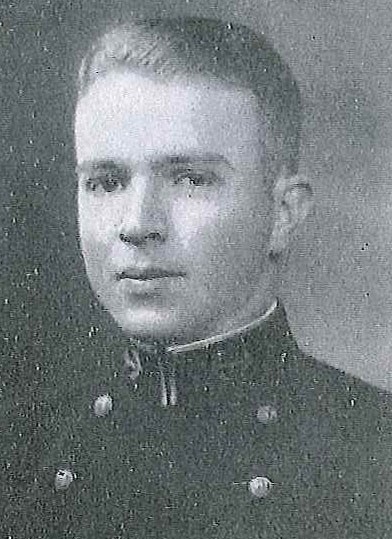
Robert John Esslinger (3 April 1908 – 21 August 1980) was a United States Navy officer from Michigan who graduated from the Naval Academy in 1930, spent much of his junior career as a destroyer engineer, and retired as a rear admiral. As engineer officer of the destroyer Kearny he kept the ship’s remaining plant running after a German submarine torpedoed her in the North Atlantic on 17 October 1941, weeks before the United States entered the war, and received the Navy Cross for that night’s work. In 1945 he commanded the Fletcher-class destroyer Sproston on the Okinawa radar picket line and received the Silver Star. After the war he took the cargo ship Alcona into Greenland waters for Exercise Nanook. He died in 1980.
He was born on 3 April 1908. The Navy registers examined here give the date without naming a town. Secondary award compilations place the birth at Trenton, Ohio. By the time he entered the Naval Academy his classmates knew him as a young man from Ypsilanti, Michigan. The 1930 Lucky Bag prints that hometown under his name and the nicknames “Bob” and “Red.”
Nothing firm about his parents or schooling before Annapolis appears in the sources examined here. The yearbook sketch says only that he arrived with “no more idea of the Navy than that sailors were given to the use of ships,” and that a “growing affection for the service” never cured him of opening windows in January because he “always seemed to be a little bit warmer than anyone else.” Six feet tall, with auburn hair, he was a familiar figure in Dahlgren Hall on weekends. Winter found him in the swimming tank; the rest of the year “class or company calls were always honored.” The entry ends without predicting greatness: “Held in affection by all who know him, he will surely show his true worth to others, as he has to us.”
He entered the Academy on 28 June 1926. On the merit roll of the graduating class of 1930 he stood 138th among roughly four hundred who finished the course. He was commissioned an ensign on 5 June 1930.
His first sea duty was in the battleship New York. The Navy Directory of late 1930 lists him there as an ensign. By early 1931 he was communications officer of Battleship Division 3, Battle Force, whose flag was in the New York. He remained associated with that ship into 1933.
In 1935 the directory places him as a lieutenant (junior grade) in the destroyer Southard, a Clemson-class ship then serving as flagship of Destroyer Division 11 in the Battle Force. The next year he was engineer officer of another Clemson-class destroyer, the Trever (DD-339), still carrying her destroyer hull number; she would not be redesignated a high-speed minesweeper until November 1940. The directories of 1936 and 1937 list him in her engineering department under Lieutenant Commander E. F. McCartin. Four years after graduation he was already running machinery at sea.
He then went ashore for postgraduate work. The Register of 1938 lists him at the Naval Academy for instruction, with date of rank as lieutenant from about October or November 1937. The Academy’s own annual register for 1938–39 names him among the student officers of the Postgraduate School. The Navy Register later marked him with the qualification codes for the War College correspondence course in strategy and tactics and for the postgraduate course in naval engineering (design). He was becoming, in the peacetime Navy’s terms, an engineering specialist.
By 1940 he was back at sea as a lieutenant in the new Gleaves-class destroyer Kearny, then completing her first year in commission. The directory of 1941 lists him expressly as her engineer officer.
The Kearny had been on Neutrality Patrol and North Atlantic convoy escort when, on the night of 16–17 October 1941, she and other American destroyers were ordered to reinforce a hard-pressed convoy under attack south of Iceland. At about midnight a torpedo from the German submarine U-568 struck her starboard side in way of the forward fireroom. Eleven men were killed and more than twenty wounded. The forward fireroom flooded; No. 1 boiler was wrecked and driven to port; the stack was split; bridge wing gear was blown overboard. Because the ship had been steaming as a split plant, the after fireroom and port engine kept turning. Steam was raised again in a stand-by boiler. For a time the starboard engine ran on back pressure. The destroyer made about ten knots for Iceland and reached Reykjavík on 19 October.
Esslinger’s Navy Cross citation, published in Bureau of Navigation Bulletin No. 299 of 1 February 1942, describes what the engineering department did under him that night. After “a quick and accurate analysis of the situation,” working “under extremely hazardous and difficult conditions,” he “coolly and skillfully surmounted all obstacles and kept the engines operative, permitting the Kearny to proceed out of the dangerous submarine area and make port.” The citation credits “efficient and loyal performance of duty without regard for his own personal safety.” The Bureau of Ships’ preliminary damage report, written from photographs and early returns after she reached Iceland, confirms the engineering outline without naming him: the after plant kept the ship alive; fuel suction had to be shifted aft after a slug of water put out fires in No. 2 fireroom; a fouled reach rod kept a bulkhead stop valve from closing until a metalsmith cut it free with a torch at daylight. The men who kept that plant running worked aft of a wrecked and flooded forward fireroom, with the ship down by the head and still in U-boat water.
The Ann Arbor News of 18 October 1941 identified him to local readers as a Ypsilanti officer aboard the torpedoed destroyer. The sources examined here do not show when he left the Kearny, or where he served between her repair and his next destroyer command. The Register of 1942 lists him as a lieutenant commander; by mid-1944 he was a commander. The Navy Cross distinction appears beside his name in the wartime registers.
On 6 February 1945 he took command of the Fletcher-class destroyer Sproston from Commander Michael J. Luosey. She was already a veteran of Aleutian bombardments, Leyte, Samar, and Lingayen. Under Esslinger she finished the Philippine campaign and went north for the Ryukyus. She relieved another destroyer on picket and patrol duty off Kerama Retto and Okinawa on 26 March 1945. On 4 April a bomb near miss fifty yards off the port beam damaged her sonar and main-battery computer; there were no casualties, and after a brief repair period at Guam she was back on station. Through late April, May, and into June she fought off suicide and bomber attacks on the picket line, shared in the destruction of several aircraft, furnished call fire ashore, and on 6 June recovered a ditched escort-carrier pilot.
His Silver Star citation, issued by Commander, Amphibious Forces, Pacific, serial 02455 of 23 September 1945, covers the picket period from 30 April to 1 June 1945. It describes him as commanding officer of the Sproston “stationed in advance of other units of the Fleet,” fighting the ship against suicide and bomber aircraft, directing batteries that destroyed several planes, and maintaining “a high state of efficiency and alertness” under “constant threat.” An Ann Arbor sailor who had been in the Sproston since her commissioning told the Ann Arbor News in January 1946 that “Cmdr. Robert Esslinger of Ypsilanti” was a “mighty fine skipper” who had led the ship “unscarred” through the Okinawa suicide-plane area while she supported the landings with shore bombardment and radar picketing. The praise was a crewman’s; the near miss of 4 April shows she was not untouched, but she was not among the destroyers broken or sunk on the picket stations that spring.
While steaming independently for the United States for overhaul in late June 1945, the Sproston answered a submarine-attack call from the stores ship Antares between Saipan and Eniwetok. The destroyer’s depth-charge attacks and later gunfire, as related in her official history, destroyed a midget submarine; a torpedo wake from another contact passed clear along her side. She reached San Francisco on 14 July 1945. Esslinger remained in command until 2 November 1945, through the ship’s preparation for inactivation. She decommissioned at San Diego on 18 January 1946.
On 8 May 1946, at Boston, he relieved Lieutenant Commander H. D. Byington, USNR, who had brought the Alamosa-class cargo ship Alcona home from the Pacific, and took her into Exercise Nanook, the Navy’s Arctic force sent to establish weather and air facilities in Greenland and the Canadian Arctic. The ship’s official history styles him captain at that change of command; the Navy registers examined here date his captaincy to 1 May 1949, so the history may be using a later rank for an officer who had already commanded a destroyer as a commander. The Alcona was the last ship of the force to sail from Boston, held while delayed Weather Bureau cargo was loaded. She crossed Baffin Bay alone to Thule, anchored in North Star Bay on 27 July, and discharged heavy equipment for an Army engineer aviation battalion building a runway. Fog and a stiff offshore breeze complicated boat work; the unloading went on.
The official history records that he proved “an able diplomat,” calming local alarm at American landings on Greenland soil and encouraging “cordial relations.” When the Royal Danish Navy surveying tender Ternan grounded at the entrance to North Star Bay, one of the Alcona’s landing craft pulled her off. Days later the Dane grounded again; a wounded seaman with a shotgun injury to the head was brought aboard the American cargo ship for emergency surgery. When the Danish commander said he had to return to Godthaab at once, Esslinger offered to carry the man to any convenient Greenland port on the homeward passage. The offer was accepted. On the way south the Alcona rode out a severe Davis Strait storm, delivered the recovering seaman at Arsuk Fjord, and was the last Nanook ship back to Boston in late September 1946. A Danish surgeon later sent a dispatch thanking the Alcona’s doctor for the surgery. The sources examined here do not say how long Esslinger remained in the Alcona after Nanook.
He appears as a captain in the Navy registers of the mid-1950s, with date of rank 1 May 1949. In the Register of 1959 he is still a captain; in the Register of 1960 he is listed as a rear admiral, retired. The compilations that record his decorations also state that he retired as a rear admiral. The exact date and place of retirement are not settled in the sources examined here.
He died on 21 August 1980. Secondary compilations place the death in Michigan. No contemporary obituary, burial record, or account of his family life after the Navy has been found among the sources examined here. What survives of him in the public record is the Navy Cross from a torpedoed destroyer’s firerooms before Pearl Harbor, the Silver Star from the Okinawa picket line, a cargo ship’s Arctic summer, and a crewman’s short praise of a Ypsilanti skipper who brought a destroyer through.