Ships
- USS Evans (DD-552) Captain, 12 March 1945 – 28 August 1945
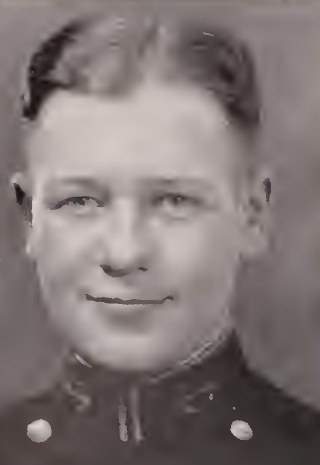
The records support the ship, the navy, and the command dates 12 March 1945 to 28 August 1945 as a compiled pair, and they correct the rank language. "Captain" on that command is the billet, commanding officer. On 11 May 1945, the day that defines the command, the Navy Cross citation calls him commander, "Captain [then Commander]." A Navy Department dispatch given to the Associated Press and published 14 July 1945 was already calling him captain. He is not 荒木傳 and not 荒木政臣. He is a U.S. Naval Academy graduate of the class of 1928, jacket number 062004, later a rear admiral on the retired list.
What follows is one command of five and a half months set on a career that the Navy's own registers document in rank and, until 1941, in duty station, and that then goes quiet for long stretches. The morning off Okinawa is densely recorded. The man who took the ship there is not.
Origins
The Register of Commissioned and Warrant Officers dated 1 July 1945 gives his date of birth as 24 December 1906 and his date of entry into the Navy as 7 July 1924. The 1928 Lucky Bag places him in Spokane, Washington, and the Navy's public account of the Evans fight in July 1945 still described him as "formerly of Spokane, Wash." Nothing consulted here names his parents, a school, or how the appointment to Annapolis was obtained. The class book says he came into the Academy fresh from high school, "with few ideas of the Navy, but he was determined to make a success of his naval career." That is a classmate's sketch, not a record. It calls him Bob. It says the academic departments gave his "ever ready mind" no trouble, that fencing in plebe and youngster years was the activity he made time for, and that "Bob's most important extra curricular activity is the gentler sex." The printed line of credits is fencing in fourth-class and third-class years, varsity numerals in his plebe year, and a Clements Medal in third-class year. What that medal was given for, in 1926, is not established in the sources used here. The sketch's motto, offered as his, is "Why worry?" It also has him preferring a West Coast cruise to a European one. Yearbooks of that kind invent a voice for a twenty-one-year-old. It is fair to report the voice. It is not fair to carry it forward as the temperament of the man who later stood on a destroyer's bridge.
He was still a midshipman in the Register of 1 January 1928. The class graduated that June. By the Navy Directory of 1 January 1929 he was an ensign, ordered to the battleship West Virginia.
Formation
The directories keep him on West Virginia on 1 January and 1 October 1930 and on 1 January 1932. The Register of 1 January 1931 still lists him as an ensign. The directory of 1 January 1932 lists him as lieutenant (junior grade), so the promotion fell in 1931. A secondary compilation, uboat.net, gives 7 June 1931, the ordinary three-year point for the class of 1928. The Register does not, in the pages read for this essay, print that day next to his name, and the date is left as a class pattern rather than a cited order.
From the battleship he moved to the train. On 1 January 1933 he was a lieutenant (junior grade) in Nitro. On 1 April 1934 he was in Bridge. On 1 January and 1 April 1935 he was in the destroyer Dallas. The alphabetical directories say that much. The ship-roster pages are ambiguous about his billet and about which squadron header belongs to Dallas, so this account does not assign him a title aboard her or a squadron. A destroyer tour of at least the first four months of 1935 is what the directories securely show.
On 1 January 1936 he was back at Annapolis as an instructor, still a lieutenant (junior grade). On 1 January 1937 he was still an instructor, and a lieutenant. The day he made lieutenant is not fixed here beyond that window. The postgraduate school of that era sat at the Academy, but the directory calls him an instructor, not a student, and the two are not the same thing.
By the Register of 1 July 1938 his name carried three qualification numbers that the same series of registers defines, and that stay beside him through the wartime lists: 18, completed the Naval War College correspondence course in strategy and tactics; 24-a, completed the postgraduate course in communications; 31, completed the course in torpedo instruction. The registers do not say when he finished each course. They do say that by the summer of 1938 the Navy had marked him as a communications specialist who had also done the War College correspondence course and a torpedo course. That marking matches the next billet the directories give him.
On 1 January 1938 and again on 1 July 1938 he was a lieutenant in the light cruiser Memphis, and the January ship roster abbreviates his duty as "commun." Memphis made a cruise to Australia in the first months of 1938. He is on her books at both ends of the half-year. No muster roll was read for this essay, so the cruise is the ship's, overlapping his assignment, not a reconstructed itinerary of his liberty ports.
Then the Asiatic Fleet. On 1 January 1939 and on 1 October 1939 he was a lieutenant in Isabel. The Dictionary of American Naval Fighting Ships puts that yacht, through the 1930s, with the Asiatic Fleet in the Philippines and China, much of the time as flagship at Manila. He was aboard her in 1939, well before the war, and gone before the December 1941 raids that later made her famous. Nothing here says what he did in her, only that the directory parked a communications-qualified lieutenant on the fleet's yacht for at least those two dates.
By 1 June 1940 the same list has him in the destroyer Peary, and it says "exec." On 1 April 1941 he is still in Peary. The ship roster that month appends "exec nav" to his name, after a year in which the alphabetical line had already called him executive officer. Whether "nav" means he was also navigator, a common double duty in a small destroyer, or is an abbreviation run together by the directory's printer, the roster does not spell out. The secure fact is the executive officer's billet on an Asiatic Fleet destroyer from at least June 1940 through April 1941. The Register of 1 July 1941 still carries him as a lieutenant.
Peary was sunk at Darwin on 19 February 1942, with her commanding officer killed and, on the published accounts of that morning, one officer surviving the ship. Archer is not that officer. He had left. Where he went, and where he was on 7 December 1941, the directories stop in April 1941 and the registers of 1942 and 1943 record rank without station. Nearly three years of a line officer's war are a blank between the last Peary entry and the next document that puts him anywhere.
The staff
The next document is an award, not a deck log. The Legion of Merit, with Combat "V," to Commander Robert John Archer, Navy service number 0-62004, cites him as staff watch officer and flag communication officer on the staff of Commander Carrier Division One, in fast-carrier offensive operations in the South, Central, and Western Pacific from 14 January 1944 to 15 November 1944. The citation's verbs are the Navy's: alertness, a cool and effective watch on the flag bridge, a thorough knowledge of carrier-task-force operations, an aggressive spirit. It says those operations contributed to the capture or neutralization of Truk, Kwajalein, Eniwetok, Saipan, Guam, the Visayas, and Manila, and to the destruction of a large part of the enemy's air and sea forces. That is the citation describing the operations of the force, not a log of which strikes he stood. No flagship is named. No admiral is named in the sources read here. The work itself is the work his education had pointed at since the communications course: someone had to keep a carrier-division flag bridge coherent while the force ran from the Marshalls to the Philippines. He did that job for ten months. Then the citation stops, on 15 November 1944, and the next fixed date is Evans, 12 March 1945. Four months, unaccounted for.
His rank in those years has to be read carefully, because the wartime registers distinguish permanent rank from temporary rank and the secondary lists do not. The lineal list in the Registers of 1 July 1943 and 1 July 1945 dates his rank as lieutenant commander from 1 April 1942. The alphabetical index of 1 July 1943 still calls him lieutenant commander. The index of 1 July 1944 calls him commander. So the temporary promotion to commander fell between those two July registers. uboat.net's date of 15 September 1942 for temporary commander does not survive the 1943 Register and is not used here. On 1 July 1945, two months after the action off Okinawa, the lineal list still seats him among the permanent lieutenant commanders, which is where a temporary higher rank would leave him. The Navy Cross, awarded for 11 May, styles him "Captain [then Commander]." The press release of 14 July calls him captain. A temporary captaincy therefore came after the battle and before that release. uboat.net's 25 March 1945 for temporary captain falls before the battle and contradicts the citation's "then Commander." It is rejected.
Evans
The command dates, 12 March 1945 to 28 August 1945, are the dates given by the compiled commanding-officer list on NavSource, credited there to Wolfgang Hechler and Ron Reeves, and repeated by uboat.net. No deck-log entry of the relief was read for this essay. Within that limit the dates are consistent, and they put him in Evans for the only battle that ended her.
Evans was a Fletcher-class destroyer, commissioned 11 December 1943 under Commander F. C. Camp. Her war before Archer, summarized by the Dictionary of American Naval Fighting Ships and by the ship's page at destroyerhistory.org, was screening, escort, a bombardment of Yap, and the logistic edge of the Iwo Jima landing. He inherited a worked-up ship, not a new one. Nine days after the date given for his taking command, on 21 March, she left Ulithi with escort carriers for the strikes that preceded the landing on Okinawa, stayed with them through the 1 April assault, and entered Kerama Retto on 2 May. If the 12 March date is right, his first weeks in command were that screen: fueling groups, escort carriers, the unglamorous outer ring of an invasion. The record does not preserve an order he gave in those weeks.
On the afternoon of 10 May, Evans and Hugh W. Hadley left the Hagushi anchorage under Commander Task Group 51.5 for Radar Picket Station 15. Hadley was fighter-director ship. Evans was fire-support ship. With them were LSM 193 and LCS 82, 83, and 84, in a diamond a thousand yards on a side, ten knots, reversing every half hour. The two destroyers circled them in column, Hadley leading, fifteen hundred yards apart, fifteen knots, about a mile out. The station sat on the northwest approaches, the side from which the home islands sent aircraft. Commander B. J. Mullaney of Hadley, in his action report, wrote that Evans turned tactical command over to him. The mission, as Hadley stated it, was to detect and report aircraft, control the combat air patrol, and keep enemy planes from the transport area.
That evening, at 1934, Evans shot down a Kate. Hadley logged the same contact a minute later and noted that Evans reported it destroyed. From 0151 to 0340 on the 11th, Evans stayed at general quarters for aircraft in the immediate area, probably reconnaissance. Before dawn a general warning came from Commander Fifth Fleet to expect heavy raids. There were aircraft again from 0640 to 0654. Then a clear interval. At 0605 Hadley had a combat air patrol of twelve planes on station.
The sea, when the fight started, was calm. Wind twelve knots from 170 true. Barometer 29.90 and starting to rise. Air 74 degrees, wet bulb 71, injection temperature 78. Low stratocumulus around five thousand feet, altostratus above, seven-tenths cloud, visibility five to ten miles. Evans's report, printed by Commander in Chief, United States Fleet, in Battle Experience Bulletin No. 24 of 20 July 1945, notes that the calm and the light wind later made it possible to recover men blown overboard and to keep the ship. Those are the sentences of a commanding officer's report. The bulletin heads them "CO USS Evans reports." It does not print his signature. The voice is the ship's, and he was the officer responsible for it.
At 0745 radar showed a bogey from the north. At 0751 a seaplane was in sight about ten miles on the port quarter. It could, from the side, have been friendly. The ship went to general quarters anyway, set Condition Able, and came up to twenty-seven knots. By 0753 it was a twin-float Jake. The five-inch battery opened, then the 40 mm and 20 mm, and the ship was handled to unmask guns. At 0757 the Jake hit the water a thousand yards on the starboard quarter and blew up out of all proportion to its size. Hadley's report has a similar float plane, shot down by Hadley at twelve hundred yards, and describes pontoons that exploded as if packed. The two reports do not have to be the same aircraft. They describe the same opening minutes.
There was a lull until 0830. Then three low planes on the SG radar, bearing 350 true, ten miles. Evans opened with the main battery at 0831 and, within two minutes, splashed all three: a Kate at six thousand yards, a second Kate disintegrated by a five-inch hit at four thousand, a third Kate, which had bent left, burned by 40 mm fire five hundred yards off the port beam. From there the report is a sequence of ranges and type-names, the ship at twenty-eight to more than thirty knots, reversing a well-started turn at the last moment, closing Hadley whenever the attacks let her. Mullaney wrote that he suggested three times that the two destroyers close for mutual support, and that each time the attacks prevented it. They fought, for long stretches, miles apart.
The gunnery chronology in Evans's report, compressed, is the work of less than forty minutes after those first three Kates. An unidentified plane splashed in an assist with Hadley. A Zeke burned at twenty-five hundred yards. Another Zeke into the water at eight hundred. A Tony, shared with Hadley, into the water close aboard the other destroyer. A Tony set on fire, a bomb close aboard, then the plane itself at fifteen hundred yards. An Oscar in flames a thousand yards off the port quarter. A Jill at seven thousand, the five-inch guns already in automatic, the director slewed from the previous target without a cease-fire. A Kate hit and burning that held on until, two hundred yards on the port bow, she dropped a torpedo. Evans, making about ten knots at that instant, put the rudder hard left. The torpedo crossed the bow at less than twenty-five yards. The Kate was finished, going away, by five-inch fire. Another shared Tony. A Val hit so often that the suicide run went out of control and the plane crashed two thousand yards off the bow. An Oscar that dropped a bomb four hundred yards off the port quarter, missed the ship, and crashed. By 0902 two more boilers were on the line and she was making better than thirty knots. A Jill lost a wing to the 40 mm and crashed five hundred yards off the beam. A Tony died at nine thousand yards to the first salvo.
At 0907 the first plane got in. A Judy, already hit, struck at the waterline on the port side at frame 16. The hole was three feet by four. It flooded the lower sound room and a forward living compartment. Power held. A telephone junction box broke and communications with the combat information center went out for a time. The battery was intact.
Two minutes later a Tony was destroyed at thirty-five hundred yards by a direct five-inch hit. Then an unidentified aircraft, on fire, reached frame 122 below the waterline. Divers later reported that the bomb or torpedo it carried exploded just outside the after fireroom. The pilot's body was found on the fantail. The after fireroom and the after engineroom flooded at once; the bulkhead between them was largely blown out. Steering went, then came back on the trick wheel. Speed fell to about eighteen knots.
At 0913 an Oscar out of the sun, hit and still coming, released a bomb and crashed through the superstructure deck over the galley. The bomb went through the main deck and exploded in the forward fireroom. Both boilers went with it. At the same moment a second Oscar, under machine-gun fire, hit the after starboard boat davit and came down on the main deck just forward and outboard of the first. Gasoline burned on the main deck, the bridge, and the director deck. One pilot was in the galley, one on the main deck. Light, power, steam, water pressure, and most communications were gone. The diesel generator picked up and was then shut down because fuel oil and water were over part of its switchboard. Evans was dead in the water.
Hadley's report times Evans out of action at 0900 and then describes twenty minutes in which Hadley fought alone, ending at 0920 in a simultaneous attack by ten aircraft, a bomb, a baka, and two suicide hits, with both enginerooms and one fireroom flooded. The clocks in the two reports do not match to the minute. They agree on the shape of the morning: two destroyers separated by the fight, Evans silenced first, Hadley carrying the last attacks, both ships finished as fighting units, the transport anchorages not reached by this raid. Hadley's fighter-director officer estimated 156 enemy aircraft in five raids. The Presidential Unit Citation later said approximately one hundred. The ship's report does not try to count the sky. It counts what it shot.
At 0925 one more aircraft came dead ahead at four thousand yards, two Corsairs after it. The number-two 40 mm, in manual, hit the port wing at twenty-five hundred yards. The plane missed the bridge, went down the port side, and crashed close aboard astern. That was the last attack.
There was no pressure on the fire main. Bucket brigades formed, using 40 mm cans, buckets, carbon-dioxide extinguishers, and gasoline handy-billies. At 0929 LCS 84 came alongside to starboard. By 0950 the fires were out. Pumping started in the forward engineroom and in compartment A-302-C, with salvage gear from the landing craft and the ship's own pumps. Draft was twenty-two feet forward and seventeen feet six inches aft. A maximum list of three degrees to starboard does not sound like much until it is set next to a ship with three engineering spaces open to the sea and gasoline having burned through the topside. Twenty-seven wounded were treated aboard and sent to LCS 84 for transfer to Ringness (APD-100). Ringness also took off 120 men not needed for salvage. The port anchor had already been jettisoned as the bow took water. Depth charges, smoke generators, and topside ammunition went over. Eight torpedoes were fired to get the weight off; two more, and their tubes, had been wrecked by a crash. LCS 82 picked up the men who had been blown overboard and was alongside to port by 1045, pumping. Harry E. Hubbard came alongside at 1108 with pumps and the impulse charges that let five of the torpedoes be fired. Arikara took the tow for Ie Shima at 1350, draft already down two feet forward and one foot aft. Cree joined. From 1630 to 1900 the ship pumped fuel overboard. At 1915 Cree anchored at Ie Shima. The report's last operational sentence is that a long day was over.
The gunnery officer's comment, printed with the report, is the place where the arithmetic is argued rather than narrated. He had watched thirty to thirty-five aircraft crash into the sea and did not trust that impression. The count he and the other officers would sign to was fifteen shot down unassisted, three assists with Hadley, one assist with the combat air patrol, and four that were hit and still crashed into the ship. Ammunition expended was about eight hundred rounds of five-inch, thirty-four hundred of 40 mm, and fifty-five hundred of 20 mm. He wrote that three aircraft had been destroyed within eight hundred yards, that a five-hundred-pound bomb and a torpedo had missed inside two hundred yards, and that the guns stayed manned until cease-firing was ordered. After power failed he sent the main-battery director crew to salvage, took over as executive officer because the executive officer was critically wounded, and left the assistant gunnery officer on the guns that could still fire in local control. Those guns stayed manned until Ie Shima.
The Associated Press story moved by the Navy on 14 July names that executive officer: Lieutenant John W. Gilpin of Windsor, Vermont, blown over the side by one of the explosions, kept up by Seaman Pat J. Macciocca of Baltimore until both were picked up. The ship's report says critically wounded. The press account says blown overboard and recovered. Both can be true, and neither says whether he lived. The press account also quotes the ship's surgeon, Lieutenant James M. Smith of New Freedom, Pennsylvania: the guns fired so long and so fast that the ammunition loaders had to be relieved. That is the only personal detail the Navy chose to release about how the crew endured the hour. It is not a portrait of Archer. It is a portrait of the battery he was maneuvering the ship to unmask.
The Navy Cross citation, to Captain (then Commander) Robert John Archer, compresses the morning into one sentence of credit and one of damage: he directed the batteries in shooting down fifteen enemy planes and assisting in the destruction of four others; the ship, hit by four suicide planes and in a sinking condition, was saved and brought to port. The Presidential Unit Citation to the ship, signed for the President by James Forrestal, uses different numbers: fourteen destroyed, three assisted, then a coordinated attack by five, one shot down clear, four crashed into her; engineering spaces flooded, a fire amidships, the ship saved and towed to port. The 14 July press account says fifteen and four assists in seventy-three minutes, which matches the citation more nearly than the unit citation. The gunnery officer's fifteen-plus-four is the count made by the men who had the logs. The disagreements are small and official. They are left standing. What does not move is the four hits, the loss of the engineering plant, and the fact that the hulk was still a ship that evening.
The Dictionary of American Naval Fighting Ships, as quoted in the Navy's own history index and as followed by destroyerhistory.org, gives the price as thirty-two killed and twenty-seven wounded. The twenty-seven wounded are the number the action report says were treated aboard. The thirty-two dead are not itemized in the bulletin extract. The same histories say she was towed into Kerama Retto on 14 May for repairs. That does not contradict Ie Shima on the night of the 11th. It is the next port, the repair anchorage. She was not restored. She was towed on to San Francisco, decommissioned on 7 November 1945, and sold for scrap on 11 February 1947. NavSource dates Archer's relief by John Edward Pace to 28 August 1945, more than two months before decommissioning. Where that relief happened, and whether he rode the tow, is not in the sources read here. His command, on those dates, ran from a fighting destroyer to a ship the Navy had already decided not to spend a yard period on.
The unit citation belongs to the crew. The Navy Cross belongs to him, for directing the guns and then the saving of the ship. Nothing in either document, or in the action report, records a word he spoke. The report is all bearings, speeds, frames, and drafts. That is the evidence of how he conducted the hour: a communications-trained destroyer executive, seventeen years out of Annapolis, given a Fletcher for nine days before the Okinawa sortie and a picket station six weeks after that, handling the ship to keep guns bearing, taking a torpedo across the bow at twenty-five yards, and, once the plant was gone, stripping weight off a hull that had no fire main. The yearbook's "Why worry?" has no business in that paragraph. The report worries, in the only way a damage-control narrative can, about draft, list, and which bulkhead is still there.
The cost
Thirty-two men, if the fighting-ship history is right, did not come back from a station he had occupied for less than a day. Twenty-seven were wounded badly enough to be logged as treated and transferred. His executive officer was critically wounded and, on the Navy's press account, in the water. A hundred and twenty men were taken off because the ship no longer needed them to fight her, only a salvage party to keep her from going down. The four aircraft that hit her ended a hull the Navy would not repair. Archer remained her commanding officer, on the compiled dates, until 28 August, which means the cost was not a morning he could hand to someone else. It was the summer of a dead ship, the identification of the dead, the tow, and the knowledge that the saving of her had bought a decommissioning rather than another patrol.
No letter home, no court of inquiry transcript, and no oral history of his were found. The press release of 14 July gives him a residence, Piedmont, California, and a past, Spokane, and gives Mullaney's wife a city. It does not give Archer a wife. If there was a household in Piedmont waiting on the casualty list, this research did not learn its names.
After
The Register of 1 July 1947 lists him as a lieutenant commander again, the permanent rank dated 1 April 1942, the wartime temporary ranks no longer worn in that book. The Register of 1 January 1952 lists him as a captain, and so does the Register of 1 January 1955. The Register of 1 January 1958 still carries him among the unrestricted line officers in the company of the classmates who had been captains in 1955; the rank word itself is not legible in the copy read, but he is not in a retired section there. The Register of 1 January 1960 lists him, file number 062004, as rear admiral, retired. Hall of Valor's short biography says the same: Naval Academy, 1928, retired as a rear admiral. uboat.net dates the retirement 1 July 1958 and the flag rank to that day. The registers bracket the retirement between 1 January 1958 and 1 January 1960 and do not prove the day, or whether the star was an active-duty selection or an advancement on the retired list. The registers also do not say what billets he held from the end of Evans to that retirement. Fourteen years of a captain's career are, in the sources used here, a rank and a file number.
The only later household that can be documented is his widow's, and it is documented from her death, not his. A Maryland death notice transcribed on GenealogyBuff, consistent in style with an Annapolis newspaper obituary, reports that Elsie Southerland Archer died at home in Virginia Beach on 25 September 2000, aged 89, after a short illness. She had lived at Ginger Cove in Annapolis and had been in Annapolis for forty years until August 2000. She was born and raised in Durham, North Carolina. The notice calls her the widow of retired Admiral Robert J. Archer, a 1928 Naval Academy graduate, and says they were for many years active in the Annapolis Sailing Club. It says she worked seventeen years for Maryland state senators Edward P. Thomas and John Derr and retired in 1982 "at the age of 81," which cannot be reconciled with a death at 89 in 2000 without assuming a misprint in one figure or the other. The notice does not say which. Her survivors are given as two sons, William Thomas Rigsbee and Robert Henry Rigsbee, both of San Francisco, a daughter, Ann Rigsbee Glenn of Virginia Beach, a sister, three grandchildren, and a great-grandson. They are her survivors. The surname is not Archer. The notice does not say they were his children, his stepchildren, or the children of an earlier marriage of hers. A private graveside service was to be held at the Naval Academy Cemetery. That is her service. It is not, by itself, proof of where his body lies, though it is the ordinary arrangement for a widow buried with a graduate.
Hall of Valor and uboat.net both give his death as 2 January 1991 at Annapolis, aged 84. No contemporary obituary, death certificate, or cemetery card was found to confirm the day. The widow's notice is compatible with his having died years before 2000, and with the couple having settled in Annapolis around 1960, which is when her "forty years" would have begun and when his retirement, on the register evidence, had recently happened. Piedmont in 1945 and Annapolis in retirement are both attested at one remove. The road between them is not.
He left, on the paper that survives, a Navy Cross, a Legion of Merit with Combat "V," a ship's Presidential Unit Citation earned under his command, a file number, and a widow who sailed and then worked into old age in the town where he had been educated. He did not leave, in any source read for this essay, a statement of what the morning on Station 15 had cost him, or the name of a child who bore his name.