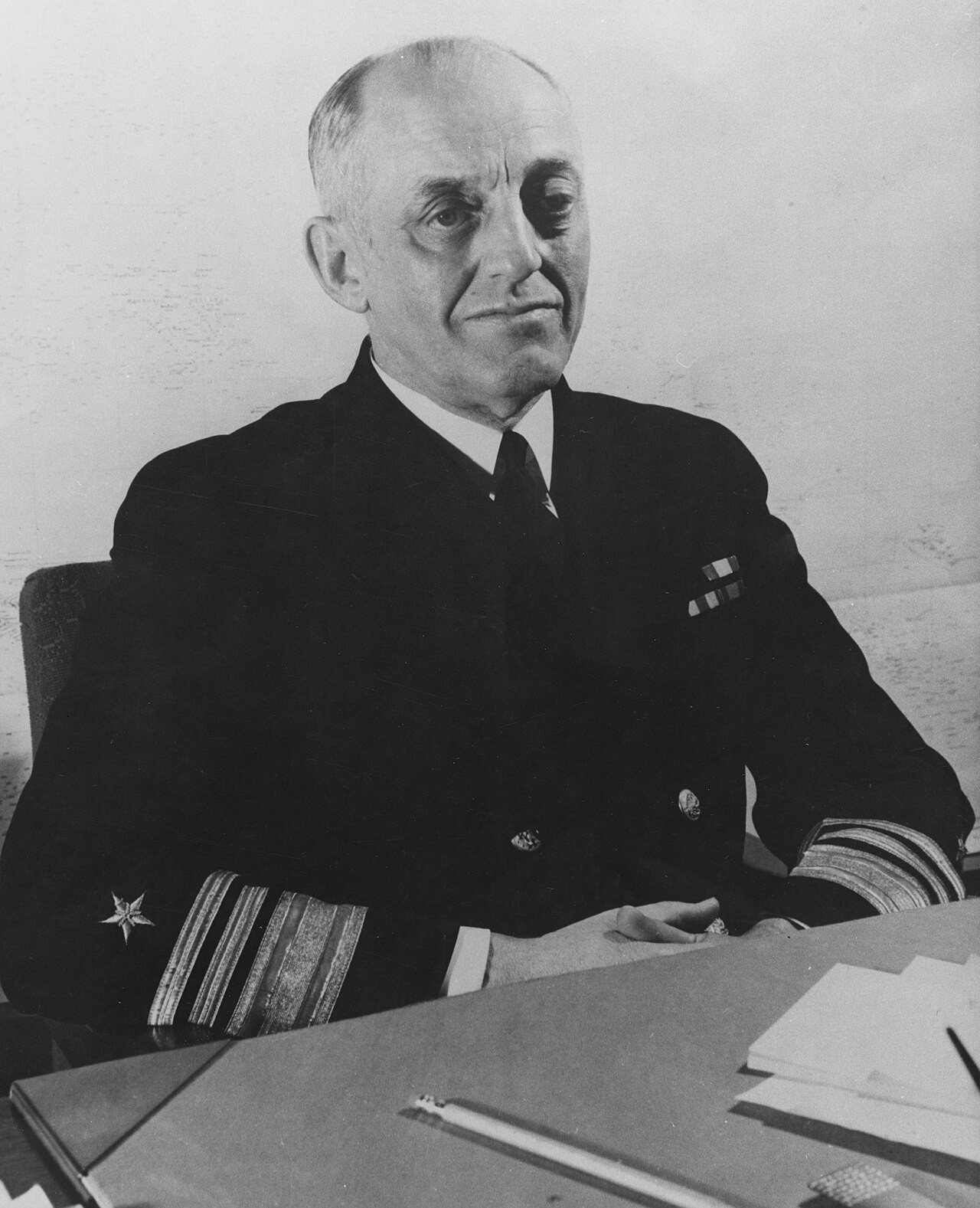
Ships
- USS Nevada (BB-36) Captain from 25 June 1935 · Relieved on 23 June 1936
Robert Lee Ghormley was born in Portland, Oregon, on 15 October 1883, the eldest of six children of David Owen Ghormley, a Presbyterian minister, and Alice Minerva Irwin Ghormley. He was a student at the University of Idaho when he was appointed to the United States Naval Academy. He entered Annapolis on 23 September 1902 as a midshipman from Idaho and graduated in June 1906, twelfth in a class of 116. At the Academy he played football as a back, and classmates remembered a quiet man who was anything but quiet in a game.
His first ship was the armored cruiser West Virginia. After the two years at sea then required before a commission, he was made an ensign in 1908 and went on to the auxiliary cruiser Buffalo and the cruisers Charleston and Maryland. From 1911 to 1913 he served as aide and flag lieutenant to the commander in chief of the Pacific Fleet and took part in the Nicaraguan campaign of 1912. He then returned to the Naval Academy, with duty in the Division of Physical Training and in the Executive Department.
In June 1916 he joined the battleship Nevada. On 6 January 1917 he became her first lieutenant. Promoted to lieutenant commander on 23 May 1917, he spent the rest of the First World War as gunnery officer of Nevada and as aide and flag lieutenant on the staff of the commander of Battleship Force One and Squadron Two, Atlantic Fleet. The Secretary of the Navy sent him a letter of commendation for that staff duty. Late in the war he came ashore as assistant director of the Naval Overseas Transportation Service.
In 1920 he commanded the patrol vessel Niagara, and in 1921 the destroyer Sands, taking Sands to the Mediterranean. He was promoted to commander in July 1921. From 1923 to 1925 he was aide to the Assistant Secretary of the Navy, and for the next two years he was executive officer of the battleship Oklahoma. In 1927 he became secretary of the General Board in Washington. Three years later he went to sea as chief of staff to the commander of the Battle Force, and in 1931 he shifted to the same kind of duty with the commander in chief of the United States Fleet. He then headed the tactical section in the Fleet Training Division under the Chief of Naval Operations.
As a captain, Ghormley took command of Nevada on 25 June 1935 and was relieved on 23 June 1936. He knew the ship from the inside, having learned her guns and her routine as a lieutenant two decades earlier. After he left the battleship he spent a year as operations officer on the staff of the commander in chief, United States Fleet, and in 1938 he finished the senior course at the Naval War College.
Promoted to rear admiral, he served as director of the War Plans Division and as assistant chief of naval operations until August 1940. The Navy then sent him to London as special naval observer at the American Embassy. Through the last months of American neutrality, and into the first months after Pearl Harbor, he followed the Royal Navy's war and sat in the confidential Anglo-American staff talks that set out how the two navies would fight the Axis together.
In the spring of 1942 he was ordered to the Pacific. On 19 June 1942, in the rank of vice admiral, he became commander of the South Pacific Area and South Pacific Force. He opened his headquarters in Auckland and then moved them to Nouméa, in New Caledonia, closer to the coming fight. On 7 August the Marines landed on Guadalcanal and Tulagi and took the airfield soon named Henderson Field. The hold on that field turned desperate at once. In a night action off Savo Island on 9 August a Japanese force sank four Allied cruisers. The carriers drew back, and the troops ashore were left short of food, fuel, and ammunition. Through September and early October Ghormley tried to keep the island supplied and the airfield working while Japanese ships and aircraft pressed the campaign. He ran the theater from Nouméa for the whole of his time in command. His reports grew bleak about whether Guadalcanal could be held with the forces he had. Admiral Chester W. Nimitz relieved him in October 1942 and gave the South Pacific to Vice Admiral William F. Halsey, Jr. Ghormley's tenure ended on 20 October.
He served at the headquarters of the commander in chief, United States Fleet, in Washington until February 1943, then became commandant of the Fourteenth Naval District and commander of the Hawaiian Sea Frontier. Near the end of the war he commanded United States naval forces in Germany. He retired on 1 August 1946 as a vice admiral and died on 21 June 1958.