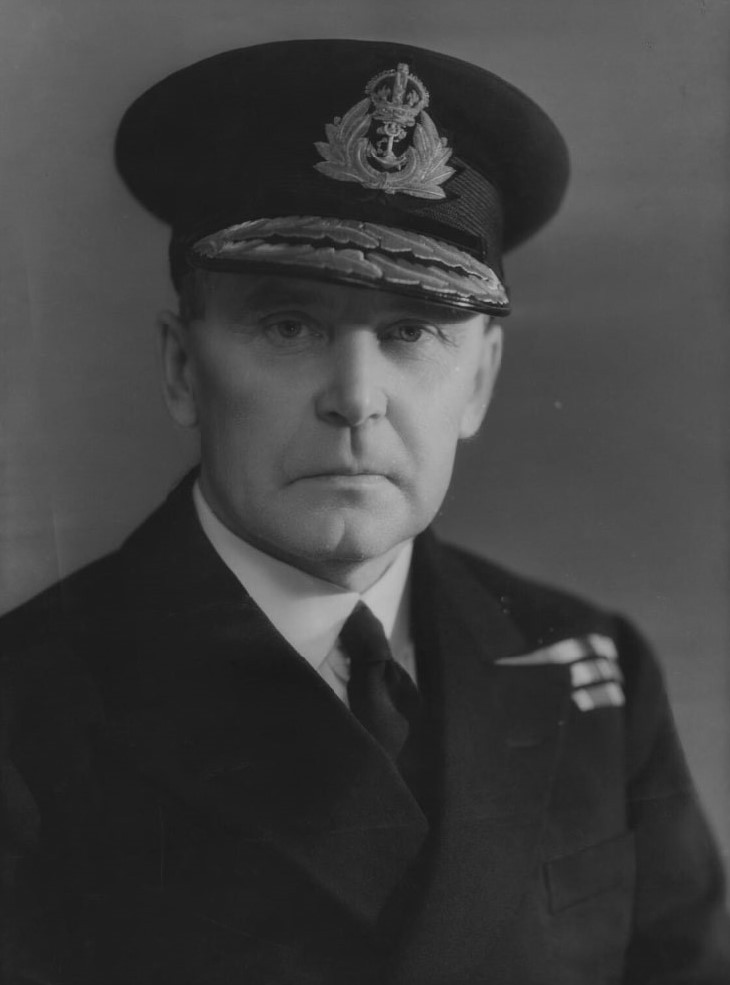
Admiral Sir Tom Spencer Vaughan Phillips was a Royal Navy officer whose service ended in the first week of the Pacific war. He was born on 19 February 1888 at Pendennis Castle in Falmouth, Cornwall, the son of Colonel Thomas Vaughan Wynn Phillips of the Royal Artillery and of Louisa Mary Adeline de Horsey, daughter of Admiral Algernon de Horsey. He stood about five feet four inches and was known in the service as Tom Thumb. He was a Knight Commander of the Bath. His wife, Lady Phillips, lived at Bude in Cornwall.
He joined the Navy as a cadet in 1903, after Stubbington House, and the next year he was a midshipman under training in Britannia. He was a lieutenant before the First World War. During that war he served in destroyers in the Mediterranean and in the Far East, and in July 1916 he was promoted lieutenant-commander. After the Armistice he attended the Royal Navy Staff College and then spent a period as a naval adviser with the League of Nations commission on naval, military, and air questions. He became a commander in 1921 and a captain in 1927.
Between the wars his name was made largely on the staff. He served in the Admiralty Plans Division as an assistant director in the early 1930s, with a spell at sea in the Far East between staff appointments, and from the middle of the decade he directed the division. In 1938 he returned afloat as commodore in charge of the Home Fleet destroyer flotillas. On 10 January 1939 he was promoted rear admiral, having lately been an aide-de-camp to King George VI.
On 1 June 1939 he became Deputy Chief of the Naval Staff. The post was restyled Vice Chief of the Naval Staff while he still held it, and he remained there until October 1941. Winston Churchill backed him, and in February 1940 he was given the acting rank of vice admiral. He sat close to the center of naval planning through the first two years of the war. That autumn he was sent east with the acting rank of admiral to command British naval forces based toward Singapore. Inside the Navy the choice was disputed, because so much of his recent service had been at a desk rather than with a fleet.
He sailed from home waters in late October 1941. The new battleship Prince of Wales was his flagship, in company with the older battlecruiser Repulse and a small destroyer escort. The carrier meant to join them, Indomitable, had grounded in the West Indies and stayed behind. The ships reached Singapore on 2 December 1941 and were designated Force Z. Captain John Leach commanded Prince of Wales. Phillips flew his flag in her. Phillips was not her captain.
Japan began landing troops in Malaya on 8 December 1941. That evening Phillips took Prince of Wales and Repulse north from Singapore with destroyers, hoping to strike Japanese transports before more soldiers could be put ashore. He had asked for air support on the run toward Singora and had been told that fighters could not be provided there. He left Rear Admiral Arthur Palliser at the Singapore base. On 9 December Japanese aircraft and a submarine found the force. Phillips turned south again for Singapore. During the night a signal reported a landing at Kuantan, halfway down the east coast. The report proved false. He altered course to investigate and held radio silence, so Singapore did not learn of the diversion and no fighters were sent to that part of the coast.
On 10 December 1941, off Kuantan, shore-based Japanese naval aircraft attacked in successive waves with bombs and torpedoes. The sinking is not credited to one plane. Repulse went down in the early afternoon. Prince of Wales, already badly hit, sank a short time later. Phillips was lost with Prince of Wales, and Captain John Leach was lost with the ship. The escorting destroyers took off the greater part of the crews. About 840 men from the two ships were killed. Phillips was 53. His name is on the Plymouth Naval Memorial. With Prince of Wales and Repulse gone, the Royal Navy had no capital ship left off Malaya, and Singapore surrendered on 15 February 1942.