Ships
- USS Mississippi (BB-41) Captain from 20 December 1941 · Relieved on 27 June 1942
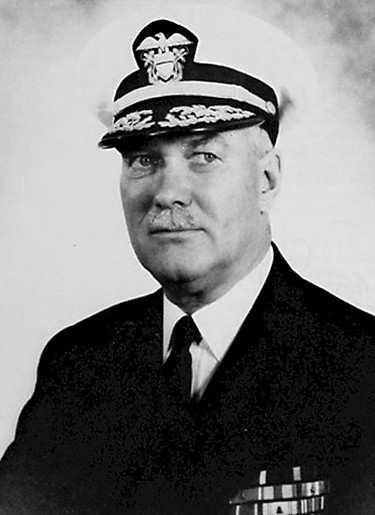
Walden Lee Ainsworth, known in the Navy as Pug, was born in Minneapolis, Minnesota, on 10 November 1886. He graduated from the United States Naval Academy in 1910 and was at sea for the occupation of Veracruz in 1914. During the First World War he served in the transport DeKalb. In the years that followed he specialized in ordnance, commanded destroyers, and returned to Annapolis for a tour as an instructor.
Study at the Naval War College led to his assignment, in June 1936, as executive officer of the battleship Mississippi. He left that ship in 1938 to become professor of naval science and tactics at Tulane University in New Orleans. As a captain he took command of Destroyer Squadron 2 on 22 July 1940 and kept the squadron on the Atlantic Neutrality Patrol while war spread in Europe. He had married Katherine Gardner in 1916.
Ainsworth came back to USS Mississippi (BB-41) as commanding officer on 20 December 1941, days after the attack on Pearl Harbor. He took the battleship from the Atlantic into the Pacific, where the battle line needed reinforcement, and through the first half of 1942 she watched the Pacific coast. He was relieved on 27 June 1942.
Promoted to rear admiral, he hoisted his flag on 4 July 1942 as Commander, Destroyers, Pacific Fleet. In December 1942 Admiral William F. Halsey placed him over a cruiser and destroyer striking force in the South Pacific, Task Force 67, formed around Cruiser Division 9 and based at Espiritu Santo. The force earned the name Ainsworth Express for the pace of its runs up the Solomons. On 5 January 1943, with his flag in Nashville, he led a night bombardment of the Japanese airfield at Munda Point on New Georgia.
The heaviest surface fighting came that summer. On 5 July 1943 his ships shelled Japanese positions around Kula Gulf while troops landed at Rice Anchorage, and the next night they met a Japanese force in the gulf. American gunfire sank the destroyer Niizuki, and torpedoes sank the light cruiser Helena. Off Kolombangara a week later, gunfire from his formation sank the Japanese light cruiser Jintsu, while torpedoes damaged Honolulu, St. Louis, and the New Zealand cruiser Leander and left the destroyer Gwin to be scuttled. The Navy Cross recognized his conduct at Kula Gulf, and the Navy Distinguished Service Medal covered his South Pacific task-force command from 10 December 1942 to 18 July 1943.
He remained commander of Cruiser Division 9 into the autumn of 1944, leading task forces and groups through the Marianas, the Palaus, and Leyte, including the fire-support group for the landings on Guam. Honolulu, often his flagship, received a Navy Unit Commendation, and he was awarded the Legion of Merit with a Gold Star in lieu of a second award. On 31 October 1944 he became administrative commander of the cruisers and destroyers of the Pacific Fleet. He returned to the United States in the summer of 1945 and on 20 August assumed command of the Fifth Naval District.
Ainsworth held the Fifth Naval District until he retired on 1 December 1948, when he was advanced to vice admiral. He and Katherine settled in Wonalancet, New Hampshire. He died at the Naval Hospital in Bethesda, Maryland, on 7 August 1960, and was buried at Arlington National Cemetery. On 15 April 1972, at Westwego, Louisiana, his widow christened the frigate Ainsworth, named for him.