Ships
- USS Northampton (CA-26) Captain from 17 May 1930
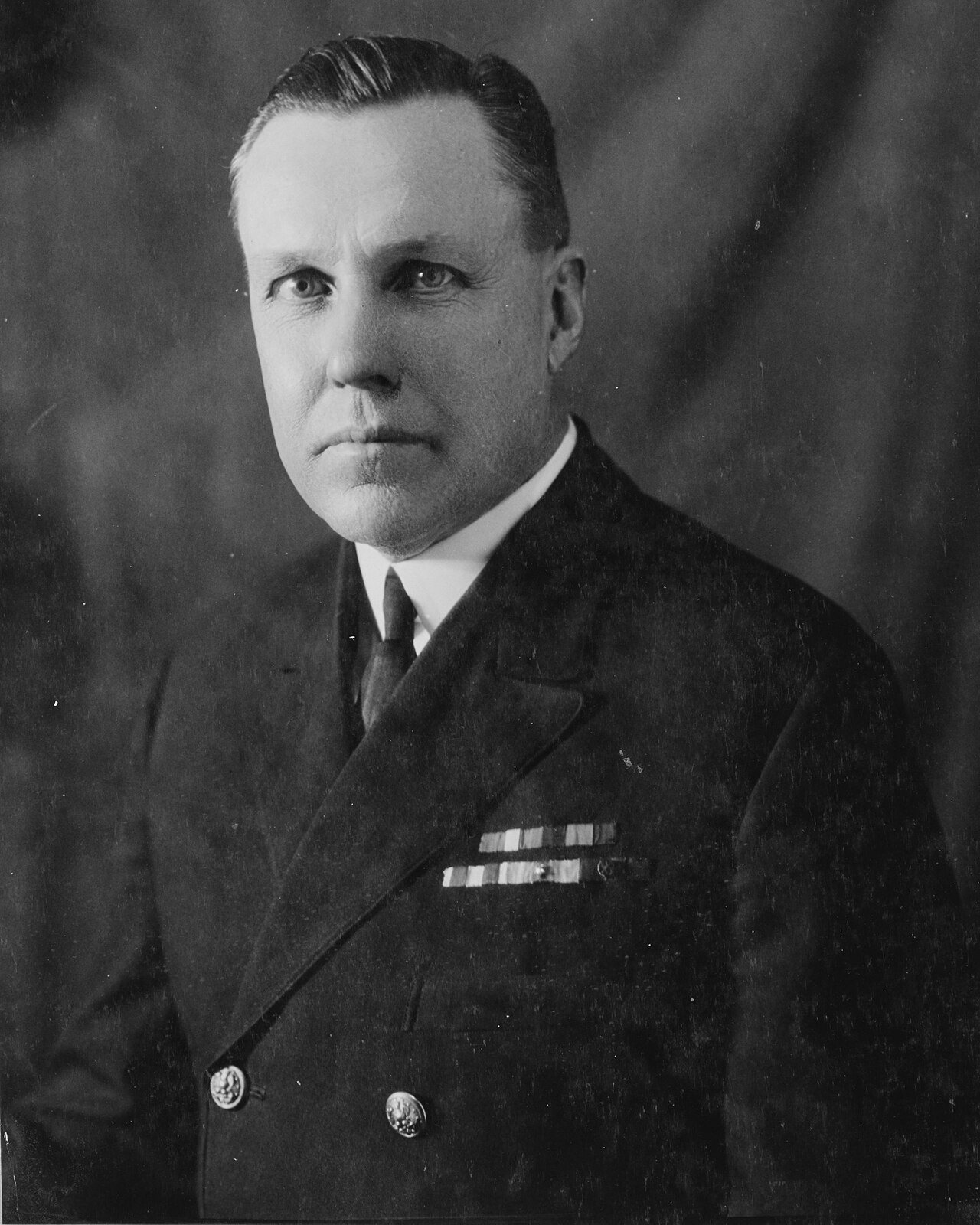
Walter Newhall Vernou was born on 10 February 1878 at Fort Larned, Kansas, the son of Army Colonel Charles Alexander Vernou, a Civil War veteran, and Lucy Mary Lewis Vernou. Appointed a naval cadet from Michigan, he entered the United States Naval Academy in September 1897. During the Spanish-American War the Academy sent him to sea in the cruiser Newark and afterward in the gunboat Peoria. He returned to Annapolis, finished with the Class of 1901, and began a career that carried him into the first months of the Second World War. His time in Newark brought the Sampson Medal, and he also received the Spanish Campaign Medal.
In the First World War Vernou commanded destroyers in European waters. He led Beale and then Cassin on patrol and convoy duty off Ireland and with the naval forces working from France. On 15 October 1917, while Cassin was screening a convoy, a German submarine attacked the destroyer. Vernou’s conduct of the ship in that fight earned him the Navy Distinguished Service Medal. In May 1918 he placed the new destroyer Sigourney in commission and commanded her into late summer. His World War I Victory Medal carried the destroyer clasp for service in Sigourney.
After the war he studied at the Naval War College in Newport, then served on the college staff from 29 May 1924 until 2 July 1925. He next went to China as chief of staff to the commander in chief of the Asiatic Fleet, whose flagship was Pittsburgh, and spent about two years on that station. The Yangtze Service Medal marks that duty. In October 1927 he returned to the War College staff and stayed until May 1930.
On 12 February 1930 he reported to the Bethlehem yard at Quincy, Massachusetts, to fit out the new cruiser Northampton. He took command when she was commissioned on 17 May 1930 and remained her captain until June 1932. That first summer she made her shakedown cruise to the Mediterranean, then joined the Atlantic Fleet’s training schedule in the Caribbean and the Canal Zone, with occasional exercises in the Pacific. In 1931, still under his command, she was reclassified as a heavy cruiser with the hull number CA-26, lead ship of a class armed with 8-inch guns.
Leaving Northampton in June 1932, Vernou became naval aide at the White House and held that post for two years, first under President Herbert Hoover and then under President Franklin D. Roosevelt. He afterward completed the senior course at the Naval War College. Promoted to rear admiral with date of rank from 1 September 1934, he reported on 30 March 1935 as commander of Cruiser Division Three in the Battle Force. On 10 June 1936 he also assumed command of the Battle Force cruisers, keeping Cruiser Division Three, and he held both assignments until 22 June 1937.
From 4 September 1937 until 10 August 1939 he was commandant of the Fifteenth Naval District and commanding officer of the Naval Station at Balboa, in the Canal Zone. He then commanded Battleship Division Two, with Tennessee as his flagship, until 31 January 1941. His last active assignment was senior member of the Board of Inspection and Survey, Pacific Coast Section, at Long Beach, California. That duty ran from before the Japanese attack on Pearl Harbor through 28 February 1942.
Vernou went on the retired list on 1 March 1942, having reached the statutory age of sixty-four, and was released from active duty. He held the retired rank of vice admiral. With the Distinguished Service Medal he also wore the Sampson Medal, the Spanish Campaign Medal, the World War I Victory Medal with destroyer clasp, the Yangtze Service Medal, and the American Defense Service Medal with fleet clasp. He died in Coronado, California, on 23 May 1955.