Ships
- USS Lamson (DD-367) Captain, 12 June 1942 – 23 June 1942
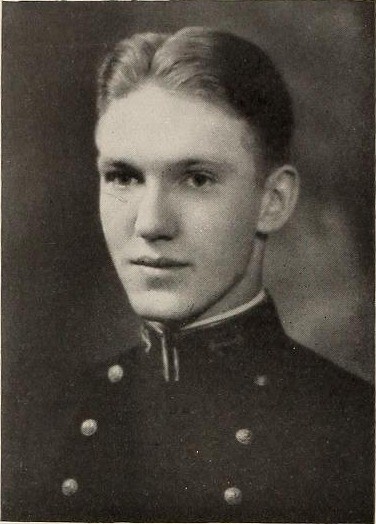
Walter Terry Jenkins, born at Youngstown, Ohio, on 2 April 1907, was a Naval Academy graduate of 1930 and a gunnery specialist. For eleven days in June 1942, as a lieutenant, he is listed as commanding officer of the destroyer Lamson in the South Pacific, between the departure of her previous captain and the arrival of the man who would command her through Tassafaronga and the first New Guinea operations. A year later, as a commander, he was gunnery officer on the staff of Commander, North Pacific Force, and received the Legion of Merit for that work. The surviving record is short and mostly official, and it leaves most of his life unlit.
The 1930 Lucky Bag gives his home as Youngstown, Ohio, and the Hall of Valor entry for his Legion of Merit gives the same town. The yearbook sketch is the only account of his boyhood the sources offer, and it offers hardly any: he was, it says, "more proud of being one of Ohio's native sons" than anyone else in his class, and a visit to Annapolis and "a glimpse of the Navy with its fascinating life" had been too strong an attraction for him. His parents, schooling before the Academy and the circumstances of his appointment are not recorded in the sources. He entered the Academy in 1926, at nineteen, if the usual four-year course is taken as the guide to the date.
The sketch was written by his classmates and is affectionate and teasing. It says he began "as a very unobtrusive young man," but that at the start of second-class year "he seemed to take on a new role": he "forgot his seriousness and became essentially a seeker of the lighter things." He was "of an independent disposition," did not believe "in relying upon others for guidance," was "quick to flare up" and "just as quick to forgive." He "never did care for D.O.'s" (duty officers), and "always had a tender regard for the little brown Regulation Book." He wanted to be an athlete "but somehow just never got around to it." The one thing he could be depended on for was rifle shooting, where, the sketch says, "he could always be depended upon to bring back four cents change from a nickel." Its last word is that in four years the class had found in him "a sterling character and a friend who will remain."
His classmates called him "Jinks." The listed activities include the outdoor rifle squad for several years, the Masqueraders in his second-class year, and class football in his first-class year. Rifle shooting is the most useful clue to what followed, since he would spend a large part of his later career in ordnance and gunnery, but the sketch does not say that he planned it. He graduated in 1930, at twenty-three.
The record between graduation and the war is almost blank. The one fixed point is a promotion: he became a lieutenant on 30 June 1938, at thirty-one.
His only listed command is Lamson (DD-367), a Mahan-class destroyer built at Bath, Maine, and based at Pearl Harbor from 1939. She was returning to Pearl Harbor from patrol during the attack of 7 December 1941, and she went to the South Pacific early in 1942. According to the ship history, in March she arrived in the Fiji Islands to join an expanded antisubmarine screen "to keep the South Pacific supply lines open," and after six months of patrol and screening she saw action on 22 October, when she and Mahan attacked Japanese picket boats between the Gilbert and Ellice Islands and sank two.
Command lists give her commanding officers in this period as Lieutenant Commander Preston V. Mercer from April 1941 to 12 June 1942, then Lieutenant Walter T. Jenkins from 12 June to 23 June 1942, then Lieutenant Commander Phillip H. Fitz-Gerald from 23 June, who stayed until November 1943. Jenkins therefore had the ship for eleven days at the age of thirty-five. The same lists show his rank advanced to lieutenant commander, on a temporary basis, on 15 June 1942, three days into the interval. The record does not say whether he had been Lamson's executive officer, why Mercer left on 12 June, or whether Jenkins was simply holding the ship until her new captain reported; it also names no event in those eleven days.
He was promoted to temporary commander on 15 October 1942, according to the same source. The next fixed point is the Legion of Merit citation, printed in the Bureau of Naval Personnel Information Bulletin for April 1944. It credits Commander Walter T. Jenkins, United States Navy, with "exceptionally meritorious conduct in the performance of outstanding services" as gunnery officer on the staff of Commander, North Pacific Force, from February to October 1943. He "rendered invaluable assistance," it says, "in the planning and operations involving all gunner matters and in the supply, replacement and storage of all ammunition." The North Pacific Force was the command that fought the Aleutian campaign in 1943, and his months on its staff fell inside that campaign, but the citation itself names no operation, and what he did day to day is not described. He was thirty-five when the period began and thirty-six when it ended.
Nothing in the sources places him between October 1943 and the postwar years.
In 1954 a Captain Walter T. Jenkins, a graduate of the Class of 1930, was Head of the Department of Ordnance and Gunnery at the Naval Academy and a member of the Academic Board, as the Academy's annual register for 1954–55 lists him. That year the U.S. Naval Institute Proceedings printed his review of United States Navy Bureau of Ordnance in World War II by Buford Rowland and William B. Boyd, which gives a sense of how he wrote and what he thought important.
He described a book "written in an interesting narrative style" that "vividly describes the problems, failures, and accomplishments in Naval Ordnance" during the interwar and war years, and he praised the chapter on torpedoes for those "who held such a marked respect for the Japanese torpedo and little else but criticism for our own," because it set out the defects, "the manner in which they were discovered, and the tremendous problems surmounted in overcoming them." He noted what the British had passed on, in degaussing, depth charges and nets and booms, and he ended by saying that with the book as a guide there was "assurance that responsible personnel in the field of Naval Ordnance can continue to insure our preparedness in the future."
That is the last time he appears in the sources, apart from the officer listing that records him. He is recorded as having died at Gladwyne, Pennsylvania, on 23 March 2001, aged ninety-three. His marriage, children, the date of his retirement and the rank at which he retired are not given in the sources.