Ships
- USS Alden (DD-211) Captain, 24 November 1919 to 5 February 1921
- USS Colorado (BB-45) Captain, December 1934 to February 1936
William Alexander Ancrum was born on 8 July 1881 at Rossdhu, his mother’s parents’ place in Abbeville County, South Carolina. He was the eldest son of William Alexander Ancrum II, a planter who had fought in the Civil War, and Anna Susan Calhoun. The family was Huguenot and Scottish Charleston stock that had settled around Camden, and his mother’s line ran to John C. Calhoun. He grew up on Redbank Plantation and in Camden.
South Carolina sent him to the Naval Academy in May 1898. He left in February 1899 and came back that May. He graduated on 2 February 1903 and was commissioned an ensign on 3 February 1905.
His first sea duty was in Asia. He crossed to China in the battleship Wisconsin, then served in Oregon, then in the destroyer Chauncey. In the Russo-Japanese War, Chauncey kept a neutrality patrol in the western Philippines and took part in operations against the Moros. In 1907 he joined Minnesota at her commissioning and made the cruise of the Great White Fleet.
The first ships he commanded were destroyers. He had Warrington late in 1912 and Jarvis in 1913. From September 1913 to July 1915 he had Flusser and the First Division of the Atlantic Torpedo Flotilla. That division escorted General Funston’s force to Veracruz and brought refugees out of Tampico.
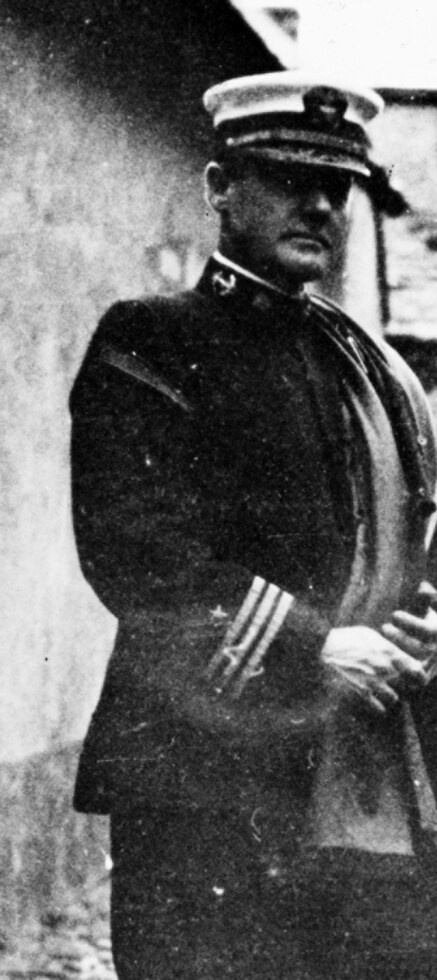
On 1 August 1917 he joined Admiral William S. Sims’s staff in London. Through 1918 he also worked at Southampton, inspecting conditions on the small steamers. He was made a temporary commander on 1 January 1918, and the Secretary of the Navy sent him a special letter of commendation. The photograph is from France in that war. The three stripes are a commander’s.
After the armistice he trained merchant captains for the ships that carried the troops home. He then commanded Sigourney and Destroyer Division Six, and after that Alden and Destroyer Division Twenty-Six, from 24 November 1919 to 5 February 1921. In 1920 and 1921 the division worked the eastern Mediterranean and the Black Sea. From the Adriatic he was sent back to Constantinople. About 130,000 White Russians had left the Crimea in roughly 120 vessels after the Bolsheviks took it, and he helped see them through. He went on to Cattaro Bay ahead of the first 20,000 the Yugoslavs had agreed to receive. For the Adriatic work Italy gave him the Order of Saints Maurice and Lazarus. Belgium had already given him the Order of the Crown, in October 1918.
He reached captain on 4 June 1926. Between the wars he had Tallahassee, inspected ordnance at Homestead Steel, and was executive officer of Utah, including her diplomatic cruise to South America in 1924. He held a short regimental command ashore from Battleship Division Two, then the hospital ship Mercy, the senior course at the Naval War College, and Captain of the Yard at Charleston from 1927 to 1929. He commanded the destroyer tender Whitney. From 1931 to 1934 he was Marine Superintendent of the Panama Canal. A slide in the Gaillard Cut stopped traffic for two days while he held that post, and the whole United States Fleet made its first continuous transit of the canal. From December 1934 to February 1936 he commanded the battleship Colorado. He closed the peacetime career as chief of staff and aide to the commandant of the Fifth Naval District, at Norfolk. Passed over for flag rank, he retired at his own request on 1 September 1938, after about forty years.
Charleston
Orders dated in May 1941 recalled him. From 24 July 1941 through 12 March 1945 he was Port Director of the Sixth Naval District, with headquarters at Charleston, and he was the district’s convoy and routing officer. The district covered the South Carolina and Georgia coast and the ports nearby. He had no ship. He controlled the merchant ships that used those ports, the Armed Guard gun crews and the communication liaison groups put aboard them, and the routes of the merchantmen, the hospital ships, and certain naval auxiliaries. The work ran through the U-boat attacks of 1942 and the build-up that followed. The Secretary of the Navy commended him, and the commendation carried the ribbon, for leadership and administration well beyond what the billet usually asked. He was sixty-three. He asked to be relieved and left active duty on 12 March 1945.
For that war the medals were the Commendation Ribbon, the American Defense Service Medal, the American Campaign Medal, and the World War II Victory Medal. He already held the Spanish, Philippine, Mexican, and World War I campaign medals. The Belgian and Italian orders belong to the first war and to the Adriatic duty of 1920 and 1921.
He married Cora Nesbit Carrison of Camden in 1909. Their son, William Alexander Ancrum IV, graduated from the Citadel in 1932, served as a Coast Artillery reserve lieutenant, and died in 1939 at twenty-nine. Their daughter Margaret married Roger Trask Carleson of the Marine Corps, who became a general. In 1938 Ancrum bought Lower Waverly Plantation at Pawleys Island and renamed it Rossdhu. He died on 11 March 1963 at his brother Thomas’s home in Camden and was buried at Arlington National Cemetery, Section 8, Site 5096-B.