Ships
- USS Cushing (DD-376) Captain, 24 May 1940 – 24 September 1941
William Bennett Jackson Jr. (2 July 1898 – 6 September 1973) was a United States Navy officer from Ohio, a graduate of the Naval Academy in the class of 1921. He spent the 1920s and 1930s in the fleet's cruisers, battleships and destroyers and on staffs ashore, and in May 1940, as a lieutenant commander, he took command of the Mahan-class destroyer Cushing, which he kept until September 1941. He was promoted to temporary captain in June 1942 and from 7 January 1943 to 17 March 1944 served as chief of staff of the Navy's service squadrons in the South Pacific, for which he received the Legion of Merit. On 15 May 1945 he put the new light cruiser Providence into commission, and he commanded her through the first nine months of her career, until February 1946. He died at Camarillo, California, in 1973, aged seventy-five.
He was born on 2 July 1898, the son of William Bennett Jackson, and is recorded in naval compilations as born at Antwerp, Ohio, a small Paulding County town in the northwest corner of the state. The Naval Academy's yearbook gives his home as Paulding, the county seat. A genealogical listing records his father as born at Antwerp in 1857 and dying in Paulding County in 1923; the sources examined here name no mother, no brothers or sisters, and say nothing of what the elder Jackson did for a living.
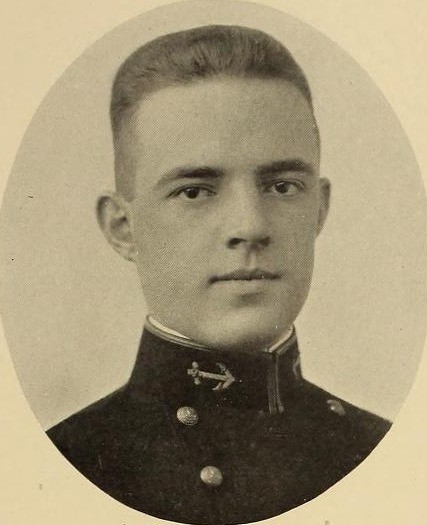
The 1921 Lucky Bag gives him a full page headed "William Bennett Jackson, Jr., Paulding, Ohio," with three nicknames, "Bill," "Jack" and "Bluebeard." According to it, he came from "the Buckeye state via the B & O and Bobbie's Knowledge Factory" (a place the sources examined here do not identify) "with the firm intention of becoming a gentleman sailor." The classmates who wrote the sketch thought the quality that carried him was persistence. It had "put him well in the first half of his class." As a plebe and again as a youngster he swore he would "grease shamelessly in all his professional subjects, but he has yet to be caught in the act." He did not star, they said. "He is just reliable, and always has a little velvet." As for the ladies, "as a pink tea artist he fills the bill acceptably, but for all that he is still his own boss and will remain so until his ideal comes in sight. After that we refuse to prophesy." They closed with the verdict that "whatever he does will be done right and wherever he goes he will receive a royal welcome. Bill is a good scout in any situation, and is even willing to drag blind for a friend." The line under the picture is a request in his voice: "Joe, see if you put strop in my laundry bag. I needs must shave." The activities line lists crew squad.
He graduated in 1920 and was commissioned an ensign; the Register for 1921 lists him among the ensigns. By 1923 the Navy Directory has him as an ensign in the destroyer Pruitt. He was a lieutenant (junior grade) in the cruiser Raleigh by 1925 and 1926, and in 1926–27 in the destroyer Sharkey. In 1928 the directory lists him, now a lieutenant, under instruction at the Naval Academy, and in 1929 under instruction at the Naval War College at Newport, Rhode Island. From 1930 to 1932 he was in the battleship West Virginia, and from 1932 to 1933 assistant operations officer on the staff of Commander, Battle Force, in the flagship California. In 1934 the directory shows him as district communication officer at Key West, Florida, and in 1935 on the staff of Commander, Cruiser Division 6, in the cruiser Louisville. The Navy lists him as lieutenant commander with date of rank 1 July 1936. In 1937 and 1938 he was executive officer of the destroyer Farragut, and in 1938–39 he was on the staff of the Postgraduate School at the Naval Academy in Annapolis. The sources examined here do not describe any of these tours beyond the stations.
In May 1940 he was forty-one and was given a destroyer. He took command of the Cushing on 24 May. She was one of the Mahan class, launched at Puget Sound in 1935 and commissioned in August 1936; by the time he joined her she had been in the Pacific Fleet for nearly four years and had taken part in the search for Amelia Earhart in the Hawaiian Islands and at Howland Island in July 1937. Under Jackson she is listed in the Navy Directories of 1940 and April 1941, with him as her commanding officer. The sources examined here give no details of her cruising or of his conduct of her. He was promoted commander on 1 July 1941 and left her on 24 September 1941. She was in the yard at Mare Island when the Japanese attacked Pearl Harbor, and in the night action off Guadalcanal on 13 November 1942 she was sunk.
What the Navy asked of him between September 1941 and January 1943 is not recorded in the sources examined here. The Navy list shows him a temporary captain from 20 June 1942, at forty-three. From 7 January 1943 to 17 March 1944 he was chief of staff to the Commander, Service Squadrons, South Pacific Force. His Legion of Merit citation, published in the Bureau of Naval Personnel Information Bulletin for September 1947, records the award for that service. The full text of the citation was not seen in the sources examined here. Service squadrons are the Navy's afloat logistic organization, the tankers, supply ships and repair ships that keep a fleet in the field. The details of what he did in the post lie outside the sources examined here.
On 15 May 1945 he took command of Providence (CL-82) at her commissioning. She was a Cleveland-class light cruiser, built by Bethlehem Steel at Quincy, Massachusetts, laid down in July 1943 and launched on 28 December 1944. The war in Europe had ended a week earlier; the war in the Pacific had three months to run. She left Boston on 13 June and shook down at Guantanamo Bay, then reached Newport on 4 September, two days after the Japanese surrender, and trained prospective cruiser and carrier crews there until 6 October. In November she sailed from Boston for the Mediterranean and visited Piraeus in December. Jackson, now forty-seven, commanded her until 23 February 1946.
The Hall of Valor gives his home as Arlington, Virginia. The sources examined here do not say where he served after he left the Providence in February 1946, when or why he left the Navy, whom he married or whether he had children. He died on 6 September 1973 at Camarillo, California, aged seventy-five. The place of his burial was not found.
What the record leaves of him is a sequence: the sailor from the Paulding County seat whom his classmates called reliable; the lieutenant moving from ship to staff and back; the lieutenant commander with a prewar destroyer; the captain who spent the war's central year keeping a Pacific fleet supplied; and the first commanding officer of a cruiser that arrived at the end of the war.