Ships
- USS Charles J. Badger (DD-657) Captain, 23 July 1943 – 18 April 1944
He is not the J. W. Cooper of the neighboring line. The Navy Directory keeps a Joshua W. Cooper, lieutenant, in Northampton on 1 June 1940 and in connection with the NROTC unit at Harvard on 1 April 1941, and it keeps a separate J. W. Cooper among the pay clerks. It also keeps William Starling Cooper of the Supply Corps, Robert W. Cooper, and a Marine reservist, Walter G. Cooper. None of those is this man. A classmate, Jacob Elliott Cooper, was appointed from Georgia a year earlier and appears beside him in the midshipman list; the Lucky Bag gives Jacob his own sketch. A Virginia separation notice for a William Cooper, lieutenant (junior grade), born in Brooklyn in 1912, is a reserve officer of another life. The man on this line is the William Goodwin Cooper whose classmates at Annapolis printed that full name, whose home they printed as Atlanta, and whose Navy Register birth date is 22 July 1903.
Origins
The Register does not give a birthplace. The Lucky Bag of 1926, which is where the initials become a name, prints “atlanta, georgia” under William Goodwin Cooper, and the nicknames “Bill” and “Coop.” The Register of 1 January 1926, still listing the first class, gives the appointment state as Georgia and the date of admission as 13 June 1922. Later registers repeat that date of entry and add the class footnote that these midshipmen were commissioned ensign on 3 June 1926. Secondary pages say he was born in Savannah. Nothing opened here in a register or in the yearbook says Savannah, and one unsourced ship narrative says Palmerton, Pennsylvania. The appointment state and the yearbook home are Georgia, and Atlanta is the only town the Academy printed.
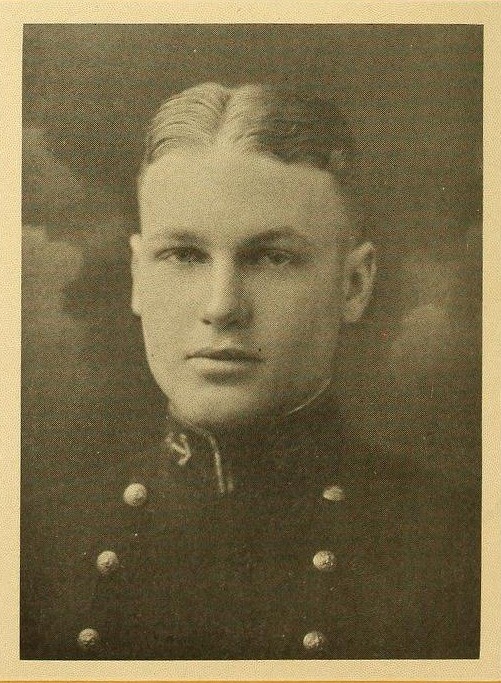
What the classmates wrote is the only portrait of him before the fleet. They called him a son of the Old South, blue-eyed, with curly blond hair and what they called a childishly innocent smile, and they made a joke of the mail. The day began, in their telling, with a shout for the mail orderly and, if the mail was not out, with the lesson. They said the letters came from many places and that answering them was the work he put off, the laziness they assigned to “peaches and watermelons.” They also said the academics came easily, with little application and excellent results, and that the easy manner had a limit: nobody put anything over on him, he had his own idea of right and wrong, and he stuck by it. They would rather be called his friend, they wrote, than have five stripes. The activities printed under the sketch are class basketball in plebe year and the hop committee in first-class year. A swimming-team photograph in the same book includes a Cooper, W. G., and the season story says a Cooper won the diving at the intercollegiates. A C. S. Cooper is on the same photograph. The sketch that is certainly his does not list swimming, so the championship is not claimed for him here.
That is the whole of the boyhood the sources used here will support. No parents, no brothers or sisters, no wife, and no children turned up in the registers, the yearbook, or the directories.
Formation
On 1 January 1927 the Register lists him as an ensign, signal number 4912. The cruise column reads 15 September 1926, the expiration of the previous cruise is a ditto of August 1925, and the station is Arkansas. The June 1926 commission date is the class footnote in later volumes, not a line printed beside his name in the 1927 book.
The promotion law of those years was slow. On 1 January 1930 he is a lieutenant (junior grade). The date of rank printed at the head of that run, and then dittoed down through his line, is 3 June 1929. His qualifications are already “2” and “32”: naval aviator, heavier than air, and the chemical-warfare course. The same day’s Navy Directory is more precise about the job than the Register’s fleet label. It puts Lieutenant (junior grade) William G. Cooper in VS-5S, aircraft squadrons, Scouting Fleet, in Marblehead. The Register of that date says “V. S. squad. 5S, aircraft squads., Battle Fleet.” The squadron and the ship agree. The fleet name does not, and the Directory is the one that names Marblehead.
He was still a lieutenant (junior grade) on 1 January 1934, still with the aviator and chemical-warfare marks, and the station is a chain of “Do.” back to “Naval Academy (instrn.).” The Directory of 1 April 1934 says the same thing in plain words: instruction, Naval Academy, Annapolis. Four years as a junior-grade lieutenant was the hump, not a personal stall. On 1 July 1936 the Register lists him among the lieutenants, date of rank 30 June 1936 and still marked subject to examination or confirmation. The qualifications on his column are now 2, 26, and 32. The new mark, 26, is the general postgraduate course in ordnance engineering. The station on that column is “Duty conn., Tucker,” duty in connection with the new destroyer, not command of her. The Directory of 1 January 1937 has the billet: Lieutenant William G. Cooper, Tucker, gun. The ship’s roster names Lieutenant Commander G. T. Howard as commanding officer. On 1 January 1939 he is still the gunnery officer. The commanding officer by then is Lieutenant Commander H. F. Gearing.
The ordnance work moved ashore. On 1 June 1940 the Directory lists him as a lieutenant at the Naval Mine Depot, Yorktown, Virginia. The station roster names Captain C. H. Wright as inspector of ordnance in charge. Cooper is “Lt. W. G. Cooper,” not the officer in command. The Register of 1 July 1940, a month later, lists him among the lieutenant commanders, date of rank 1 July 1940, again marked subject to examination or confirmation, qualifications still the aviator, the ordnance course, and chemical warfare. On 1 April 1941 the Directory’s Yorktown roster has caught up: Lieutenant Commander W. G. Cooper, still under Captain Wright.
The line, then, from a Georgia appointment in 1922 to the spring of 1941, is battleship ensign, scout-plane pilot, Academy instructor, destroyer gunnery officer, and ordnance duty at a mine depot. Nothing in those books says he had yet commanded a ship.
War years as lived
The Register of 1 July 1942 still has him a lieutenant commander. It does not print a ship. The second McCalla, a Gleaves-class destroyer, was laid down at Federal Shipbuilding in Kearny on 15 September 1941, launched on 20 March 1942, and commissioned on 27 May 1942. The Dictionary of American Naval Fighting Ships, in the passage quoted from the Naval History and Heritage Command page, names Lieutenant Commander W. G. Cooper in command at that commissioning. The page itself would not open here. What follows, for the months before the night he is named in a combat narrative, is the ship’s history as Wikipedia reprints it from that dictionary, not a log signed with his name on every date.
During shakedown McCalla escorted a New York convoy from Cape May on 19 July 1942. On 3 August she reported at Norfolk for a short antisubmarine turn along the mid-Atlantic coast. Two weeks later she took oilers toward Aruba and went on to the Pacific, reporting to Commander, South Pacific, at Nouméa on 28 September. On 7 October she joined Task Force 64, Rear Admiral Norman Scott’s cruisers, then covering transports for the Marines on Guadalcanal. The force was to search for and destroy enemy ships and landing craft, and it patrolled mostly north of the island.
On the night of 11–12 October, off Cape Esperance and Savo, Scott’s cruisers and destroyers met a Japanese force under Rear Admiral Aritomo Gotō. The Office of Naval Intelligence combat narrative, written in 1943 from the action reports, is the account that puts Cooper on the bridge in his own sentences. McCalla sighted what she took for a friendly destroyer 2,000 yards forward of the starboard beam, probably Duncan, and to the left of her an enemy cruiser and a destroyer. Between 2353 and the turn of the night she was firing alternately on a heavy cruiser and a destroyer. At 0016 she engaged a destroyer again; the narrative says that destroyer retired in flames. Scott could not reach Captain Tobin in Farenholt or Captain Moran in Boise to have a destroyer stand by the damaged cruiser. He designated McCalla to remain. The rest of the task force retired on 205° true.
She searched for Boise and did not find her. Boise had already gone back to the formation. What McCalla did find, close to Savo and burning, she closed with caution because the fires hid the ship’s shape. At 0220 a searchlight at about 2,500 yards showed she was not Boise. A lookout read the hull number 485. She was Duncan.
At 0300 Cooper’s ship lowered a boat and sent a salvage party under Lieutenant Commander Floyd B. T. Myhre, with orders to take no unnecessary chances, to go carefully, and to fire a red Very star if they needed help at once. Myhre was told McCalla would stay about half an hour and then go back to looking for Boise, returning only if the star was seen. The party found no one alive. Fires were still burning. Myhre got them down and, after looking through the ship, thought she might be saved. He asked for a repair party and said that, deep aft, she could be towed by the stern.
Cooper’s choice, as the narrative records it, was to take the men out of the water first. At daylight they were on rafts and wreckage east of Savo, a patch to the east of Savo, about eight miles north and south and two miles west. The largest group was thirty-one men on three rafts lashed together. The first survivors came aboard at 0630. The work went on until 1209, with planes and landing boats sent by the commanding general on Guadalcanal. The narrative’s total is nine officers and 186 enlisted men rescued, the great majority of them by McCalla. One man was being taken in when another, two hundred yards off, was attacked by a shark. Three of McCalla’s crew fired rifles until a boat could be lowered for Lieutenant Herbert R. Kabat. Other survivors were looked over by sharks. Three were attacked. The narrative says no one died of it.
When the Duncan men were aboard or on their way to Guadalcanal, McCalla tried to tow. The tow failed. Duncan sank shortly after noon. At 1430 McCalla sighted a large number of men still in the water. They were Japanese. Lines were thrown. None took hold. A boat captured three. She did not take more; she was already crowded and had little space to confine them. A message went to Guadalcanal asking that the rest be picked up. Two other destroyers later took 113 Japanese prisoners. The dictionary’s short version says McCalla rescued 197 of Duncan’s crew and captured three Japanese sailors. The Navy Cross citation, printed in the Bureau of Naval Personnel Information Bulletin No. 315 of June 1943, says nearly two hundred officers and men were placed safely aboard by noon.
The citation’s language is the award, not the deck log. It says Commander Cooper brought McCalla through the action and directed her guns with telling accuracy; that after the task force retired he stayed and searched for missing ships; that he found Duncan, heard explosions from the burning hull, approached cautiously, and left a salvage party; that he searched for others, came back, decided she was beyond saving, and made sure she would not fall into enemy hands; and that from dawn until noon he picked up the survivors under the chance of enemy ships and aircraft. The combat narrative is colder about the guns, does not award him a particular sinking, and puts the failed tow and the sinking after the rescue, not as a separate act of keeping her from the enemy. Both documents are his night. The citation is how the Navy chose to decorate it. The cross is the “(B)” already printed after his name in the Register of 1 July 1943.
He was, by that register, a commander. The temporary date of rank at the head of his run is 15 August 1942, dittoed from Willard Merton Sweetser’s explicit line, and the permanent rank is still lieutenant commander from 1 July 1940. The Navy Cross citation calls him commander. On 1 July 1944 the Register still places William Goodwin Cooper (B) in the commanders’ list. It does not yet add the Bronze Star or the commendation ribbon.
Charles J. Badger, a Fletcher-class destroyer, was launched at Bethlehem, Staten Island, on 3 April 1943 and commissioned on 23 July 1943. Search extracts of the dictionary entry name Commander W. G. Cooper in command at that commissioning. The history.navy.mil page would not open, and the Wikipedia text that cites it does not repeat his name. That text sends Badger to San Francisco on 30 November 1943 and to Adak on 17 December for Aleutian patrol and escort, then on to the Philippines, Lingayen, and Okinawa, where on 9 April 1945 a suicide boat’s charge knocked out her engines. None of those later sentences names the commanding officer. Commander lists on the open web put Cooper in McCalla until early April 1943 and in Badger until 18 April 1944, and they do not agree with each other on the April day he left McCalla. Those lists are not the Register. They are not used here as a cruise. What can be said is that he commissioned McCalla, was her captain at Cape Esperance, and is named, in the dictionary extracts, as the officer who commissioned Badger fourteen months later. The Aleutians, Leyte, and Okinawa are the ship’s war after that sentence, not a war this essay will put in his hands.
By 1 July 1945 the Register has moved him into the captains’ list, signal 1924. The qualifications are still 2, 26, and 32. The distinctions are now (B), (G-1), and (H-1): Navy Cross, Bronze Star Medal, and the commendation ribbon that came with a special letter of commendation. Birth 22 July 1903. Entry 13 June 1922. A ditto in that captains’ run reads 1 August 1943 for temporary rank. It cannot be squared with the commanders’ list of 1 July 1944, so it is not treated as the date he became a captain. The citations for the Bronze Star and the letter of commendation were not in the bulletin that printed the Navy Cross, and they were not found elsewhere.
After
The postwar registers that could be read as clean type do not resume the story until the middle of the 1950s. A 1947 machine listing still shows William Goodwin Cooper with a lieutenant-commander date in 1940, a 1943 date too broken to trust, the birth date 22 July 1903, and 3 June 1926. The Register underlying the 1955 list prints him a captain. Set beside Charles Allen Buchanan, whose birth date in the wartime register is 28 October 1904, the columns read as a date of rank of 1 January 1954, birth 22 July 1903, and 3 June 1926, the old ensign date rather than the 1922 admission.
The ship’s own association history, not the 1970 dictionary volume, says that on 28 July 1951, in a change-of-command ceremony, Captain Parker was relieved by Captain William Goodwin Cooper. The next sentences put Newport News out of Norfolk on 4 August 1951 with 400 midshipmen, to Halifax, Boston, and Guantánamo, back on 14 September. As flagship for Vice Admiral Felix B. Stump, Commander, Second Fleet, she then went into Lantflex 52, one of the largest fleet exercises since the war, and into the Portsmouth yard from 21 November 1951 to 9 January 1952. The association’s 1952 page says she served as fleet flagship for Admiral Gardner in the Mediterranean until 8 May 1952, and then, in a sentence that also says she was in the yard from 8 May to 17 September 1952, that Captain William Cooper was relieved by Captain Walter Price on 27 June 1953. The year in that sentence does not match the months around it. The dictionary volume consulted for Newport News does not name Cooper at all. The July 1951 change of command is the firm line. The day he left the ship is not.
On the staff roster of the Register for 1958, William G. Cooper is a rear admiral in the Office of the Comptroller. A line in the same register’s lineal list, name truncated by the print as “COOPER WILLIAM COO” and paired with the rear-admiral grade and the designator 1100, sits on the file number that also belongs to William Goodwin Cooper’s captain line, date of rank still reading 1 January 1954, birth still 22 July 1903. A photograph in the East Carolina University collections is catalogued as Vice Admiral W. G. Cooper, inscribed to Captain Sheldon H. Kinney, the date only approximated as 1958–1969, and the subject heading is Cooper, W. G. (William Goodwin), 1903–1971. Hall of Valor says he retired as a vice admiral and gives the death as 3 March 1971. He is not on the compiled list of tombstone vice admirals, the rear admirals advanced one grade on retirement for a combat commendation. No register opened here gives the day he became a vice admiral, the day he retired, or the day he died, and no obituary could be read.