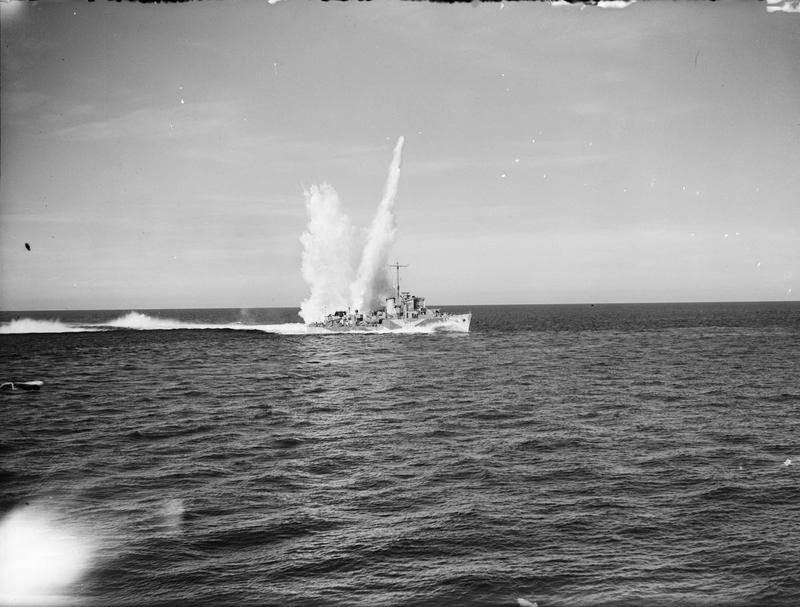
She was named for Quiberon Bay. On 20 November 1759 Admiral Sir Edward Hawke caught a French fleet in a gale off Brittany and ended that year's threat of invasion. The motto on the crest was Seek and Subdue. The Q class repeated the J and N destroyers under wartime rules, with longitudinal framing and four 4.7-inch guns instead of six, because the guns were short. The gain was range, about fifteen percent over an N-class ship, which is why Australia wanted them for the Pacific. On trials she made 32.7 knots. As finished she also carried a quadruple 2-pounder pom-pom, six 20 mm Oerlikons, two quadruple 21-inch torpedo mounts, and depth charges. In 1941 the Naval Board had asked to man three more N-class destroyers. Those went to the Dutch and the Poles. The Admiralty offered Quiberon, Quickmatch (G92), and Quality instead. The Board accepted in January 1942, then cut the promise to two ships because the crews were not there. Quiberon and Quickmatch were the two.
She was ordered on 2 April 1940 and laid down on 14 October 1940 by J. Samuel White at Cowes, on the Isle of Wight. Mrs Tillard, wife of Rear Admiral S. D. Tillard, Flag Officer Southampton, launched her on 31 January 1942. A near miss in the yard held her up by about a month. She commissioned into the Royal Australian Navy on 6 July 1942 as Quiberon (G81), under Commander H. W. S. Browning, RN. The crew was Australian from that day. The ship stayed British property.
She worked up at Scapa Flow through August. Her first long job was a convoy of twenty-one ships bound for the Cape. She was pulled off it to hunt a U-boat supply ship in the North Atlantic, and she reached Freetown on 27 September. By then she had steamed 12,000 miles in forty-two days, with three days in harbour. Late in October she joined the covering forces for Operation Torch and went into the Mediterranean under repeated air attack. On 28 November, northwest of Bône with the destroyer Quentin, she made her first attack. Quentin gained Asdic contact on a submarine and lost it. Quiberon got the contact back, slowed to 7 knots, and dropped charges set for 500 feet. The crew heard breaking-up noises, then oil and bubbles. The submarine was the Italian Dessiè. Those were the first depth charges she had ever fired. Browning received the DSO.
She joined Force Q at Bône: the cruisers Aurora, Argonaut, and Sirius, with Quentin and Quiberon, under Rear Admiral C. H. J. Harcourt. The work was to cut the run from Sicily to Tunis and Bizerte. Around midnight on 1–2 December, about forty miles north of Cape Bon, Force Q found a convoy of four ships. The fight lasted about an hour, at ranges close enough to see the hits. Cunningham later wrote of ships on fire in the steam and smoke, men going over the side, and vehicles sliding off the decks as the hulls turned over. All four supply ships were lost. Quiberon fired the last salvos, at 01:35, into a capsized Italian destroyer. That ship was Folgore. Some Australian accounts name the torpedo boat Lupo. Lupo was lost the same night, but by the J-class destroyers of Force K, off the Kerkennah Bank, not by Force Q.
On the way back to Bône an air-dropped torpedo hit Quentin. Quiberon went alongside under attack, took off most of Quentin's company, and cleared the wreck as a stick of bombs fell where she had been lying. Browning's report is the account of the next hour. He was bombed and cannoned, went to full speed, and was attacked six more times by low-level bombers, dive bombers, and one torpedo run that did not finish. Sticks of bombs fell close. The guns and the speed kept her clear. She entered Bône with Waltzing Matilda playing and the Australian flag up. Browning was promoted captain at the end of December and left the ship in January 1943. His first lieutenant, Lieutenant L. M. MacLiver, RAN, received the DSC for the convoy action and died some months later. The Naval Historical Society records him as the ship's only wartime death. On 21 December she picked up survivors of the troopship Strathallan, torpedoed by a U-boat off Algeria.
At the end of January 1943 she took a convoy from England toward the Cape, reached Durban on 27 February, and arrived at Fremantle on 29 March. Since commissioning she had steamed 51,000 miles. Command had passed to Commander G. S. Stewart, RAN. After a refit at Williamstown she sailed in June for Kilindini, in Kenya, to join the Eastern Fleet, and was almost at once sent against the U-boats in the South Atlantic and the Mozambique Channel. With Quickmatch (G92) and Norman (G49) she escorted convoys as far as the mouth of the Congo. In July, south of Madagascar, she and Quickmatch took off fifty-one survivors of the Canadian ship Jasper Park, sunk by U-177 on 6 July in 32°52′ S, 42°15′ E. From September the Australian destroyers on that station — Quiberon, Quickmatch, Norman, and Nizam (G38) — worked out of Colombo on Indian Ocean convoy escort. Merchant losses there fell sharply.
In March 1944 the Eastern Fleet turned to the attack. Quiberon joined Operation Diplomat, the gathering that brought Renown, Valiant, Queen Elizabeth, Illustrious (87), and the French Richelieu together with the American Task Group 58.5, Saratoga (CV-3) and three destroyers, at Trincomalee on 31 March. Operation Cockpit followed. The fleet sailed on 16 April and struck Sabang on 19 April. Aircraft from Illustrious and Saratoga destroyed twenty-seven Japanese aircraft and damaged the dockyard. Somerville's signal said they had caught the Japanese with their kimonos up and their heads down, and had given Sabang a damn good bang. She was back at Trincomalee on 21 April. Operation Transom was the strike on Surabaya. The fleet sailed on 6 May, fuelled at Exmouth Gulf, and launched ninety-three aircraft on 17 May. Quiberon was in the heavy-ship screen, Force 65. She then detached to Fremantle for refit.
Commander W. H. Harrington, DSO, RAN, later a vice admiral and Chief of Naval Staff, took command in July 1944. His first lieutenant was Lieutenant A. M. Synnot, RAN, who had been in the ship since commissioning and would himself be Chief of Naval Staff in 1976. She rejoined at Trincomalee on 1 August. In October she took part in Operation Millet, a bombardment of the Nicobar Islands timed as a diversion for the American landings at Leyte. Force 63 sailed on 1 October under Vice Admiral A. J. Power. Quiberon screened Renown in Group 1. Indomitable (92) and Victorious (38) flew off on 17 October, and the heavy ships bombarded. The feint did not draw the Japanese fleet out. On 1 December she helped screen the battleship Howe (32), flagship of the forming British Pacific Fleet, from Colombo to Fremantle, arriving on 11 December, and went on to Williamstown. At dawn on Christmas Day the 4th Flotilla hunted a submarine reported eighty-five miles south of Jervis Bay, after an American ship's SOS. The ship had already gone down.
Lieutenant Commander George Frederick Edmund Knox, RAN, relieved Harrington on 16 February 1945. The British Pacific Fleet sailed from Sydney on 28 February: King George V (41), Howe, four carriers, four cruisers, and twelve destroyers, Quiberon and Quickmatch among them. They reached Ulithi on 20 March and became Task Force 57 of the United States Fifth Fleet for Operation Iceberg. From 26 March she screened the strikes on the Sakishima Islands, the airfields that were feeding kamikazes into Okinawa. On Easter Sunday, 1 April, a kamikaze hit Indefatigable (10) and put her out of action for a short time. Quiberon stayed with the force through the April round of strikes and refuelling, then retired to Leyte on 23 April. In May the task force steamed about 12,000 miles. Through May and June she ran mail and replenishment with the logistic force as well as standing in the combat screen. In July Task Force 57 joined the attacks on Japan. On 17 July she screened King George V for the night bombardment of the Hitachi industrial area. She was still on those operations when Japan surrendered. By then she had steamed 236,000 miles on war service. The battle honours were Mediterranean 1942, North Africa 1942–43, Atlantic 1943, Indian Ocean 1943–44, East Indies 1944, Pacific 1945, Okinawa 1945, and Japan 1945.
She was at the reoccupation of Singapore. Early in September she went north with Task Group 111.3 — the carrier Colossus, the cruiser Bermuda, the cruiser Argonaut, and three destroyers — to Kiirun, on Formosa, to collect Allied prisoners and nationals. She then worked the East Indies until February 1946: troop lifts, the return of prisoners, and the handing back of Dutch control. After a short refit at Sydney she began the first of three deployments with the British Commonwealth Occupation Force in Japan, between 1946 and 1948.
Early in 1950 the RAN decided to convert its five Q-class ships into anti-submarine frigates, on the lines of the Royal Navy's Type 15. Australia offered 400,000 pounds a ship for the vessels still on loan. The Admiralty gave them to Australia instead, on 1 June 1950. Quiberon had already paid off for the conversion, on 15 May 1950. The work was done at Cockatoo Island and Garden Island, in Sydney, and it took more than seven years. She recommissioned on 18 December 1957 as a modified Type 15, pennant F03, in the 1st Frigate Squadron with Quadrant, Queenborough, and Quickmatch. The forecastle was extended. An aluminium superstructure replaced the destroyer bridge. The 4.7-inch guns and the torpedo tubes came out. The frigate fit was a twin 4-inch, Bofors guns, and two Limbo triple-barrel anti-submarine mortars, with Type 170 and 174 sonar.
She served with the Commonwealth Strategic Reserve in the Far East and on the Australia Station. In 1959 she made the last RAN visit to Burma until HMAS Childers in 2014. In October 1962, with Queenborough, she took off twenty-five survivors of the Panamanian steamer Kawi, lost in a storm in the South China Sea. In December the same pair rescued the crew of the steamer Tuscany, aground on a reef in that sea. She paid off to reserve on 26 June 1964. Sold on 15 February 1972 to Fujita Salvage of Osaka for $68,260, she left Sydney under tow on 10 April 1972 with the old destroyer Tobruk, behind the tug Sumi Maru No. 38, and was broken up in Japan.