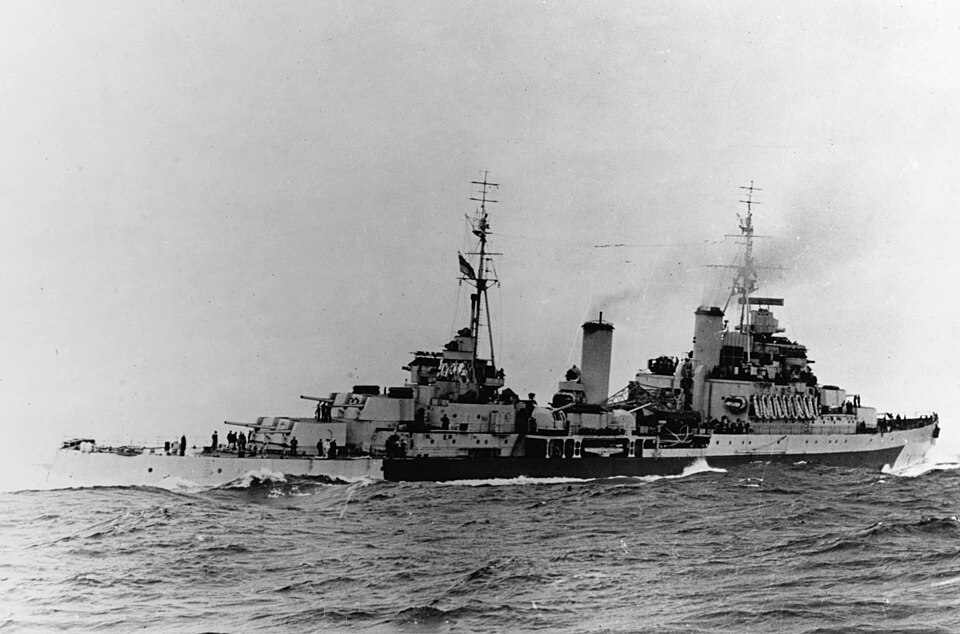
Gambia was a Fiji-class light cruiser, built by Swan Hunter and Wigham Richardson at Wallsend-on-Tyne. She was laid down on 24 July 1939 and launched on 30 November 1940. Captain Maurice James Mansergh was appointed to her on 25 November 1941, before she was finished. Uboat.net records that she was commissioned at Newcastle upon Tyne at 0900 on 4 February 1942 for trials, and that on 21 February the shipyard handed her over at Rosyth and placed her in full commission. Geoffrey Mason's chronology gives the same completion date and a commissioning for service on 5 February. She worked up at Scapa Flow and in April sailed as ocean escort of military convoy WS 18. She was still on that passage, and was detached at Freetown on 29 April, when the Japanese carrier raid hit Ceylon. She reached Kilindini on 23 May and joined the Eastern Fleet. In September she escorted the transports of Operation STREAM to Majunga and took part in Operation JANE, the landing at Tamatave. She stayed on Indian Ocean convoy work into 1943, including the ocean escort of Operation PAMPHLET in February. Mason records that she paid off on 16 June 1943 for a refit at Liverpool in which the aircraft fittings were removed. Uboat.net keeps Mansergh in command until 23 June, and then lists Commander Leslie Edward Moncaster until 24 August.
The Admiralty agreed to lend her to New Zealand, manned from Achilles, on condition that she stay under Admiralty operational control. Captain Newton James Wallop William-Powlett took command on 24 August 1943. HMNZS Gambia was commissioned at Liverpool on 22 September 1943. S. D. Waters records that a few of the officers and three-quarters of the ratings were New Zealanders, and that she floated out of dock on 10 October. She worked up at Scapa Flow. In December she went to Plymouth for Operation STONEWALL, the patrol against blockade runners north of the Azores. On 27 December she was at Fayal when Glasgow and Enterprise (D52) met the German destroyers that had come out for the supply ship Alsterufer. Waters records that Gambia was more than 100 miles south-west of that action. William-Powlett wrote that, as senior of the four cruisers, she could merely play the part of an exasperated listener-in. She returned to Plymouth on 1 January 1944.
She sailed from Plymouth on 30 January 1944 and arrived at Trincomalee on 19 February, joining the Fourth Cruiser Squadron. Her first job was Operation SLEUTH, a sweep south-west of Cocos Island with Illustrious for a suspected blockade runner. Nothing was found. In March she went out on Operation DIPLOMAT, the meeting with an American task group. On 19 April, during Operation COCKPIT, she and Ceylon were detached to thicken the anti-aircraft screen of the carriers that struck Sabang. In May she sailed with the fleet for Operation TRANSOM, the carrier attack on Sourabaya, and was back at Trincomalee on 27 May. On 25 July, in Operation CRIMSON, the cruisers stood in and bombarded Sabang. Waters records that this was the first time her guns were in action against Japanese shore defences, that Gambia and Kenya silenced the batteries that were their targets, and that the cruisers fired 1,074 rounds at a mean range of 8,500 yards. She refitted at Colombo in September. On 16 October she left Trincomalee for New Zealand and reached Wellington on 24 November. Mason dates her transfer to the British Pacific Fleet, on the fleet's formation, to 22 November, while she was still on that passage.
She refitted at Auckland. In February 1945 she sailed for Sydney with Howe, and the British Pacific Fleet left Sydney on 1 March. Mason records that she joined Task Force 57 on 23 March, in Task Group 57.5 with Swiftsure, HMS Argonaut, and Black Prince, and sailed from Ulithi for Operation ICEBERG, the strikes on the Sakishima Gunto in support of the Okinawa landings. On 1 April a kamikaze hit Indefatigable and a near-miss disabled Ulster. Gambia took the destroyer in tow at midday and left the fleet. Waters records a tow of 760 miles at an average of eight knots. The hawser parted on 4 April after the minesweepers Ballarat and Lismore had joined, and the ships reached the entrance to Leyte Gulf on the evening of the 5th. Forty-five cases of mumps were isolated on board. She sailed again on 6 April with the Canadian cruiser Uganda and was back with the force for the strikes on Formosa. On 13 April her port pom-pom shot down a Hellcat that had not got clear of the fleet, and the pilot was killed. Captain Ralph Alan Bevan Edwards arrived on 27 April and assumed command the next day. On 4 May the cruisers went in with King George V and Howe against the airfields on Miyako. Swiftsure and Gambia fired on Nobara. Waters records that Gambia fired 230 rounds of 6-inch. She was with Task Force 57 for the whole Sakishima series except the seven days of the tow. The ships reached Manus on 30 May and Sydney on 5 June.
Rear-Admiral E. J. P. Brind hoisted his flag in her on the morning of 28 June, when she sailed from Sydney, and shifted it at sea to Newfoundland two days later. She reached Manus on 4 July and sailed with Task Force 37 on 6 July. At daybreak on 16 July the force joined the American Task Force 38 off Japan. On 9 August she went with Newfoundland and four destroyers, as Task Unit 37.1.8 under Brind, to bombard the steel works at Kamaishi. During the retirement she shot down a Japanese aircraft. Waters calls it probably the last enemy aircraft engaged by gunfire from a ship of the British Pacific Fleet. On 11 August Formidable, Victorious, Implacable, Achilles, Euryalus, HMS Argonaut, and eight destroyers were detached toward Manus. Gambia stayed with King George V, Indefatigable, Newfoundland, and ten destroyers, and the British ships joined Task Group 38.5. On 13 August she covered the air attacks on northern Honshu and Hokkaido. On 15 August the Commander of the task force signalled cease hostilities against Japan at 11.23 a.m. While that signal was still flying, a Japanese bomber dropped a bomb between Gambia and Indefatigable and was shot down. Part of the aircraft fell on Gambia's after superstructure.
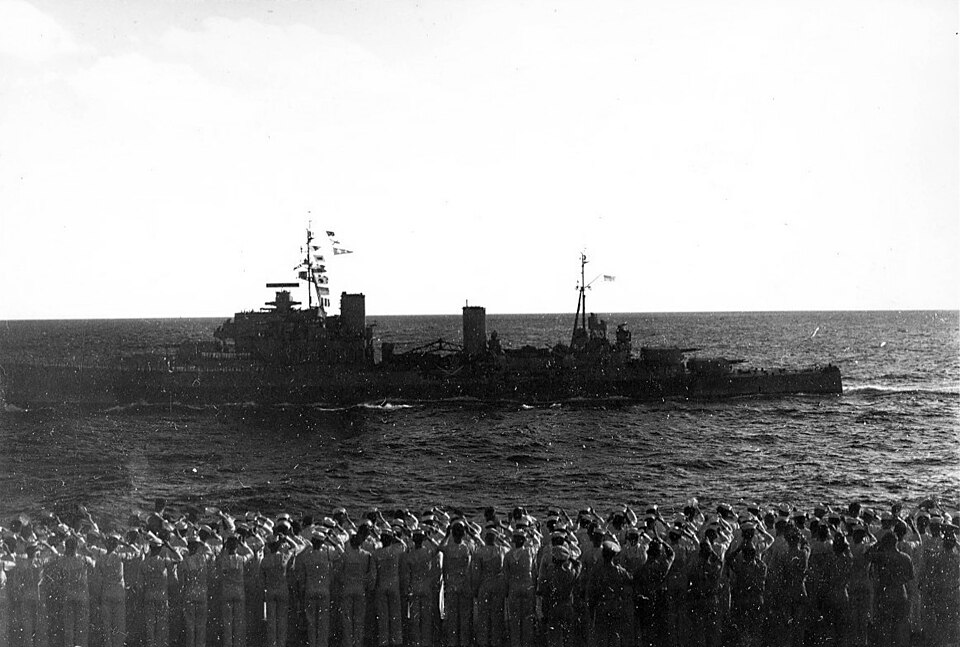
She entered Tokyo Bay with Newfoundland on 31 August. On 2 September she represented the Royal New Zealand Navy at the surrender signed on board Missouri. Edwards and five of his officers attended the musical sunset on Duke of York that day. A landing party under Lieutenant-Commander G. R. Davis-Goff had left the ship on 20 August in American destroyer-transports, and went ashore at Yokosuka on 30 August. That afternoon the White Ensign and the New Zealand ensign were hoisted at the company headquarters in the dockyard. On 12 September she left Tokyo Bay with the Australian-manned destroyer Nizam for Wakayama, to help take off prisoners of war. On the night of 17 September a typhoon struck the anchorage. Edwards steamed her up to her anchors, at revolutions for fifteen knots on the port engines when she began to drag, and later at revolutions for eight to ten knots. She and Nizam took minor damage. She sailed for New Zealand on 11 October and reached Auckland on the 30th. Waters records that on 7 February 1946 she ceased to be a unit of the British Pacific Fleet, paid off, and re-commissioned with a steaming party. The Navy Museum dates that re-commissioning to 8 February. She sailed from Auckland on 12 February, and Edwards sent the Naval Board a farewell. She arrived at Spithead on 27 March 1946. Waters and the Navy Museum say she was paid off from the Royal New Zealand Navy on 1 July 1946. She was not sunk. Mason records that she paid off at Portsmouth on 7 December 1960. She was sold for demolition by T. W. Ward and arrived in tow at Inverkeithing on 5 December 1968.
A note on sources. The completion on 21 February 1942, the pay-off on 16 June 1943, the New Zealand commission on 22 September 1943, the join with Task Force 57 on 23 March 1945, the Miyako bombardment on 4 May, the cease-fire aircraft on 15 August, and the Portsmouth pay-off on 7 December 1960 are from Geoffrey Mason's chronology on naval-history.net The Liverpool commission, the tow of Ulster, the 230 rounds at Nobara, Kamaishi, the 15 August bomb, the Yokosuka landing, the Wakayama typhoon, and the 1 July 1946 reversion to the Royal Navy are from S. D. Waters, The Royal New Zealand Navy, chapters 23 to 25, digitized copies of those chapters. Command dates are from the uboat.net pages for HMS Gambia and HMNZS Gambia. The commission date used is the New Zealand commission of 22 September 1943, which both uboat.net and Waters give. Uboat.net also records a trials commission at 0900 on 4 February 1942 and full commission on 21 February; Mason says commissioned for service on 5 February. Mason dates the departure with Ulster to 2 April; Waters says she left the fleet at midday on 1 April, and that date is the one used here. Mason's supply-ship spelling Alstrufer is Waters's Alsterufer. Waters's class footnote says she covered the capture of Diego Suarez in May 1942, and the Navy Museum names Operation IRONCLAD. Mason and the uboat.net movements put her on WS 18 until Freetown on 29 April and at Kilindini on 23 May, after that landing, so the Diego Suarez claim is not followed. The Navy Museum says the formal transfer waited until 8 May 1944. Waters says she commissioned as a ship of the Royal New Zealand Navy on 22 September 1943 and that full financial responsibility was recommended from 8 May 1944. The museum says a Corsair shot down the 15 August bomber and that Gambia fired the last shots of the Second World War. Waters describes the bomber and the wreckage on her superstructure and does not use that phrase; the 9 August aircraft is the one Waters calls probably the last engaged by a British Pacific Fleet ship. Uboat.net dates the return to the Royal Navy to 27 March 1946, the day she reached Spithead. Waters and the museum put the pay-off from the Royal New Zealand Navy on 1 July 1946. Uboat.net ends Edwards's command at about October 1945. Waters still has him in command for the February 1946 sailing, and no exact relief day was found, so the command is given as a single line from 28 April 1945. Unithistories lists Edwards as commanding officer from 15 March 1945, before Waters and uboat.net say he assumed command. Digitized copies of these pages were used. No photograph was downloaded.