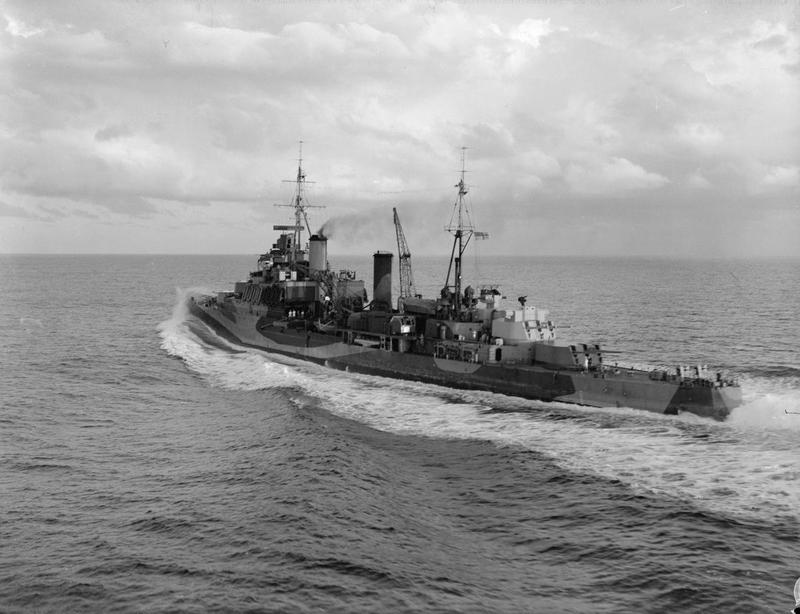
Mauritius was a Fiji-class light cruiser, pennant 80, and the first Royal Navy ship of the name. She was ordered from Swan Hunter at Newcastle upon Tyne in December 1937, under the 1937 programme. Uboat.net dates the order 20 December 1937 and places the build at the firm's Wallsend yard. The naval-history chronology says she was laid down on 13 March 1938. She was launched on 19 July 1939. Build was completed on 14 December 1940 and she began acceptance trials. Uboat.net dates her commissioning 1 January 1941. In February 1942, after a Warship Week, Kingston-upon-Hull adopted her. Captain William Derek Stephens had her from 6 February 1941 until 22 March 1943. He took her through the work-up at Scapa Flow with the 10th Cruiser Squadron and then to the East Indies.
She escorted military convoys out to Freetown in the first months of 1941 and in April was transferred to the 4th Cruiser Squadron of the East Indies Squadron. She reached Colombo on 20 June and relieved Shropshire. Through the summer she was on trade defence in the Indian Ocean and the Bay of Bengal. On 1 August she escorted Capetown Castle and Empress of Japan from Colombo toward Singapore as part of WS9AX, and was relieved by Durban on the 3rd. In September she was with the carrier Hermes and the cruisers Enterprise (D52) and Hawkins searching, without success, for a Vichy French convoy said to be on passage from Saigon to Madagascar. On 31 October she escorted WS11X from Colombo to Singapore and was taken in hand for refit there on 6 November.
The refit was suspended on 10 December 1941, after the Japanese invasion of Malaya. On the 11th she sailed for the United Kingdom by the Cape, carrying some of the survivors of the battleship Prince of Wales and the battlecruiser Repulse. She had been in dock at Singapore. She was not at sea with those two ships when they were lost. Devonport completed the interrupted refit in the spring of 1942, and she worked up again at Scapa Flow. She was nominated to go back to the 4th Cruiser Squadron at Ceylon.
She was on squadron duty in the Indian Ocean from June 1942. On 21 July she joined Force A for Operation Stab, a diversion in the Bay of Bengal: the battleship Warspite, the carriers Illustrious and Formidable, the cruiser Birmingham, and destroyers. The force fuelled in the Seychelles, left Colombo on 30 July to cover the diversionary convoys, and on 1 August was sighted by a Japanese seaplane. On the 2nd a Martlet from Formidable shot down a Japanese aircraft. The operation was then ended and Force A returned to Trincomalee. She went back to Kilindini. In October she was nominated with Devonshire and Enterprise for Operation Demcat, a search for a Japanese merchant ship reported to be supplying submarines or raiders in the Indian Ocean. The search, with RAF aircraft, was abandoned on 30 October and she returned to Kilindini. She stayed on Indian Ocean convoy work into 1943, including cover for Operation Pamphlet in February, the convoy taking Australian and New Zealand troops back toward Australia.
Captain William Wellclose Davis relieved Stephens on 22 March 1943. Uboat.net places Admiral Somerville's flag, as Commander-in-Chief of the Eastern Fleet, in Mauritius at Durban on 23 March, when she docked. In May she was nominated for the Mediterranean and the 15th Cruiser Squadron. She grounded in the Suez Canal on the way to Alexandria and was repaired there. For the Sicilian landings she sailed from Alexandria on 7 July with Newfoundland, Uganda and Orion. She grounded again at Malta on 9 July and damaged her keel. On the 10th and 11th she fired in support of the landings southwest of Syracuse. On the 14th she bombarded a shore battery at Lentini, which the chronology prints as Lentinmi, in Catania Bay. On 23 July, at Augusta, the flag came across to her from Newfoundland after that cruiser was torpedoed. In September she bombarded the Calabrian coast before the Baytown landings, with Valiant, Warspite, Orion and the monitors, and then supported the Salerno landings with the Northern Attack Force. She was under air attack, including FX 1400 glider bombs, and was relieved by Sirius on 17 September.
She spent the winter of 1943–44 between the central Mediterranean, Atlantic interception, and, from 30 January 1944, gunfire support at Anzio, Operation Shingle, in rotation with other cruisers. She was released on 3 March. In April she came home to be flagship of Bombarding Force D for the Normandy landings. The Chatham refit took out her aircraft facilities. On 6 June 1944 she bombarded Houlgate and the Merville battery during the assault on Sword Beach, in company with Warspite, Ramillies, Arethusa, Danae, the Polish cruiser Dragon and the monitor Roberts. On 13 June she was slightly damaged by shore fire. In July she fired again for the army, including the bombardments near Caen on the 11th, 17th and 18th with Roberts. In August, as Force 27 with the destroyers Ursa and Iroquois, she worked the Bay of Biscay against craft taking troops off the coast. Off Les Sables on the 14th she damaged the torpedo boat T 24 and two ships of a convoy. On the 15th Force 27 sank a minesweeper off the island the chronology prints as Ile de Yeux. On the 25th, in the bay the chronology prints as Audieme Bay, patrol boats V 702, V 717, V 720, V 729 and V 730 were sunk. She was back at Devonport for repair on 1 September.
In October 1944 she joined the 10th Cruiser Squadron of the Home Fleet. On the 26th she escorted the carrier Implacable for air strikes on Norway, Operation Athletic. Captain Charles Alfred Evelyn Stanfield relieved Davis on 23 October 1944 and kept her until 16 September 1946. On 28 January 1945, with the cruiser Diadem, she engaged two German destroyers trying to pass from Bergen into the Baltic, damaged Z 31, and took one hit in return. The German ships reached Kiel. On 25 February she began a refit at a commercial yard in Birkenhead. The work ran through August 1945. She was still in that refit when Japan surrendered. The chronology says she was kept in service on completion of the refit in March 1946, served as a cruiser-squadron flagship in home waters and the Mediterranean until 1947, went into reserve, recommissioned in 1950 as flagship in the East Indies, and was paid off in 1952. She was not sunk. Sold to BISCO, she arrived in tow at Inverkeithing on 27 March 1965 to be broken up by T. W. Ward.
A note on sources. Dates and operations follow the naval-history.net service history by Lieutenant-Commander Geoffrey B. Mason That page is a digitized copy. It prints Lentinmi, Ile de Yeux, Audieme Bay, and beachead. It does not name commanding officers. Their names and dates are from the uboat.net ship page, and the three officer pages saved beside it. Pennant 80, the Wallsend yard, the order date 20 December 1937, and commissioning on 1 January 1941 are uboat.net. Mason gives build completion and the start of acceptance trials on 14 December 1940, and laid down on 13 March 1938. Uboat.net gives laid down on 31 March 1938. The story uses Mason's laying-down date. The battle-honour line on Mason's page lists the Atlantic, Sicily, Salerno, the Mediterranean, Anzio, Normandy, Biscay and Norway, and does not list Japan. The East Indies and Eastern Fleet passages are in the same chronology and are what places her against Japan. Uboat.net's header says she arrived at Inverkeithing to be scrapped by T. W. Ward Ltd. on 27 March 1965, which matches Mason. No Navy List or unithistories page was fetched for Davis or Stanfield. Stephens was already on the captain list as the same man.