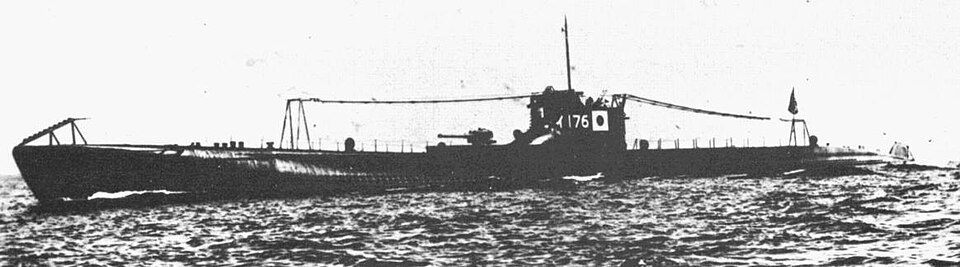
I-177 was a Kaidai Type 7 cruiser submarine, the second boat of the class that began with I-176. She was ordered as Submarine No. 155. Kawasaki laid her down at Kobe on 10 March 1941. On 17 December 1941 she was numbered I-77. She was launched three days later, on 20 December. On 20 May 1942 the cruiser submarines were renumbered, and she became I-177. She commissioned on 28 December 1942. Commander Hajime Nakagawa, who had commanded I-4, was her first captain.
A KD7 was a fleet boat. She displaced 1,630 tons on the surface and 2,602 submerged, and she was 105.5 meters long, about 346 feet, with a beam of 8.25 meters. Two diesels on two shafts gave her about 23 knots on the surface and 8 submerged, and about 8,000 miles at 16 knots. Test depth was 80 meters. She had six bow tubes, twelve torpedoes, a 120 mm deck gun, and a pair of 25 mm guns. The designed crew was 86.
On 25 February 1943 she joined Submarine Division 22 with I-178 and I-180. She left Kure on 30 March, reached Truk on 7 April, and sailed on 10 April with those two boats for the east coast of Australia. On 26 April, about twenty miles southeast of Cape Byron, she sank the British freighter Limerick, 8,724 tons, out of an escorted convoy, near 28°54′ S, 153°54′ E. The escort dropped two depth charges. Neither hurt her.
Before dawn on 14 May, east of Brisbane, one torpedo hit the Australian hospital ship Centaur. She was carrying 332 people on the run from Sydney toward New Guinea. She caught fire and sank in about three minutes. The next afternoon the destroyer Mugford picked up 64 survivors. Twelve Australian Army nurses had been aboard, and Sister Ellen Savage was the only one of them still alive. The boat's signal that morning claimed a 15,000-ton freighter, not a hospital ship. Nakagawa lived through the war and would not admit the sinking. The signal and the place are what put it on I-177. The wreck was found in December 2009, near 27°17′ S, 153°59′ E, in about 2,000 meters of water. She was back at Truk on 23 May.
She left Truk again on 14 June, bound for the same coast. The landings on New Georgia pulled her off that patrol, and she reached Rabaul on 24 July. From there she was a supply boat for the army on New Guinea, into Lae and then Sio.
Nakagawa left her at the end of August for I-37. Zenji Orita, coming from RO-101, was appointed on 30 August and assumed command on 6 September. He kept the supply runs: Lae, Finschhafen, and Sio. On 14 September, leaving Lae on the surface, the sound man heard destroyers. Orita took her deep. The charges never came. On 12 October American and Australian aircraft struck Simpson Harbor. She was lying in deep water and went under. I-180, alongside a pier for repairs, was hit by a bomb and did not sink.
On the night of 24 November, off Cape St. George, American destroyers sank the Japanese destroyers Yugiri, Onami, and Makinami. I-177 picked up 278 survivors from Yugiri. A Ventura attacked her the next day and missed. She was back in Rabaul that same day. Through December she kept running to Sio. On the night of 8 January 1944, PT boats drove her down while she was trying to embark Lieutenant General Hatazo Adachi and Rear Admiral Kyuhachi Kudo. She came back on the night of the 10th, got both men and their staffs aboard, and landed them at Madang the next day. She reached Rabaul on 15 January. The submarine base there was being given up. She went on to Truk and then to Sasebo, arriving on 27 January.
Lieutenant Masaki Watanabe took her on 23 February 1944. She was sent to the Northeast Area Fleet. From Ominato she patrolled the Aleutians in April and May, and the waters east of the Kuriles in June. Neither patrol sank anything. She reached Yokosuka on 25 June. In August she joined Submarine Division 34.
On 19 September she left Kure for the Palaus. Captain Kanji Matsumura, the division commander, was aboard. She was sent on from Palau to look at Ulithi. On 1 October a Mariner patrol plane attacked her with an acoustic torpedo and damaged her. Before dawn on 3 October, north-northeast of Angaur, radar on the escort carrier Hoggatt Bay found a submarine on the surface. The destroyer escort Samuel S. Miles was sent in. Watanabe dived. The escort's second Hedgehog salvo sank her at 7°48′ N, 133°28′ E. No one came up. About 101 men were lost, Matsumura and Watanabe among them. Tokyo presumed her lost off Palau on 18 November 1944 and struck her on 1 March 1945.