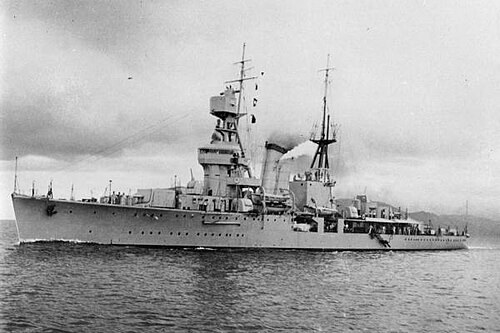
Ioshima began as the Chinese light cruiser Ning Hai, the first of two small cruisers that the Nationalist government ordered from Japan. Harima's yard at Aioi built her to a design based on the Japanese Yubari, packing six 140-millimeter guns in three twin turrets and torpedo tubes into a hull of about 2,500 tons, with a small hangar for two seaplanes. She was launched on 10 October 1931 and completed on 31 July 1932, and on 1 September 1932 she became flagship of the Chinese First Fleet. She was underpowered and top-heavy, and in June 1934 she carried a Chinese admiral to Yokohama for the state funeral of Admiral Togo.
In August 1937 she and her sister Ping Hai were sent down the Yangtze to Kiangyin to defend the approaches to Nanking. On 22 and 23 September aircraft from Kaga and from shore bases hit her with four bombs. On 25 September attack bombers put two more hits into her, and she sank in shallow water upstream of Kiangyin. The Japanese took the wreck on 5 December 1937. A first salvage attempt in April 1938 failed, and two divers were killed. She was refloated on 5 May 1938, patched at Shanghai and towed to Sasebo, where she was renamed Mikura and served as an accommodation hulk until late 1943.
In December 1943 she was towed to Harima, the yard that had built her, and rebuilt as a kaibokan, an escort ship. She was renamed on 1 June 1944, registered on 10 June, and assigned to the Yokosuka guard unit. Lieutenant Commander Akiji Fukuchi of the reserve took command on 23 June. After training in the Inland Sea she escorted a convoy from Yokosuka to Iwo Jima between 22 July and 1 August 1944, and on 26 July she avoided a torpedo from an unknown submarine.
On 19 September 1944 she sailed from Yokosuka with another convoy and other escorts. At about 0553, some 85 miles from Hachijojima, Lieutenant Commander Lawrence V. Julihn in USS Shad fired four Mark 23 torpedoes and hit her with three. She sank south of Cape Omaezaki. Fukuchi was killed. How many of her crew died is not known. Shad was hunted with depth charges for a long time afterward by the other escorts and got away. Ioshima was struck from the Navy List on 10 November 1944.
A note on sources. This history follows the Tabular Record of Movement for the ship by Bob Hackett and Sander Kingsepp at combinedfleet.com, which calls her Isojima and notes the spelling Isoshima, and the English Wikipedia article on Ning Hai, which calls her Ioshima. The name is written 五百島 in Japanese, and Ioshima is used here. The record writes her captain's surname Hukuchi, a romanization of the name usually written Fukuchi in English; his name has not been checked in Japanese records. The two sources differ slightly on her keel-laying date, which the record gives as 1 January 1930 and Wikipedia as 20 February 1931. Only one photograph of her with a clear source was found, taken on trials in 1932.