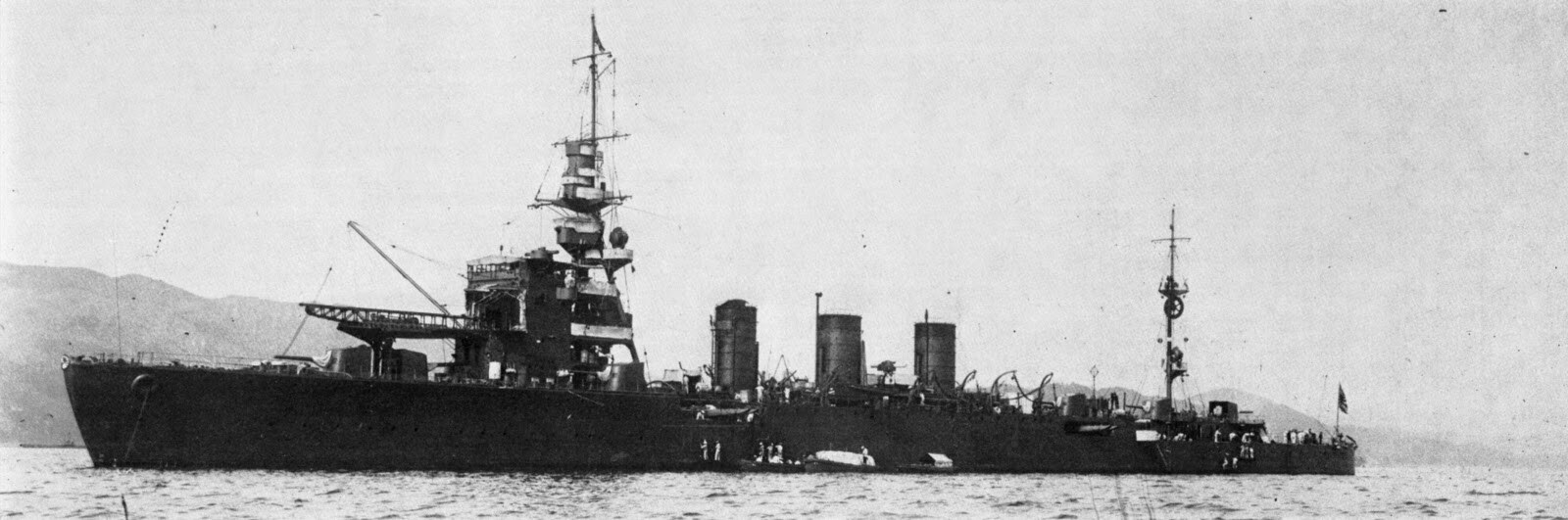
Kinu was a Nagara-class light cruiser of 5,500 tons, named for the Kinu River north of Tokyo. Kawasaki laid her down at Kobe on 17 January 1921 and launched her on 29 May 1922, and she was completed on 10 November 1922. Like her five sisters she was built to lead destroyer or submarine flotillas, and she carried seven 140-millimeter guns and torpedo tubes.
Captain Yoshiro Kato took command on 11 August 1941. When the war began she was flagship of Rear Admiral Setsuzo Yoshitomi's Submarine Squadron 4, and on 8 December 1941 she was off Poulo Condore southeast of Indochina, covering the Malaya landings. She was still in those waters when land-based bombers sank Admiral Phillips's Force Z on 10 December. She went on to cover the landings at Miri and Kuching in British Borneo in December, and in February 1942 she escorted troop convoys toward Java. On 1 March, ninety miles west of Surabaya, ten obsolete Vildebeest biplanes and fighters attacked her convoy. Near misses slightly damaged her, and shrapnel killed three men. On 2 March the American submarine S-38 fired four torpedoes at her north of Surabaya, and all missed. At the end of March she sailed from Ambon with Rear Admiral Ruitaro Fujita's force for the occupation of Dutch New Guinea.
For the next year and a half she worked in the Netherlands East Indies, between Batavia, Surabaya, Ambon, Makassar and Singapore. In September 1942 she carried troops to Rabaul. Captain Yoshio Uehara took command in December 1942 and Captain Tokushi Itakura in March 1943. On 23 June 1943 she was at Makassar with Kuma, Oi and Kitakami when seventeen B-24s bombed the anchorage, and she was repaired over the next weeks. At Kure from August to October 1943 two of her 140-millimeter guns, her catapult and her derrick came off, and a twin 127-millimeter antiaircraft mount and more 25-millimeter guns went on. On 27 January 1944 she towed the torpedoed Kitakami into safety off Penang. Captain Harumi Kawasaki took over on 4 February 1944. In late February she sailed from Singapore with Oi to escort the heavy cruisers Tone, Chikuma and Aoba at the start of their Indian Ocean raid. In late May and June she helped carry troops toward Biak in Operation Kon, embarking men at Zamboanga with the rest of Cruiser Division 16.
For the Philippine battle she was assigned with Aoba and the destroyer Uranami to Admiral Kurita's force, and on 21 October 1944 they were detached at Brunei to help carry Army troops to Leyte. Early on 23 October the submarine Bream torpedoed Aoba. Rear Admiral Naomasa Sakonjo moved his flag to Kinu, and Kinu towed Aoba to Cavite. On 24 October, on the way to Cagayan in Mindanao, she and Uranami were attacked by aircraft from Essex and Lexington. Near misses did light damage, and strafing killed 47 of her men. On 25 October she embarked 347 soldiers at Cagayan, and Uranami 150, and they took them to Ormoc.
On the morning of 26 October, in the Jintotolo Channel of the Visayan Sea, 80 or more aircraft from the escort carriers of Task Group 77.4 found them. An Avenger from Manila Bay put two bombs into Kinu, and rockets hit Uranami, which sank about noon. A third bomb struck an engine room aft and set Kinu on fire. She went dead in the water about 1400 and began to settle by the stern. At 1720 Captain Kawasaki ordered her abandoned, and transports T.6, T.9 and T.10 took off most of her crew of 813. Eighty-three were killed and 51 wounded. She sank at about 1730 in 150 feet of water, 44 miles southwest of Masbate. She was struck from the Navy List on 20 December 1944. In July 1945 divers from the American submarine rescue ship Chanticleer explored the wreck and brought up documents and coding machines.
A note on sources. This history follows the Tabular Record of Movement for Kinu by Bob Hackett and Sander Kingsepp at combinedfleet.com. The list of captains in the Japanese Wikipedia article on Kinu agrees with it on dates. The record writes the first wartime captain's name as Kato Yoshio, but the Japanese list gives it as 加藤与四郎, which is read Yoshiro, and that reading is used here. The record calls the biplanes that attacked her convoy on 1 March 1942 Wildebeests; the aircraft were Vickers Vildebeests. Only one photograph of the ship with a clear source was found, from 1931.