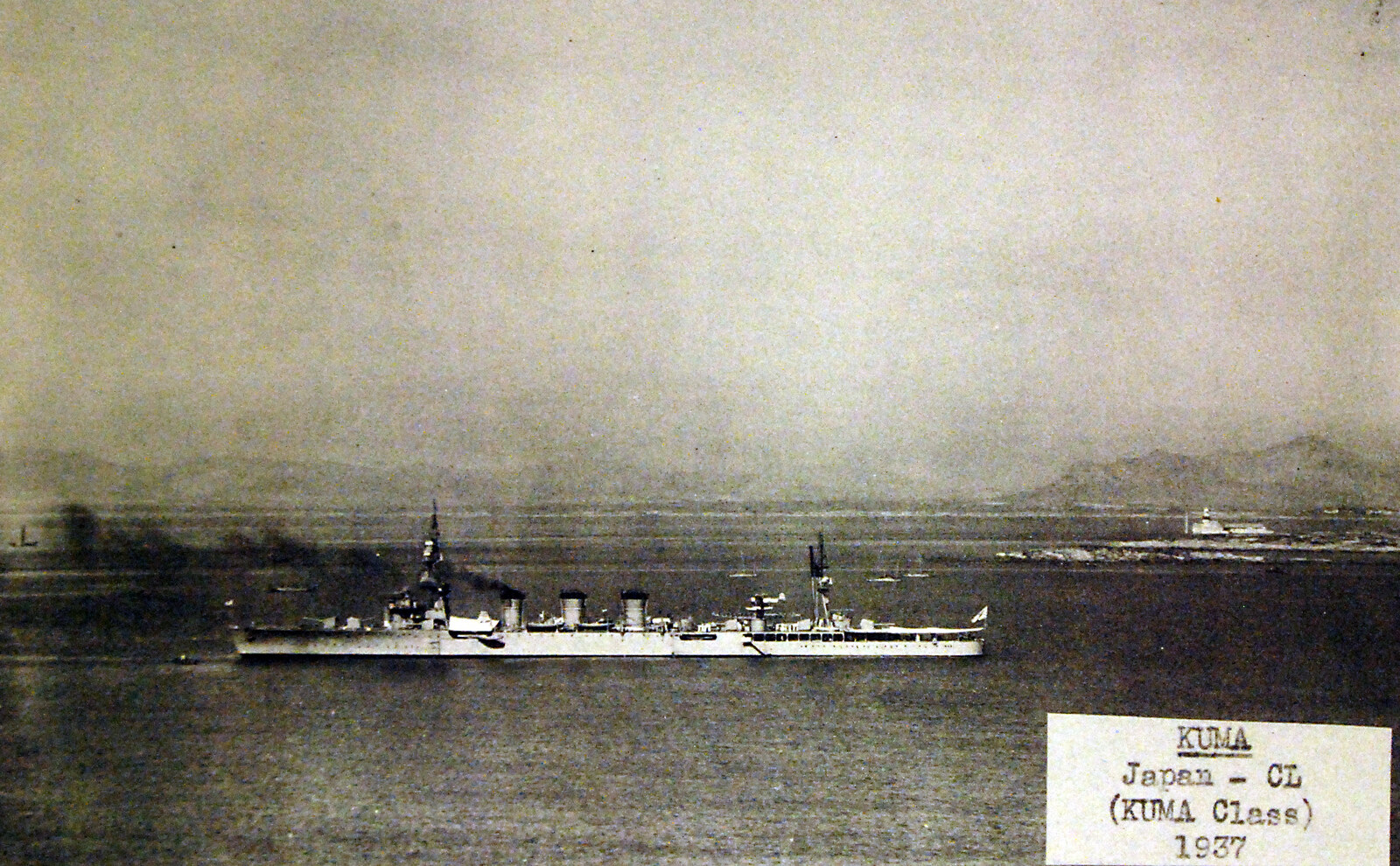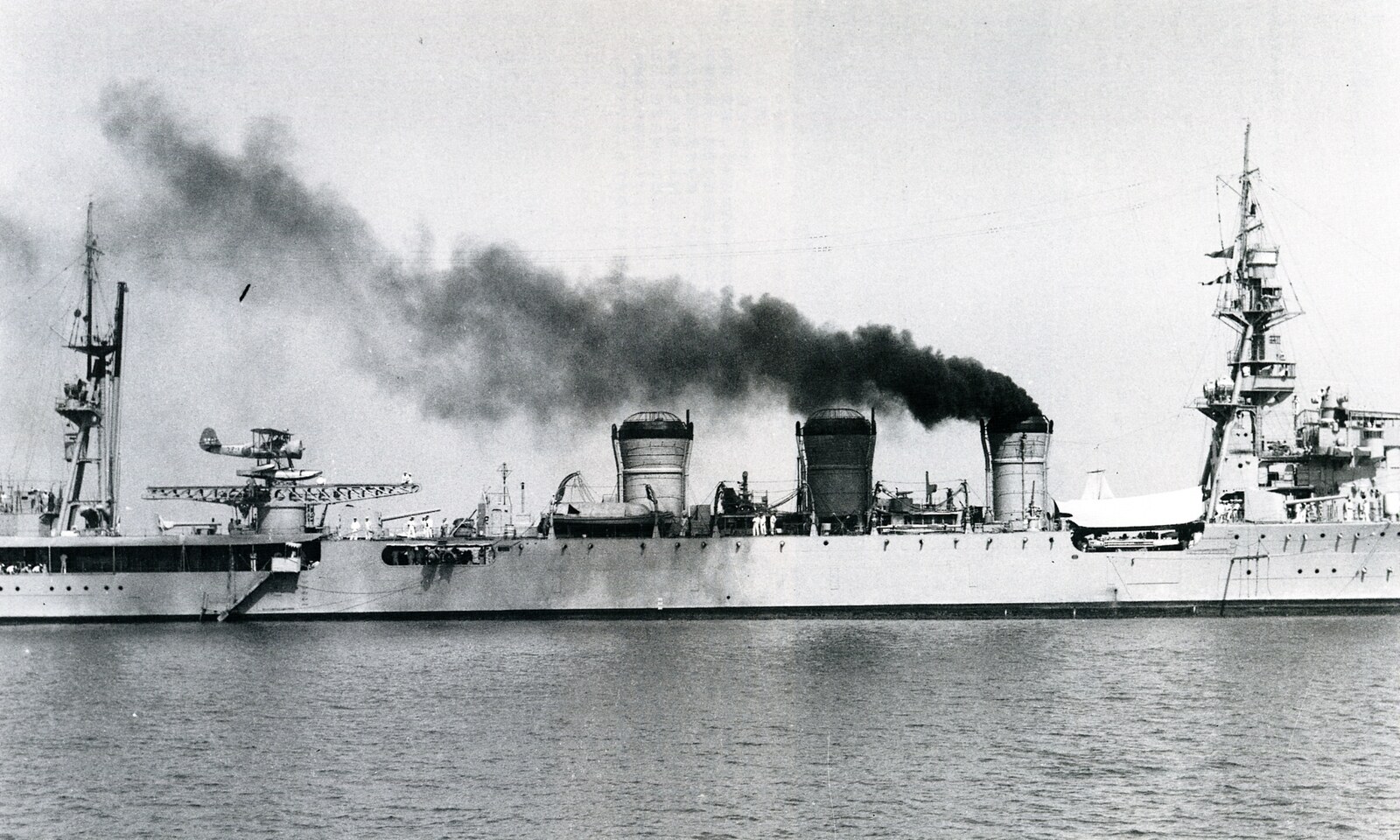
Kuma was the first of the Imperial Navy's 5,500-ton light cruisers, and she gave her name to a class of five. She was named for the Kuma River in Kyushu. The Sasebo Navy Yard laid her down on 29 August 1918 and launched her on 14 July 1919, and she was completed on 31 August 1920. Her sisters were Tama, Kitakami, Oi and Kiso. They were long, narrow ships built for speed, meant to lead destroyer flotillas, with seven 140-millimeter guns on the centerline and torpedo tubes in the waist. In the 1930s she served on the China coast. In July 1932, in fog off Tsingtao, she took off 50 passengers and 131 crew from the steamer Choshun Maru, which had run onto a rock.
Captain Kiyomi Shibuya took command on 20 September 1941. When the war began she was in Vice Admiral Ibo Takahashi's force for the invasion of the northern Philippines, with Ashigara and Maya. She left the Pescadores on 8 December, and on 10 December Catalinas of Patrol Wing 10 attacked the group west of Luzon and missed. She covered the landings at Aparri and Vigan and then at Lingayen Gulf on 22 December. In the new year she moved to the Third Southern Expeditionary Fleet and patrolled off Manila Bay. On 1 March 1942 she and the torpedo boat Kiji shelled Cebu harbor and sank the coasters Lepus and Regulus. The Tabular Record of Movement counts 325 casualties ashore, women and children among them. Two days later her landing party helped take Zamboanga and freed about 80 Japanese civilians who had been interned there.
On the night of 8–9 April 1942, while she was escorting the convoy carrying the Kawaguchi Detachment to Cebu, Lieutenant John D. Bulkeley's PT-41 and Lieutenant (junior grade) Robert B. Kelly's PT-34 attacked her and Kiji. They fired eight Mark 8 torpedoes. One hit Kuma in the bow. It did not go off and broke in two against her side. She covered the landings on Cebu on 10 April and on Panay on 16 April, and the final assault on Corregidor in early May. Then she stayed at Manila as a guardship until August.
After a refit at Kure she went to the Second Southern Expeditionary Fleet in the Netherlands East Indies. Her work there was transport and guard duty. She took troops of the 38th Division from Hong Kong to Rabaul in October 1942, carried soldiers to Kaimana in New Guinea in February 1943, and spent long spells as guardship at Makassar. Captain Ichiro Yokoyama, until December 1941 the naval attaché in Washington, relieved Shibuya in November 1942. On 23 June 1943 seventeen B-24s of the Fifth Air Force bombed Kuma, Kinu, Oi and Kitakami at their moorings at Makassar. Near misses straddled all four, and they were only slightly damaged. Captain Shuichi Sugino took over in August 1943. In August, October and December she carried troops from Belawan and Singapore to Port Blair in the Andaman Islands. At Singapore in November her No. 5 gun, catapult and derrick came out, and more 25-millimeter antiaircraft guns went in.
On 11 January 1944 she left Penang with the destroyer Uranami to act as a target for torpedo-bomber training. At 1142, seventeen miles west of Penang Island, a lookout reported what looked like a periscope. The escort took it for a decoy, and the watch had just changed. A minute later Lieutenant Commander Leslie Bennington in HMS Tally-Ho fired seven torpedoes from 1,900 yards. Two hit Kuma on the starboard side aft. Her own depth charges on the quarterdeck went off, and she sank by the stern at 1157. Uranami took off Captain Sugino and the other survivors, and 138 men were lost. She was struck from the Navy List on 10 March 1944. Divers found her wreck in 2004, lying on her starboard side at about 46 meters, and by 2014 illegal salvagers were reported to be stripping it.
A note on sources. This history follows Bob Hackett and Sander Kingsepp's Tabular Record of Movement for Kuma at combinedfleet.com for dates, movements and losses. The figure of 325 casualties at Cebu on 1 March 1942 is that source's figure and has not been checked against Philippine records. The commanding officers and their dates come from the same record, checked against the list of captains in the Japanese Wikipedia article on Kuma, which cites Toyama Misao's Kanchō-tachi no gunkan-shi. The two agree.