Mikazuki (三日月, “crescent moon”) was not a famous ship. She was a workhorse that ran out of sea room.
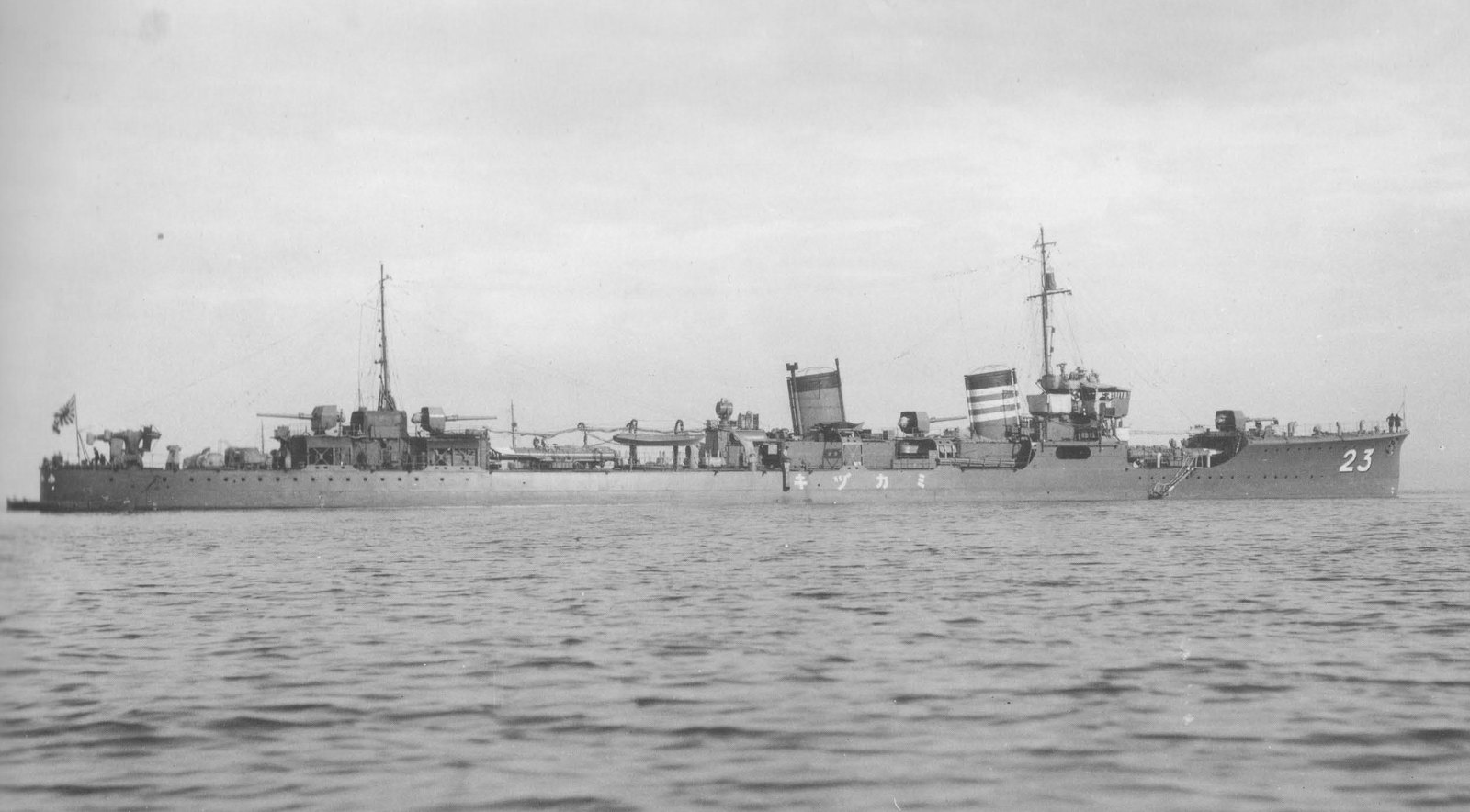
She was a Mutsuki-class destroyer, laid down at Sasebo as Destroyer No. 32 on 21 August 1925, launched on 12 July 1926, and completed on 5 May 1927. She was named Mikazuki on 1 August 1928. Normal displacement was about 1,336 tons. She was designed for 37 knots, with four 12 cm guns and two triple mounts for 24-inch torpedoes. By the Pacific War the class was already old. The navy converted most of them into fast transports. Guns and tubes came off. Antiaircraft guns and depth charges went on, because Japan needed hulls that could still make a night run to a beach. Mikazuki was the only ship of the class to have a boiler removed and her after funnel cut down. None of the twelve Mutsukis survived the war.
In China in the late 1930s she covered landings. When the Pacific War opened she was with Carrier Division 3 in home waters, plane-guarding the training carriers Hosho and Zuiho. At Midway, on 4–5 June 1942, she escorted Zuiho in Admiral Nobutake Kondo’s occupation force and never saw the carrier battle. Then came a year of convoy work between Japan and Formosa. It was useful, unglamorous, and the reason she was still afloat when newer destroyers were already gone.
One month in the Slot
In March 1943 she joined Destroyer Division 30, Destroyer Squadron 3, Eighth Fleet, and went south to Rabaul. From late June she was on the supply runs to Kolombangara.
On 5–6 July, at the Battle of Kula Gulf, she was in the first transport group with Mochizuki and Hamakaze. She put troops ashore and took no part in the surface fight. On 9 July, with Satsuki, Matsukaze, and Yunagi, she landed 1,200 men and 85 tons of supplies at Vila. On the night of 12–13 July, at Kolombangara, she was on picket for the transport run. The light cruiser Jintsu was smashed and sinking. Mikazuki tried to close and was driven off. On 17 July near-misses in an air raid on the Shortlands did minor damage. On 19–20 July she went back to Kolombangara and got about 300 men and munitions onto the beach, while the covering force lost Yugure and Kiyonami and took a bomb in Kumano. The American surface ships they expected never appeared.
That was her war in the Solomons: land the troops, stay out of the searchlights if she could, go back to Rabaul.
The reef
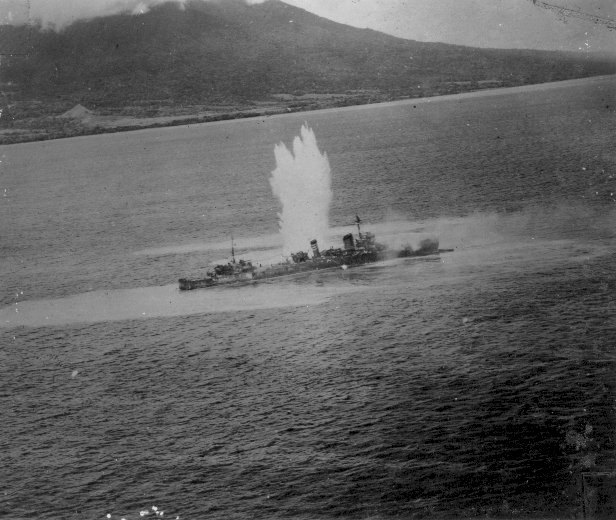
On 27 July 1943 Mikazuki and Ariake left Rabaul for Tuluvu, Cape Gloucester, on New Britain, with more troops. In poor visibility she ran onto a coral reef at 05°27′S, 148°25′E. The hull broke her back. She was stuck in daylight range of Allied airfields.
The next morning, 28 July, Fifth Air Force B-25s found her. Bombs and strafing finished what the reef had started. Eight men were killed. Survivors included Captain Tsuneo Orita, commander of Destroyer Division 30, and Lieutenant Nitaro Yamazaki, the ship’s captain. Ariake took off the living and still put the troops ashore. Mikazuki was struck from the navy list on 15 October 1943. The wreck stayed on the reef, broken up, and was bombed again later as a convenient target.
What the record is
Mikazuki has no Vella Gulf legend and no Surigao Strait escape. She guarded training carriers, steamed the Formosa convoys, and spent July 1943 doing the job the old destroyers were left with: night lifts into Kula Gulf and Vila while better ships fought and sank around her. Then she hit a reef on a routine run to Cape Gloucester, and the bombers came at first light. A crescent-moon destroyer that lasted a month on those runs, and was destroyed where she sat because the coral would not let her leave.