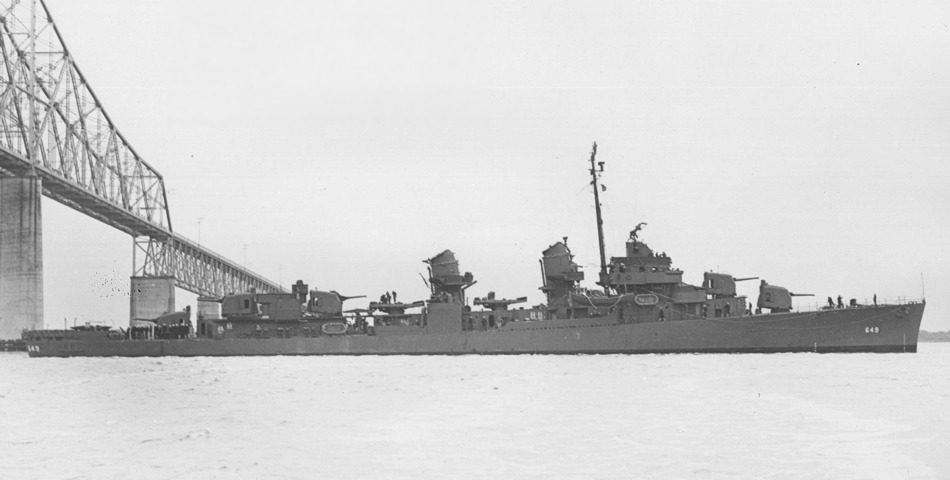
The ship was named for Albert Weston Grant. He was born on 14 April 1856 at East Benton, Maine, and grew up at Stevens Point, Wisconsin. He graduated from the Naval Academy in 1877. In the summer of 1917 he took Battleship Force 1 of the Atlantic Fleet, as a vice admiral, and in December 1918 the Atlantic Fleet itself. He died in Philadelphia on 30 September 1930. She was the only Navy ship to carry his name. She was a Fletcher-class destroyer.
The Charleston Navy Yard laid her down on 30 December 1942. She was launched on 29 May 1943. Miss Nell Preston Grant, the admiral's granddaughter, sponsored her. She was commissioned on 24 November 1943, with Commander Terrell Andrew Nisewaner in command. Her radio call sign was NBTF. That day she left Charleston for a shakedown at Bermuda and was back on 29 January 1944 for small alterations. She reached Norfolk on 8 February. Five days later she sailed as escort for the new carrier Hornet (CV-12). They passed the Panama Canal, met more ships at San Diego, and entered Pearl Harbor on 4 March.
On 4 April she sailed for Majuro and joined Task Force 58 for the landing at Hollandia. From 21 to 29 April she stood picket, patrolled inshore, and covered the troops going ashore. The campaign list dates the landings at Aitape, Humboldt Bay, and Tanahmerah Bay from 21 to 24 April. On 29 April she went on with Task Group 58.3 and screened the carriers in the strike on Truk. That star also takes in Satawan and Ponape, from 29 April to 1 May. The group left for Majuro on 2 May and was at Pearl Harbor on 11 May.
On 29 May she sailed for Eniwetok, the staging port for the Marianas. Gunfire support at Saipan began on 15 June, and she also worked Tinian. She left the Saipan area on 29 July and entered Eniwetok on 2 August. After a short upkeep she sailed on 22 August for Purvis Bay, in the Solomons. On 6 September she sortied with Task Group 32.5 for the Palaus. Through the middle of September she bombarded, then supported the landings on Peleliu and Angaur. She left for Manus on 29 September and stayed through 12 October. The star for the South Palau Islands runs from 6 September to 14 October, on past the day she sailed.
On 12 October she sailed for the Philippines with Task Group 77.2. On 17 October she covered Crosby (APD-17) while that transport put troops ashore on Suluan Island. From 17 to 24 October she fired in support of the Leyte landing.
On 24 October she went with that group against a Japanese force coming north from the Sulu Sea into Surigao Strait. Yamashiro and Fuso were in the column. Ahead of the American battle line, she and the other destroyers attacked with torpedoes. The Navy Unit Commendation, for 24 to 27 October, says she closed the range and fired half her torpedoes into a Japanese battleship. It says she was hit as she turned away, stayed, and got off the other five, which struck further ships. Newcomb (DD-586), flagship of Destroyer Squadron 56, came back with medical aid and a tow out of the strait. One account puts this ship in the center column with Newcomb and Richard P. Leary (DD-664).
The Navy history counts 22 hits, many of them six-inch shells. Fires took hold. Steering and electric power went out. Thirty-eight men were killed and 104 were wounded. Nisewaner was among the wounded. She was down by the bow and listing hard to port. The gunfire is not credited to one ship. It came from both sides. One account names the cruiser Denver (CL-58). The commendation speaks of the enemy's guns. Her own history says the crew got the engines working and brought her back into Leyte Gulf. A typhoon met her before she reached the anchorage.
Temporary repairs came first. On 30 October she left under tow of Hidatsa (AT-102), called at Seeadler Harbor and at Majuro, and reached Pearl Harbor on 29 November. One printing of the Leyte star carries that campaign through 29 November 1945. Three days after Pearl Harbor she sailed for the Mare Island Navy Yard and arrived on 9 December. The repair was a long one. A yard photograph of 20 January 1945 shows her commanding officer receiving the Bronze Star. Commander Grover Stanley Higginbotham relieved Nisewaner on 1 March 1945, while she was still in the yard. She left the yard on 11 March.
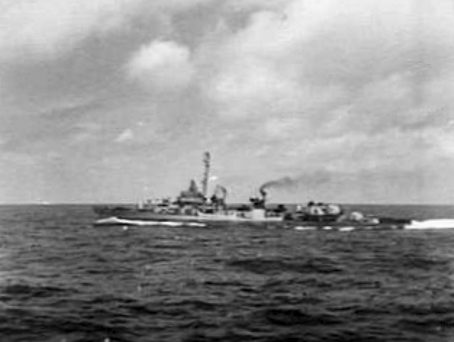
She reached Pearl Harbor on 25 March and trained there. On 23 April she sailed for the Philippines and entered Leyte on 13 May. On 3 June she stood out of Manila to escort General Douglas MacArthur, embarked in Boise (CL-47), on a tour of the islands. She then went southwest to meet Task Group 78.1 for Brunei Bay and covered that landing on 10 June. She rejoined the tour the next day and anchored at Manila on 15 June. She stayed in the bay until 27 June, then covered Balikpapan from 30 June to 9 July. The campaign list dates Brunei Bay from 7 to 17 June and Balikpapan from 28 June to 7 July. She was back at Manila on 14 July. The photograph of her underway is dated 3 July 1945, in that Balikpapan period.
She moved to the Marshalls, reached Eniwetok on 3 August, and joined Task Force 49 for the North Pacific. She sailed for Adak. The day before she arrived, the force heard that Japan had capitulated on 15 August, and it sailed for Ominato. The ships were off Honshu on 8 September and anchored at Ominato on the 10th. She stayed on occupation duty through the middle of November, then came home. Seattle took her on 2 December 1945, and the overhaul began. She was decommissioned and placed in reserve at San Diego on 16 July 1946. Higginbotham still had her. One printing of the Navy history dates that decommissioning 16 July 1945. Her name was struck on 14 April 1971. On 30 May 1972 she was sold to Levin Metals and broken up. She received seven battle stars for the war, and the Navy Unit Commendation for Surigao Strait.