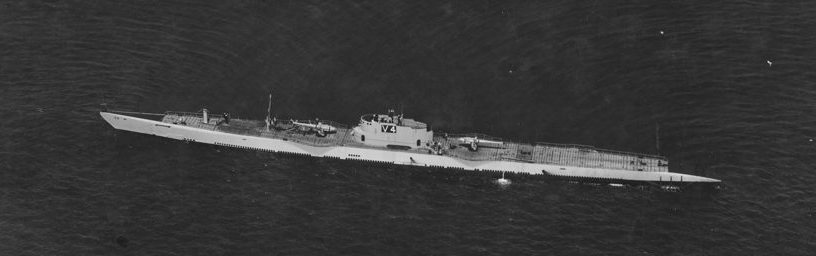
Argonaut was a minelaying submarine of the United States Navy, and the largest submarine the Navy had built when she entered service. Portsmouth Navy Yard, at Kittery, Maine, laid her down as V-4 on 1 May 1925 and launched her on 10 November 1927. She was commissioned on 2 April 1928, with Lieutenant Commander W. M. Quigley in command. In February 1931 the Navy renamed her Argonaut. On 1 July 1931 she was redesignated SM-1. The hull number later carried for her is SS-166.
On 7 December 1941 she was near Midway. That evening two Japanese destroyers shelled the island. She began the Pacific Fleet's first attempted submarine attack of the war. She was seen, and she did not finish the attack.
She was then rebuilt at Mare Island to carry troops. In August 1942 she and Nautilus took Carlson's 2d Raider Battalion to Makin. The Marines went ashore early on 17 August, and she was back at Pearl Harbor on 26 August. On 22 September 1942, after that raid, she was redesignated APS-1, a transport submarine. Lieutenant Commander John R. Pierce had been in command since 22 June.
On her third patrol, on 2 January 1943, she sank the Japanese guard boat Ebon Maru in the Bismarck Sea, near 04°30′ S, 151°30′ E.
On 10 January 1943, southeast of New Britain, she met a convoy on its way back from Lae toward Rabaul. The place later fixed for the fight is 5°40′ S, 152°02′ E. An Army plane, already out of bombs, reported what looked like a torpedo hit on one destroyer, and then saw the submarine's bow break the surface. A depth-charge attack had forced her up. Maikaze had made that attack. Isokaze joined Maikaze in shelling the raised bow until the boat went down. The sinking is not credited to one of them. The wartime credit for a damaged destroyer rests on the flier's report. Later Japanese records do not confirm that hit. No one got off. She was struck from the Navy list on 26 February 1943.