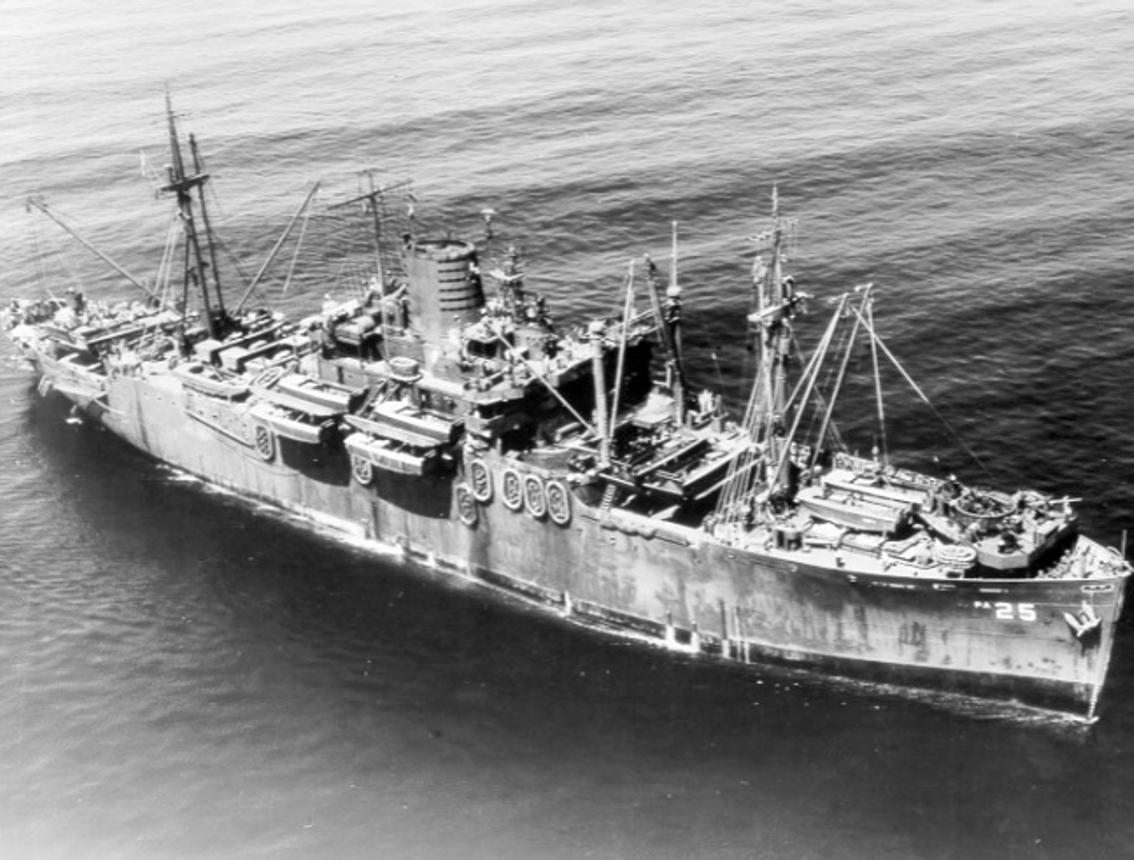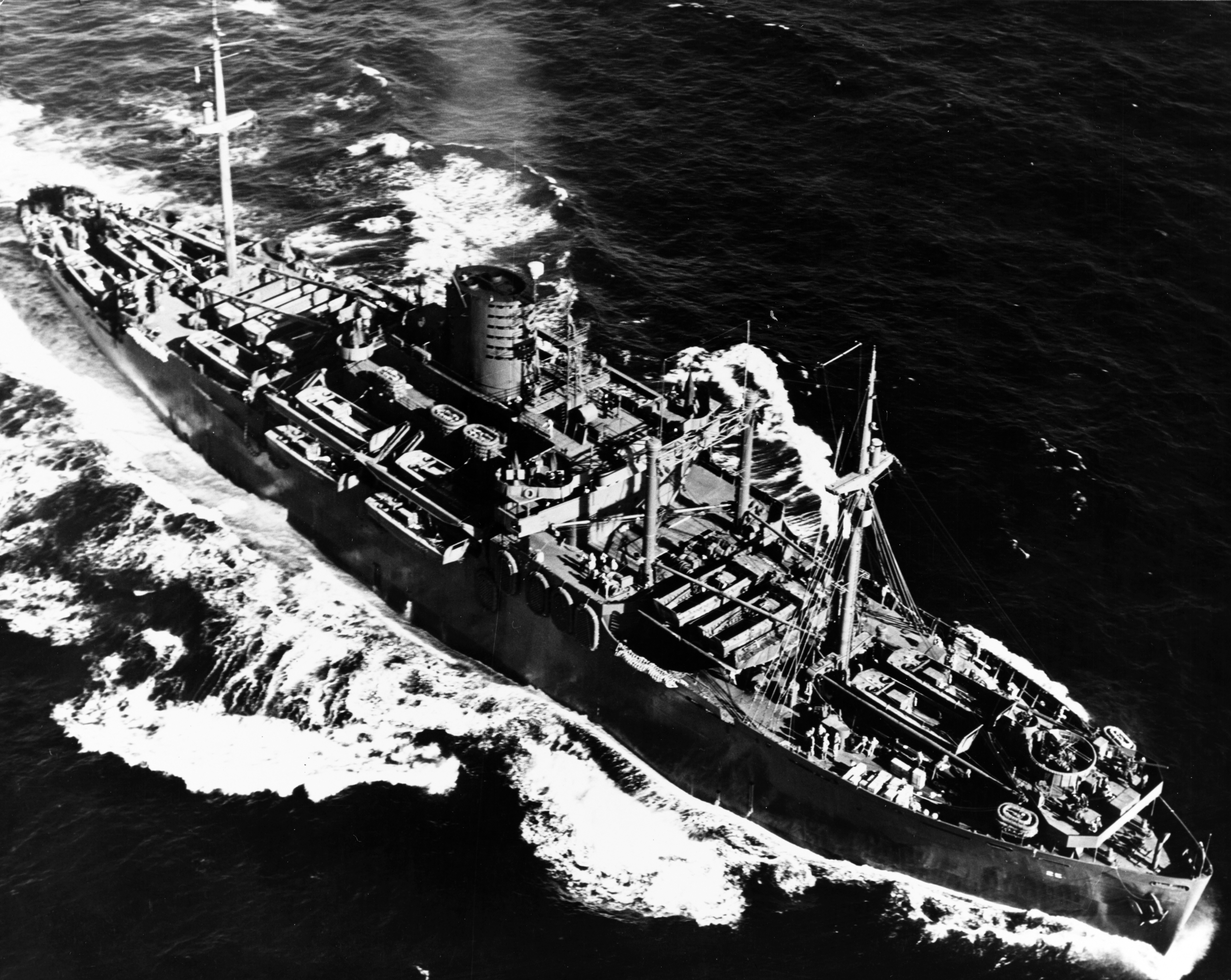
The ship was named for Arthur Middleton, born on 26 June 1742 at Middleton Place, near Charleston, South Carolina. He signed the Declaration of Independence for South Carolina. He died at Goose Creek, South Carolina, on 1 January 1787. She was the name ship of the Arthur Middleton class, a Maritime Commission C3-P&C hull finished as an attack transport. Two sisters were laid down as African Meteor and African Planet. The Navy named them Samuel Chase and George Clymer. One account calls the three the largest all-welded passenger and cargo ships then building, drawn for a run from New York to South and East Africa, with berths planned for 116 passengers.
Ingalls Shipbuilding, at Pascagoula, laid her down on 1 July 1940 as African Comet, Maritime Commission hull 106, for American South African Lines. One account says the hull had been ordered as American Banker. Another calls her ex-American Banker. She was launched on 28 June 1941. Miss Mary Maud Farrell sponsored her. She was finished, and she ran trials, as a merchant ship. The Navy took her before she entered a commercial trade. One account delivers her on 31 December 1941, has the War Shipping Administration take her from the line that day, and has the Navy buy her on 6 January 1942. The short Navy history says the Navy acquired her from the line on 6 January 1942. She was renamed Arthur Middleton, AP-55, on 7 January 1942. One list dates the renaming 6 January.
The first conversion was at the Tietjen and Lang yard in Hoboken, for a civilian crew and a convoy load. On 11 January 1942 a 4-inch/50 was fitted aft and four 3-inch/50s were fitted forward. She left New York on 18 January 1942, bound for the Pacific. One account then sends her to Charleston. A grounded transport, President Fillmore, could not make a convoy for Bora Bora, and this ship was put in her place. She sailed with a list of twelve degrees. The new guns were not properly ballasted. That account has the convoy's sailing slip from 8 January to 15 January, then to 25 January, then to 27 January, in company with President Tyler and Hamul, and it places her at Bora Bora on 17 February 1942 in Convoy BC.100. It has her back in San Francisco, from the South Pacific, in June. The combat-load conversion ran there from July into September 1942. One account names the yard Union Iron Works. Another names Bethlehem Steel, San Francisco. She was commissioned on 7 September 1942. The commissioning line gives her to Commander P. K. Perry, Coast Guard. The command list gives the tour to Captain Paul Kelly Perry.
A Coast Guard crew and a Navy crew had her together. She shook down off San Diego. One account has her leave San Francisco on 10 September 1942 for San Pedro and San Diego, and spend the next three months at landing rehearsals on the southern California beaches. She sailed for the Aleutians on 23 December 1942. On 12 January 1943 she was in Constantine Harbor at Amchitka, putting troops ashore. Worden (DD-352) grounded and broke up while covering that landing. Dewey (DD-349) stood by. This ship took 175 of Worden's survivors aboard. Before the day ended she dragged her anchor and grounded. A shorter history says she grounded while the rescue was still going on. One chronology dates the grounding 13 January. She stayed on the rocks. The short history says 84 days. The salvage unloaded her, blasted rock out from under the port side, and patched the holes the rocks had opened. Her boats worked the harbor, unloading supply ships and shifting Army barges. On eight occasions, while she was aground, she drove off enemy float planes, and four bombs straddled her. On 1 February 1943, still in Alaskan waters, she was reclassified an attack transport, APA-25.
One account has her afloat again on 9 April 1943, underway for Dutch Harbor in tow of Ute (AT-76) and Tatnuck (AT-27). Temporary repairs followed there. The short history says that after those repairs Cree (ATF-84) towed her to the Puget Sound Navy Yard on 17 June 1943. Another account says the Dutch Harbor work ran through 17 June, and that she then left in tow of the merchant ship James Griffiths and Cree (AT-84), reaching Bremerton on 27 June. One account has her ready for sea on 9 September. Another has her sail from Seattle on 6 September. Perry had her from the commissioning until 31 July 1943. That day Captain Severt Andrew Olsen, Coast Guard, relieved him. She was still in the yard.
The next passage is told with two sets of ports. One account has her leave Seattle on 6 September 1943 for New Zealand, call at Suva, and reach Wellington on 12 October, then stage at Efate and carry Marines to Tarawa. She stayed off that atoll from 20 to 29 November 1943, landing men and taking casualties aboard, and she reached Pearl Harbor on 7 December. The Coast Guard history has her at San Francisco on 12 September, embarking 78 officers and 1,354 men of the Army's 119th antiaircraft group, sailing on 18 September for Suva, and then discharging the troops and the cargo at Lantaka Harbor on Viti Levu. A Navy photograph shows her underway at sea on 18 September 1943.
She trained at Pearl Harbor. On 23 January 1944 she sortied with Task Group 51.1, carrying a Marine reserve for the Marshalls. The short history sets the Kwajalein invasion on 21 January in the same sentence as that departure. She waited east of Kwajalein from 31 January to 15 February. The troops stayed aboard. She issued stores and fresh water to destroyers and smaller ships, and she repaired boats. Captain George W. McKean, Coast Guard, had her temporarily from 19 December 1943 until 8 March 1944, so the Marshalls landings were his. On 15 February she sailed for Eniwetok. She landed assault troops on Engebi on 17 February, embarked Marines for Parry Island, and landed them on 21 and 22 February. The campaign list dates the Eniwetok occupation from 17 to 23 February. She sailed the next day with American casualties and Japanese prisoners, called at Kwajalein on 26 February, and reached Pearl Harbor on 8 March. Olsen took her back that day. The Coast Guard history says that from 12 March to 1 May 1944 the ship was quarantined for bacillary dysentery and that all hands stayed aboard. She trained off Hawaii into late May and left on 30 May with Task Group 52.3.
She arrived off Saipan on 15 June 1944 and landed her troops the same day at Charan Kanoa. Casualties came aboard while the cargo went out. Air-raid alerts were frequent. No Japanese airplane came in range of her guns. She left Saipan on 23 June. The campaign list carries the Saipan operation through 24 June. She called at Eniwetok and Tarawa for Army troops and prisoners and reached Pearl Harbor on 9 July. By 31 August she had finished two runs between San Diego and Hilo. She arrived at Manus on 3 October and sortied on 14 October with Task Group 79.2. She was off Leyte from 20 to 24 October, then went to Hollandia. A follow-up voyage from Hollandia and Morotai ended at Leyte on 14 November. The campaign list also dates a Leyte landing that day. She sailed for New Guinea the next day and trained with Marines. On 31 December 1944 she left Manus with Task Group 79.4.
She arrived in Lingayen Gulf on 9 January 1945 and put her troops ashore the same day, under air attack. Fifteen of her men were wounded by shrapnel from other ships that were firing at Japanese aircraft. She sailed for Leyte, loaded again, and was back in the gulf on 27 January. Through February and early March she trained off Guadalcanal. On 16 March she sailed with Task Group 53.1 for Ulithi. The short history says she staged through Ulithi with that group for Okinawa. She was off Okinawa from 1 to 5 April 1945. Then she went to San Pedro by way of Saipan and Pearl Harbor, arriving on 30 April for repairs. Olsen was relieved on 20 August 1945 by Captain John Arthur Glynn, Coast Guard. Japan had surrendered on 14 August, while the ship was still in the yard and still Olsen's. The repair work finished on 4 September. One account assigns her to carry relief troops out to the Philippines and bring veterans home. By the end of 1945 she had made two of those voyages. In January 1946 she was under repair at Terminal Island. A photograph shows her off San Francisco on 30 August 1945, during that yard period, with a twin 40 mm mount forward of the lattice mast.
The Coast Guard crew left her. The short history dates that detachment 1 February 1946, and then her attachment to the Naval Transport Service. The command list dates the turnover to the Naval Transportation Service 8 February 1946. That is the day Captain Joseph Wade Adams Jr., Navy, Naval Academy class of 1924, relieved Glynn. Adams had her until 8 August 1946. In those four months she made six round trips between San Francisco and Pearl Harbor, passed through the Panama Canal, and reached Norfolk on 19 July 1946. Commander Aaron Frederick Beyer Jr., Navy, Naval Academy class of 1933, relieved Adams on 8 August and had her when she was decommissioned at Norfolk on 21 October 1946. She joined the Atlantic Reserve Fleet. Her name was struck on 1 October 1958. On 3 March 1959 she went to the Maritime Administration, in the National Defense Reserve Fleet at Lee Hall, on the James River in Virginia. She was sold for scrap on 9 May 1973 to Consolidated Steel Corporation, at Brownsville, Texas, for $96,666, and withdrawn on 10 August 1973. One contract is PD-X-956, dated 4 April 1973. Another note of the sale uses PD-X-958.
The short history gives her seven battle stars for the war. The campaign list, and the Naval Cover Museum, give six: the Gilberts, for Tarawa from 20 to 29 November 1943; the Marshalls, counting Kwajalein and Majuro from 31 January to 8 February 1944 together with Eniwetok from 17 to 23 February as one operation; the Marianas, for Saipan from 15 to 24 June 1944; Leyte, on 20 October and 14 November 1944; Luzon, for Lingayen Gulf on 9 January 1945; and Okinawa, from 1 to 5 April 1945. Counting Kwajalein and Eniwetok as two operations is what makes seven. The ribbon list also gives the American Campaign Medal, the World War II Victory Medal, the Philippines Presidential Unit Citation, and the Philippines Liberation Medal with two awards. Her wartime crew was Coast Guard. Her radio call sign was NFAV.